Briefly Write Poetry Prize 2025 – Results

So many poems, so many portals.

This is the fifth time we have hosted the Briefly Write Poetry Prize. For five wonderful years, we have invited the world to write us a poem. The rules are simple: send one poem, any poem (that you have written), keep it under ten lines, be brief!, dazzle us, amaze us.

Each year, we spend months reading and re-reading every entry. Each year, the process seems to take longer; although the number of entries has stayed remarkably consistent since 2021, the publication date has crept later and later. In 2025, we have narrowly beaten the New Year’s bells.

Among more than 1,000 poems, we were treated to an abundance of themes and styles, from bookstores to sonnets, floods to fathers, and ghosts to golden shovels. As always, we are grateful for our supportive community of readers and writers who understand that even if the poems are small, the care and effort that goes into reading and judging them is not.

We think the winning and shortlisted poems are well worth the wait. We hope you do too. Please feel free to send us your feedback on the competition and our choices.

This year, we are also breaking new ground by giving out £100 in prizes for the first time. It pays to be brief.

Until next year,

Daniel & Elinor
Briefly Write Poetry Prize 2025

FIRST

Lawrence Bradby‘Shade’


SECOND

Cindy Kluck-Nygren‘Homesick’


THIRD

Kafui Siabi‘The Boy by the Kiosk’


SHORTLIST

Anaum Sajanlal‘Golden Shovel Against Bureaucracy’

Cailín Frankland‘Alive, Alive, Oh’

Amy Devine‘Starting Over’

K Roberts‘windfallen’


LONGLIST

Melanie Hyo-In Han ~ Tara Campbell ~ Marvellous Mmesomachi Igwe ~ Ellen Romano ~ Ben McGuire ~ Arushi Prakash ~ Robert Henry ~ Alina Khasanova ~ Thomas Valicenti ~ Joseph Paulson ~ Madeleine Oliver ~ Shégx ~ Elena Zhang ~ Lisa Mullenneaux ~ Augusta Anne ~ Matthew Sheret ~ Faiz Ahmad~ Winifred Mok ~ Maia Evrona ~ K. R. Thunderman ~ Lauren Mills ~ Eshwari ~ J.S. ~ Eleanor Keisman ~ Hannah Bagley ~ Susmita Ramani ~ Heather D Haigh ~ Wema Charles ~ Kris Spencer ~ Azalea Aguilar ~ Steve Denehan ~ Tricia Knoll ~ Asambhava Shubha ~ Opeyemi Oluwayomi ~ Dylan Rossi ~ Katherine Garrison ~ Scott Dalgarno


All the past winners

Briefly Write is a little literary space for bold, succinct writing. We publish an online zine of quality writing and photos. We provide free-to-enter poetry and fiction competitions with cash prizes. We are active members of the literary community, obsessive readers and supportive editors.
The Briefly Write Poetry Prize 2025 is open now!

The Briefly Write Poetry Prize is back… and bigger than ever before!

An annual poetry competition that celebrates and rewards bold, succinct writing, the Briefly Write Poetry Prize 2025 is the fifth instalment of this popular free-to-enter writing competition.

See the competition guidelines and enter here.

We are looking for well-crafted poems up to 10 lines, with innovative language, strong imagery and a subtle, focused composition.

Our biggest prize pot ever

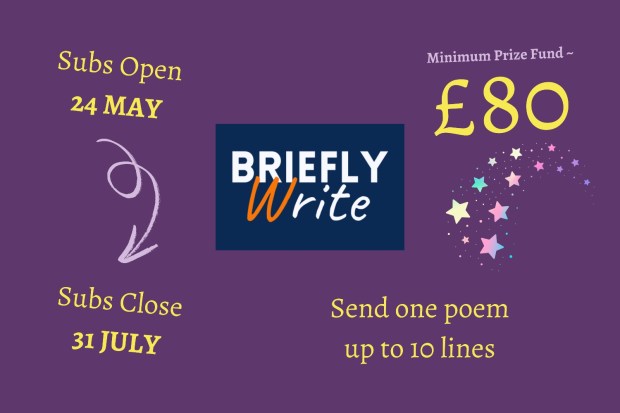
This year, the minimum prize fund in the Briefly Write Poetry Prize is £80, divided as follows:

FIRST = £40 / SECOND = £25 / THIRD = £15. All shortlisted poets will also be paid.

We are committed to accessibility and, as such, entry is free for everyone. If you can, we would appreciate any support to help us meet the costs and boost the prize fund.

Briefly Write Poetry Prize 2025 open now

Read all of 2024’s winning and commended poems here.

Briefly Write Hall of Fame

Write 10 – Winners

2023-24

Clodagh O Connor, ‘1847’

2022

Kate Twitchin (here)

2021

Rebecca Kinnarney (here)

Poetry Prize – Winners

2024

Christine C. Rivero-Guisinga, ‘Everywhere, the Body’

2023

Mesrure Onal, ‘small mercies’

2022

Aimee R. Cervenka, ‘Thinking of Basements’

2021

Khushi Bajaj, ‘Oranges’

Best of the Net Nominations

2024

Alice Willington, ‘All the time’
Cathy Ulrich, ‘Where They Found You’
Frank William Finney, ‘Elegy for an Elm’
Emily Munro, ‘suitcase dream’
Aimee R. Cervenka, ‘Thinking of Basements’
Jennie E. Owen, ‘Haircut’
Praveena Pulendran, ‘Bloodset’
Tom Frazer, ‘Green’
Elancharan Gunasekaran, ‘ghost coast’
Namratha Varadharajan, ‘A measure of the past from the future’

2023

Fadilah Ali, ‘time and time and time again’
Kristina T. Saccone, ‘Beyond Unbinds the Dragonfly’
Sara Siddiqui Chansarkar, ‘Colored Feathers’
Jayant Kashyap, ‘The Three of Us’

2022

Hibah Shabkhez, ‘Just Saying’
Richard LeDue, ‘Injuries’
Zahirra Dayal, ‘Untameable’
Sean Cunningham, ‘What Went Wrong’

RIDDLE 51

Thomas Sudell


Being a translation of an Old English (Anglo-Saxon) riddle. The tenth-century Exeter Book manuscript in which this metrical riddle is preserved does not record a solution. The solution generally accepted among modern scholars may be found below.

Four strange companions I beheld. Their track

was sable, and their footsteps wondrous black.

Swift was their pace; yet swifter still it grew

as, visiting the realm of birds, they flew

through open air to plunge beneath the wave.

With unremitting industry then strave

the diligent retainer who once more

began to steer the passage of those four

collateral travellers as they made their way

among the treasures that before them lay.

[Translated from Old English by Thomas Sudell]


PROPOSED SOLUTION TO RIDDLE 51

A quill pen held between a thumb and two fingers. The black footsteps are the ink that they leave behind. Lines 3-5 refer to the scribe lifting his quill from the page in order to refill it at his ink pot. He then resumes his writing, guiding the quill among the splendours that adorn his illustrated manuscript.


Thomas Sudell is a graduate of Oxford University (2015) where he studied English with a speciality in Old English. His translation of the Old English poem ‘Maxims II’ has recently appeared in Issue 32 of Littoral Magazine (October, 2024).

The Blue Strangler

Frank Thomas Rosen


Central Train Station Leipzig, January 1st, 1989, 2 AM

Inspired by Maxim Gorki

As to find ourselves
Buffered
Barely lit
Delayed

Withdrawing
A working-class shiver

Your swollen tongue
Down my throat

Ancient Solyanka
A brand new year

My last drop
Of the Blue Strangler

Our glasses in very slow motion
And the sun to rise in the west

Note: The Blue Strangler was East German slang for a popular, state-subsidized vodka brand.


Frank Thomas Rosen grew up in East Germany and moved to the United States in 1997. He taught English at colleges in Ohio for ten years before becoming a nurse practitioner (FNP). His latest collection – auschwitz of the digital age and other poems (new cognitive poetry) – was published by Cherry Castle Publishing in 2019. Rosen’s poems have appeared in Ambit, Dongola, The American Journal of Poetry, Belt Magazine, The Skinny Poetry Journal and many regional and international anthologies. In his writing, Rosen addresses social injustice, cross-cultural struggle, and environmental challenges.

Two Poems

Ion Corcos


A New Garden

How can I help you
take the dandelions, the grass,     

out of the bricks,
bring the morning, the river

into your eyes,
turn the day, the clouds

into a place to sit?

Winter Stone

The forecast predicts a storm, destructive winds,
fallen trees. Gulls fly over slate rooftops,
settle on antennas. The morning sky starts blue, then turns low;
I decide we will go into Hull, as planned.

A man sits on winter stone under the awning of a coffee shop,
wings hover over chips on the ground, light rain.
When I tell a local that we are going to Withernsea,
he tells us of other places – the moors, fish towns,

and York. As light diminishes, we trudge a sodden path,
quarry names for the birds along the river.  


Ion Corcos was born in Sydney, Australia in 1969. He has been published in Cordite, Meanjin, Westerly, Plumwood Mountain, Southword, Wild Court, riddlebird, and other journals. Ion is a nature lover and a supporter of animal rights. He is the author of A Spoon of Honey (Flutter Press, 2018).

Heaps of Places

Hannah Linden


Only special places have dandelions growing between cracks in the pavement. The kind of places that leave the holes in the windows to let in the light. Someone was playing with a ball or measuring the weight of abandoned ball-bearings. They didn’t throw away the old piece of rope coiled in the corner under a pile of splintered wood.

Children will be here soon and they will skip, twenty at a time in unison. The older kids will hoist that rope into the nearest thing to a rainbow. And little children will be lying on their bellies blowing at the puff-white of the dandelions making wishes, leaping up to catch the sugars on their tongues.


Hannah Linden won the Cafe Writers Poetry Competition 2021, 2nd Leeds Peace Poetry Prize 2024 and other prizes. Her debut pamphlet, The Beautiful Open Sky (V. Press), was shortlisted for the Saboteur Award for Best Poetry Pamphlet 2023. BlueSky (@hannahl1n).

Two Poems

Hayden Boyce


12X Bus at Traffic Lights

I’m looking at you looking from the clifftop out to sea.

I’m looking at you looking from the clifftop at the horizon
where the sunken sun has left a soft, pink glow on that far cloudline.

I’m looking at you looking from the clifftop
and learning how I feel by reading into how you feel.

I’m waiting on you looking from the clifftop as I wonder where we go from here.

Doomsday Hand

Friends, there was a time where it was good form
to extend a hand to those who reach back into the mists.

We are not yet washed away, but the taste is in the air.
Petrichor petrified, infused with noxious pangs
for millennia trapped under ice.
Dearest friends, it is only us that we speak between.
A promise of future became hope,
                                     became myth.

There is a hand on the clock
which does not reach back for us.


Hayden Boyce lives in Brighton and works as a mental health practitioner in the NHS. He has self-published two books of poetry, HOME (2019) and FIRE POEMS & Afterglow (2022). Hayden can be found on X (@boyciieee).

The First Soup of the Year

Lou Grimberg


Spices and boiled vegetables, all in one big pot—
The French windows licked with a layer
Of condensation. My eyes burn. I stir,
And sit back on the sofa, in the softness of his arms.
We talk about the story I wrote last year:
The very young woman standing under
The sky: a giant sheet of white hung
Between the buildings outside the Royal London Hospital.
Her insides feeling like an iron fist squeezing them.
A giant pad between her thighs; thick
With blood, and nothing to remember.
I say how ironic is it or maybe I am a fortune teller?
One of his tears lands on my cheek and
My whole body heaves with ugly sobs; between
My thighs, nothing to remember.
I stand up—I still have to check on the soup.


Born and raised in France, Lou Grimberg moved to the UK three years ago and began writing in English. She teaches languages, and lives in London with her partner and cat.

Two Poems

Fokkina McDonnell


232/A Beraroos, Handmade

Bought in Lisbon,
first port of call.
A blue pottery bowl.

It holds Co-op coupons,
two wrinkled apples,
a cutting about dead

Japanese soldiers
being identified by
the soles of their feet.

Tram No 1

is old – narrow doors, steep steps, red and creamy-yellow livery. Most generate revenue through striking colours: Cola red, Hommerson Casino green, purple for the popular new Aladdin at the Circus Theatre.

I double-checked documents, allowed an extra half hour to travel. The atrium is the largest in The Netherlands. The official welcomed me to the country, but, yes, I must belatedly (no rush) bring authenticated copy certificates of marriage (1973) and death (1977).


Fokkina McDonnell now lives in The Netherlands. Her poems have been widely published and anthologised. She has three collections and a pamphlet. Fokkina holds a Northern Writers’ Award from New Writing North (2020). She blogs on www.acaciapublications.co.uk