The poem’s the puzzle, or ‘I couldn’t not keep looking’

In ‘Street Sailing’, Matt Gilbert looks anew upon familiar streetscapes. His reader can’t not keep looking
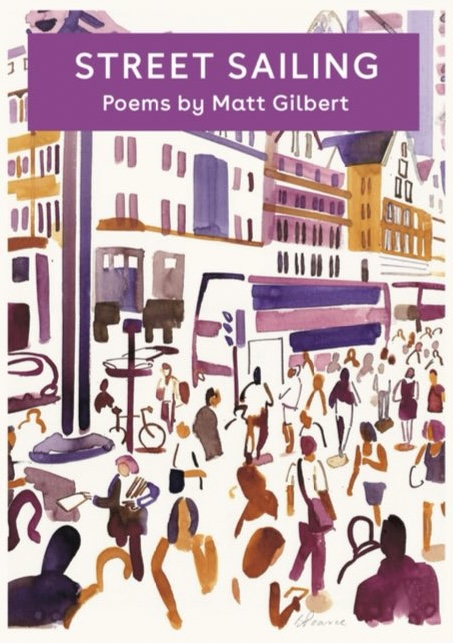
Cover of 'Street Sailing' by Matt Gilbert

In a blog post announcing the release of his debut collection, Matt Gilbert wrote:

Unlike maths, or wordle, there’s no ‘answer’ to a poem – only readings’

Poetry certainly resists the neatness of a single irrefutable solution. Instead, it invites readers to think beyond the obvious and acknowledge the plurality of possibilities that could exist.

That’s not to say though that a poem can’t be a puzzle. A puzzle in the sense of a brainteaser, a head-scratcher; a foot-tapping, eye-rolling, knee-jerking conundrum; a challenge, a problem. The world of poetry has many problems.

Even if a poem can’t be solved, it can have answers. These answers are less likely to be 43 or TOAST than another poem sparked into life by the original or a feeling too complex to put into words. A poem’s solution, however splintered and plural, is there in the text. Where else could it be? To find it: don’t not keep looking.


‘Street Sailing’ abounds with linguistic games, which pop onto the page like ‘terse notes sent rattling up through buried pipes’. The title already makes the reader do a double take: how can we sail through the street? Is the alliteration so alluring as to prevail over sense?

The answer is yes – and no. The wind that propels Gilbert’s vessel is rhythm and melody, ‘floating for no reason | until the cuff began to form, | sprouting from that plastic seed…’. But sailing the streets is not merely wordplay; it is an ideal metaphor for how the collection asks its reader to look again at familiar sights. Discovery comes in stages that slowly reveal themselves: first, ‘a sleeve, arms empty | followed by pocket, collar, yoke’.


The poetic game does not have winners or losers; the joy is in the taking part. In ‘Street Sailing’, everyday scenes are taken apart and it is the reader’s job to reassemble them.

In ‘How to flatten the moon’, the poet combines a critique of modern life and its abundance of technologies with an anecdotal plea for the importance of poetry. The title could be taken from a clickbait blog post and, like this dubious genre, you have to read (or scroll) all the way to the end of the poem to get the answer:

now ease the phone
from your pocket, point it up
towards our ancient friend,
then click.

Now you’ve done it.

The answer is simple: a photo can flatten the moon. But what does that mean?

Given that poets have obsessed over the moon for millennia, there is a certain self-deprecating nod when Gilbert romanticises ‘the rounded milky glint | of our almost full fat | satellite’. Is the point then that, where photography flattens and dulls, poetry adds depth and revivifies? The poet’s repeated focus on the present moment emphasises the disconnect between living through screens and LIVING with eyes wide open and capital everything. Poetry is firmly in the latter camp: to write poetry is to observe, really observe; to read poetry is to read and re-read and re-examine everything through someone else’s eyes. Technology has made our lives easier but it has also overcomplicated something as simple as looking at the night sky: as the poet exclaims, ‘there it is, there it is’. Look at it!

Other readings are available. Flat does not have to mean bad. The final line is deliciously ambiguous: ‘Now you’ve done it’ could just as easily be jubilant as derisive, depending on where the stress lands. Capturing a complex astrological body in an accessible 2D-frame could be considered a modern miracle. In the ‘Editor’s introduction’, Matthew M. C. Smith extols the photographic qualities of Gilbert’s collection, exclaiming that ‘his poetry wanders, camera-like […] then zooms in, on the minutiae that most of us ignore’. Flattening boxes before recycling them helps more boxes be recycled.


It’s not just the moon that people fail to notice. Drivers are an easy, and justifiable, target: ‘Rush hour cars kept coming, | oblivious to all but road’, while ‘rasping corvids’ and a ‘lone indignant… sparrowhawk’ perform to an empty audience high above (‘Take the second exit’).

The image could easily be a metaphor for governments’ narrow focus on short-term economic growth, while climate catastrophe creeps ever closer. It could also be a critique of humanity’s treatment of non-human animals, whose suffering on farms and in slaughterhouses is kept well out of sight. Either way, there is hope: although the ‘petrol-powered | roulette balls’ keep spinning, the drivers are ‘desperate for their exit’. If systems can be adapted to redefine priorities, the drivers can adapt with them.

‘Rush hour cars kept coming, | oblivious to all but road’

Although some animals are ignored and others are deliberately obscured, a fox hit by a train is grimly compulsive viewing for the poet: ‘I couldn’t not keep looking’ (‘Foxed’). The double negative is symptomatic of humanity’s confused relationship with other species: most people don’t want to harm animals but neither do they want to stop using (and abusing) them. The presence of violence and death uncomfortably close to a shielded human space (‘the platform’s end’) is a reminder of the interconnectedness of nature and mortality – however hard we try to place ourselves above other life forms. Twinged by this sorry sight, the poet feels duty bound to convert his feelings into words: ‘In the absence of a ritual | I shall mark your empty legend’.


Putting into words the illogical act of staring at something repulsive seems a fitting way to describe why poetry exists. ‘Street Sailing’ is a puzzle with many readings and many answers. Matt Gilbert is a skilful setter, spraying clues, hints and red herrings all around his poetic landscape. Getting lost in this impressive debut is no bad thing.


Matt Gilbert, Street Sailing (Black Bough Poetry, 2023). Available here: Street Sailing – Black Bough Poetry

Cover of 'Street Sailing' by Matt Gilbert

Our Best of the Net Nominations 2024

We are delighted to announce our nominations for the 2024 Best of the Net anthology.

Needless to say, this is always an extremely difficult decision (we love all the pieces we publish). Best of luck to our nominees; you can (re-)read their work via the links below.

Our Best of the Net nominations for 2024 ~

Elancharan Gunasekaran, Praveena Pulendran, Aimee R. Cervenka, Frank William Finney, Emily Munro, Jennie E. Owen, Namratha Varadharajan, Alice Willington, Tom Frazer, Cathy Ulrich

ART

Elancharan Gunasekaran, ‘ghost coast’

Praveena Pulendran, ‘Bloodset’

POETRY

Aimee R. Cervenka, ‘Thinking of Basements’

Frank William Finney, ‘Elegy for an Elm’

Emily Munro, ‘suitcase dream’

Jennie E. Owen, ‘Haircut’

Namratha Varadharajan, ‘A measure of the past from the future’

Alice Willington, ‘All the time’

FICTION

Tom Frazer, ‘Green’

Cathy Ulrich, ‘Where They Found You’


Issue 11 is coming soon. And it’s a special one for us…

Starting with Issue 11, Briefly Write will be paying all contributors!

Since we started Briefly Zine in June 2020, we have published 10 issues of quality brief writing and photography. We are delighted now to embark on the next chapter of our little literary zine: starting with Issue 11, we will be paying all contributors for their words and art.

Submissions will remain free. That will never change. Therefore, the payment won’t be life changing. Even so, we are immensely proud to be able to offer our contributors a small token of appreciation for their brilliance.

Thank you to everyone who has been a part of our journey so far. There’s a lot more to come…

What do poets really think about poetry competitions?

Poetry competitions can be a controversial topic in the writing community. As a little literary space that hosts an annual Poetry Prize, even we have mixed feelings.

Briefly Write

We want to do the best we can for writers and readers. That’s why, during the Briefly Write Poetry Prize 2022, we asked entrants to answer some questions about poetry contests. The responses we received helped shape this year’s competition. Here are the results.

Our respondents

In total, there were 412 responses. All were submitted anonymously and respondents were aware that their answers could not be traced to their entry.

Almost nine in 10 respondents (88%) had not previously submitted to Briefly Write in any form (including Briefly Zine and other competitions). Respondents were asked to answer the questions generally, not specifically for the Briefly Write Poetry Prize (except for the questions summarised in the next section).

Careful or casual?

Last year, the most popular ways that entrants found out about our competition were online listings pages (24%), Twitter (22%), search engines (17%), other social media (14%), the Briefly Write website (5%), word of mouth (3%) and Duotrope (2%).

More than four in 10 respondents (42%) wrote their entry specifically for the Briefly Write Poetry Prize, while 41% submitted a poem they had already written but had never sent to another journal or competition.

The vast majority (85%) read the guidelines carefully, though some went straight to the entry form (7%) or had only a cursory flick through the rules (7%).

Show me the money

Most respondents “never” pay to enter poetry competitions (46%), ahead of 26% who said they “sometimes” pay and 24% who “rarely” do so. Only 4% said they “often” pay, perhaps unsurprising given that the Briefly Write Poetry Prize is a free-to-enter competition.

In terms of prize pots, the result was conclusive: the most popular option was 1st – 50% // 2nd – 35% // 3rd – 15%, which received close to half of all votes (48%).

A similar option that extended to paying fourth and fifth place (1st – 35% // 2nd – 25% // 3rd – 20% // 4th – 15% // 5th – 5%) received almost a quarter of votes (22%).

The option of having five equal runners-up each winning a tenth of the prize pot (1st – 50% // Runners-up (x5) – 10% each) was favoured by 13% of respondents. Meanwhile, ten joint winners was chosen by only 6%, just ahead of winner takes all (6%).

The rest chose “Other” and offered a wide range of opinions, including one who said offering any prize money creates a “vicious circle”. Others suggested donating the prize money to charity or indicated that monetary reward made no difference to them.

Raising the funds

We have been clear since we started Briefly Write that we will never charge entry fees. Financial barriers should not stop people sharing their talents.

We do, however, rely on donations to pay our website costs and prize funds. Every penny we receive is spent directly on covering these costs: we don’t take a penny out for ourselves as editors. Each year, we have increased the prize pot of the Poetry Prize thanks to the generous support of our readers and writers – and we hope to keep doing so.

One option we have considered as a means of raising more funds whilst also providing extra value to entrants’ experience of the competition is to offer some add-on features. This could include things like short feedback or extra insights into the judging process.

Things that respondents said would add the most value to their experience of a poetry contest (besides winning) include:

  • A personalised email with very short feedback (54%)
  • An email with the results before they are publicly announced (31%)
  • An exclusive Judges’ Notes email (30%)
  • A bigger prize fund next year (27%)

Some 17% said that none of the above would encourage them to donate, while 14% said they would be donating purely to support the competition.

To theme or not to theme?

Overall, respondents preferred unthemed competitions (53%) to contests with a theme (33%). The remaining responses (“Other”) mostly expressed indifference on the issue. The result of this questions is, of course, likely to be skewed by the fact that respondents were answering after having entered an unthemed contest.

In a follow-up question, vague themes such as ‘Be inspired by X / interpret Y loosely’ (68%) comfortably beat specific themes like ‘Write a poem about X / using Y / in the form of Z’ (27%).

Don’t leave me hanging

As writers ourselves, we understand how frustrating it is to pour your heart and soul into a submission… and then never hear back. That’s why we email every entrant regardless of the outcome of their entry.

It does take a lot of time to send all these emails so we wanted to check it was worthwhile. We asked how much people valued receiving an email to say they haven’t won a competition before the results are announced publicly.

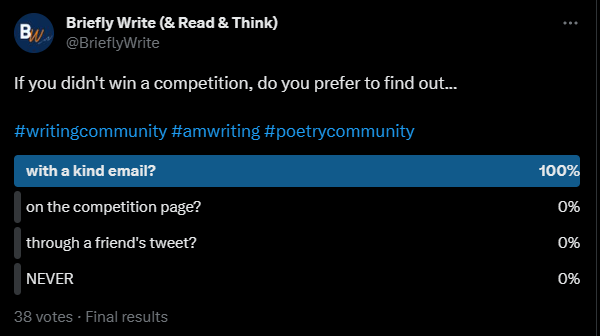
Some 62% chose “I really appreciate it and it makes a big difference to my experience of a competition”. For 31%, it was nice but not essential (“I appreciate being told but it doesn’t make that much difference to me”). Only 4% would “rather not be told if I haven’t won”. This result is supported by a recent Twitter poll we ran.

Screenshot of a tweet with the question "If you didn't win a competition, how do you prefer to find out?" showing "With a kind email?" as the clear winner

Those who chose “Other” made suggestions that could reduce the administrative burden such as an automated email to announce the winners. Multiple respondents said that no response is fine so long as this is clearly communicated in advance.

Prizes and publicity

In the event of winning a competition, two thirds wanted to make the most of the opportunity for publicity (62%), while 12% opted for “Just pay me the money”. The large number that chose “Other” reflects a flaw in the question: the intention was not to make people choose between publicity and money but to see whether they valued extra features such as interviews.

Many of the “Other” respondents said they want both prizes and publicity. Some repeated assertions that money shouldn’t mix with poetry or expressed the view that publicity and prizes are secondary to eyes on their writing: “I just want to be read”, “I want recognition for my work” and “I want to inspire people” were common answers.

In the follow-up question, the forms of publicity that winners would most appreciate included the chance to have their poem published in an anthology (75%), online publication (71%), promotion on social media (51%), an interview about the winning poem (43%) and an online feature about the poet (42%).

When all is said and done

Encouragingly, 82% said they would still read the winning and commended poems if they hadn’t won. Likewise, 79% said they read the Judges’ Notes when they don’t win a competition.

The most popular material to include in Judges’ Notes was “Insight into what made winning poems stand out” (87%) and “Insight into what made poems fall short” (55%).

An “Overview of common themes / styles / forms” was appreciated by 50%, while 41% were interested in statistics about the number of entries. The few’ “Other” suggestions we received included calls for statistics on the diversity of judges and entrants.

What are our key takeaways?

We were delighted with the level of response and thoughtful engagement our survey received. The answers reaffirmed our commitment to running accessible, free-to-enter competitions that treat all entrants with the respect they deserve.

This year, we implemented the prize pot that received an overwhelming number of votes (1st – 50% // 2nd – 35% // 3rd – 15%), despite our own instinct being to pay more writers a smaller amount. This is something we will review again for future competitions.

We will continue to email all entrants regardless of outcome. In the past two years, we have received only a handful of rude responses or arguments about why we were wrong to overlook a poem. Although rare, even these few are dispiriting.

That said, we do always welcome (polite) replies with thoughts or constructive feedback on the competition. And if you would like feedback on your poem, we offer that service too: Briefly Feedback.

If any writers or editors would like to discuss any aspects of the survey, we would be happy to provide more details. Comment below or email contact [at] brieflywrite [dot] com

Interview with Elizabeth M. Castillo

Following our review of Not Quite An Ocean, we spoke to Elizabeth M. Castillo about writing, water… and whether words should be left to do their own thing.

Daniel: In one of the opening poems, we read, ‘To write, dear lady, is to dig’. For how long were you digging Not Quite An Ocean… and what did you find?

Elizabeth: In all honesty I actually wasn’t digging at all! The opportunity arose to have a manuscript published with the wonderful Nines Pens Press, so I sort of gathered the few sundry poems I had out in the wilderness and tried to coax them into some sort of shape… to no avail!

Then I reached a point, probably a year ago, where I found myself feeling very exhausted from channelling so much of my energy into finding work opportunities and promoting my writing, without actually doing much actual creating. I was burnt out and craving renewal, and so I decided to take time off the aspects of indie publishing that were draining me, and focus on doing more writing.

D: I think this is something all writers feel at times!

E: I went through my notes, and found a good number of poem stubs… fragments, lines, images, I had jotted down to be made into something later. I set out determined to craft them into something, and was pleasantly surprised at how much material just seemed to flow out of me! ‘Love Song’, ‘In Summer I Am Beautiful’, ‘In Which Bertha Mason Cannot Sleep’, ‘Body, i love you’ and a few other poems were all conceived this way.

It was such a satisfying process… writing with the only constraint being that a complete poem needed to exist in the world once I was finished. I didn’t worry about form, or whether something like it already existed, or whether it was literary enough. I just wrote. And I ended up being very happy with the result.

D: That sounds like a liberating process! Your answer goes straight to the heart of the pros and cons of the publishing world: the chance to get your work read balanced against the pressures and time-drain of constantly seeking opportunities and submissions calls. Overall, how important would you say the lit mags that first published your poems are in the task of bringing together a collection like this?

E: Lit mags are so essential to the process! For writers, they are one of the first lines of confirmation that your work will appeal to readers. The way they showcase your work can also be helpful: I never considered my work particularly feminist until it was accepted and published alongside explicitly feminist pieces, for example.

They are also one of the first avenues by which your readers can find and engage with your work. Many places also do such an excellent job championing writers and their projects even outside the lit mag, by promoting their work on social media, or hosting readings, reviews, or interviews like this one. No indie writer has a publicist, an agent, or even a marketing budget, so we need all the help we can get.

Lit mags are so crucial in platforming of diverse voices in publishing. I remember being so discouraged when I first started looking for places to publish my poetry and seeing the same 10-15 names who had all been to the same five schools and been published by the same publishers… mostly white, mostly male, mostly from a social class that usually has the sort of disposable income that makes writing poetry a viable career choice because chances are you’re able to pay your bills from another financial source.

I don’t fit in to those genres in any respect, and am grateful for the lit mags out there that have introduced me to writers and artists like myself, who have stories to tell but very little space in which to tell them! If small presses are the vital organs of the indie publishing world, then lit mags are surely the lifeblood keeping the whole machine working properly.

D: Absolutely! The feminist angle is certainly one of the key themes I took away from Not Quite An Ocean. I was also struck by how the collection asks so many questions: ‘What do we have to do for you to stop killing us?’ and ‘Who will hold the ocean?’ are two that I found especially powerful. Do you think of poetry as a prompt for self-reflection? Can poetry really inspire people to change their behaviour?

E: You know, I’d not noticed that before! I suppose where there is a desperate need for an answer, or even better, a solution, asking a question outright just feels like the most impactful course of action.

But I am very wary of prescribing anything to my readers, be it self-reflection or any other, more concrete action. As an artist, my job is open the way for the reader, by inviting them in to explore whatever realm it is I have pitched my creative tent, so to speak…

It’s not my job to compel my readers to care about the ocean, rather to show them how she suffers at all of our hands. Whether that prompts action, compassion, self-reflection or any other reaction, is outside of and well beyond me.

D: I get what you’re saying about not hammering the point home. Even so, I read the collection as a desperate plea to protect the oceans and all its inhabitants. What impact did you hope to have with Not Quite An Ocean?

I hope people read it, love it and support my work, as well as Nine Pens who are doing such an amazing job. I hope other writers who see how aggressively I have promoted this little book are encouraged to do the same with their wonderful art. I hope women, people who have suffered, mothers and all those who give and give, read it and feel a little less alone.

D: As a writer with many strings to your bow, I wondered how your writing process differs for different genres and styles. Is the way you approach poetry much different to how your write prose?

E: Poetry tends to fall out of me, starting with a line or an image, maybe even a title that sits for a bit until I come back to it and shape it into a whole “thing” in its own right. Very occasionally I’ll birth a poem from start to finish.

My approach to prose is different because I feel less confident writing it. Short form prose is quite intimidating, so I either whack it out in one go or start and then leave it to gather dust for far too long! With my novels, I’ll write the occasional scene as it pops into my head, but mostly I need to sit with my outline in sight and just chip away at it, trusting that the sparkle will come through when it’s time for editing.

Though I must say the more I write, and the more I read, especially the sort of writing that I love, the more I see that the line between poetry and prose is a very blurry one. I have pieces that I’m still not sure about whether they fall into prose, poetry, creative non-fiction, memoir… and that’s not necessarily a bad thing. Why constrain art to a specific form? Surely the substance is what truly matters in the end?

D: It’s an interesting question about constraining art or letting it do its own thing. Form is the mode of transport but, as you say, the message is what matters most. I suppose it’s similar with structuring a collection: the decision to classify the poems into four sections partly constrains them but also allows more connections and layers to develop. How did you go about deciding which poems belonged in which ocean?

E: I like to categorise things in my creative life: I have three pen-names for the three genres I write; my first poetry book Cajoncito was divided into three chapters of Love, Loss & Madness, and my other poetry manuscript is also divided into three chapters. Maybe it’s a dyspraxic thing? I don’t know…

For Not Quite An Ocean, I was getting very frustrated with the poems as I couldn’t find a nice, mixed balance I was happy with. I tried ordering them by length, by theme, by overarching metaphor, by tone even, but nothing felt right. Then during a geography lesson with my daughters, whom I homeschool, the idea of the four oceans suddenly came to me.

There’s no deep metaphor in the ascribing of poems to ocean chapter: it was more for my own sense of organisation, as well as which poems were complementary when set side by side. The Indian Ocean is filled with very close, personal poems, as it is my ocean, the one I grew up in and feel most at home in. The Arctic is the coldest and most barren, as are the poems there-within. The Pacific hosts the poems written in any relation to Chile or Latin America and the time I spent there, and the Atlantic to life and lived experience here in Europe.

D: It’s always so insightful hearing a writer talking through their process. You seem to have found a successful balance between planning and organising without over-planning and killing those flashes of inspiration that make art spontaneous and authentic. After Not Quite An Ocean, do you already have your next project all mapped out?

E: ProjectSSSS! I subscribe to Joni Mitchell’s concept of crop rotation… lots of different crops growing at the same time, and I rotate the time and attention I devote to each of them.

I’ve just founded an arts association here in France called La Maisonnette through which I’ll be offering poetry and other creative workshops and retreats, so I’ll be working on that. I’m also chipping away at my novel: a gothic retelling of Elizabeth Gaskell’s North and South that I will publish under the pen name Elizabeth Hades. And I’ve got a few kids’ picture books I need to polish and submit.

I’ll also be offering more writing and creativity workshops and courses in the near future. I am a teacher at heart, and connecting with other creatives is something I am so very passionate about! I may not have as many formal writing credentials as some other writers, but I believe the best teachers are often self-taught, and I have garnered a wealth of knowledge on networking, promotion and art-life balance that I feel many writers would find useful.

I’m also looking into doing more reading work: I’m currently tweaking my home studio from which I’ll record my children’s poetry podcast, as well as a couple of audiobooks, including one for Not Quite An Ocean and my debut, Cajoncito. And finding a home for my matrescence-themed poetry manuscript, as well as finishing my hybrid memoir/flash/poetry manuscript on growing up in Mauritius.

D: Wow, you are busy… thank you for taking the time to respond so thoughtfully to these questions! Final one: do you have a favourite poem (or stanza or line) in Not Quite An Ocean?

E: I do! Although there are quite a few I’m fond of, I must say ‘The Other Woman’ is my favourite poem I’ve ever written of all time ever and ever to infinity!!! And the last line is an absolute banger:

Your ears twitch and you shudder,
neck craning to see what you and I
must learn the hard way:
the deadliest thing in here is me.

D: Agreed! It was great speaking to you, Elizabeth: thank you again for your insightful answers.


Read our review of NQAO here: Briefly Reviews – Who will hold the ocean?

Buy the book from Nine Pens here: Not Quite An Ocean by Elizabeth M. Castillo

Who will hold the ocean?

A stirring trailer builds the reader into a frenzy. The poems do not disappoint

Book cover of 'Not Quite An Ocean' by Elizabeth M. Castillo

Oceans can be overwhelming. To the untrained eye, an ocean is too vast, too wild, too changeable to be understandable. Elizabeth M. Castillo is an astute tour guide, for she is knowledgeable enough to know how little humans know of an ocean’s true depths.

Come with me;
I will show you how the roots are
fibrous here, like lace, like macrame,
dancing across the dirt

In Not Quite An Ocean, deference to nature is assumed. Humans are nothing but a brief irritation on Earth’s back. ‘Beneath the mountain, Gaia sleeps, weary from the angry years of men waging war across her skin, and plundering her depths with impunity,’ the poet writes in ‘When Mother Nature will not Wake’.

The poet knows that nature has the power to devour humanity. In ‘Things that have replaced my Father’, she evokes ‘this dark cloud that I watch, helplessly, as it swallows him whole’. Mythical allusions reinforce the insignificance of individuals.

One of the collection’s best poems is ‘Storm Tower’, which moves quickly from an individual influencing nature (‘… as if coffee | spilled from your cup had stained atmosphere’) to the natural world’s desperate attempts to tell humanity to change its destructive ways (‘Words are | travelling to you, a message, swollen, begging | to be deciphered’). In the end, the poet urges realism: ‘Steady yourself. Gather your clothes | and wits about you. You can’t outrun the storm’.


If that all sounds pessimistic, it is not. Not Quite An Ocean is a collection that breathes life into wearied souls and offers a brief vision of harmony.

The collection is a rallying feminist cry: ‘The earth was held between two breasts / warm | and safe from the beasts inside’. Only by acknowledging that we are children of Mother Earth can we live peacefully within nature, instead of using and abusing her abundance.

Especially moving is ‘For Sarah, and all those whose names I’ll never know’, in which the countless victims of male violence are remembered:

Prisoners
of war, victims of the Congo saga.
Mauritian
wives, Mauritian daughters, cowering in their kitchens.
Desaparecidas, at Mexican borders, in Argentine towns […]

The poem’s refrain (‘What do we have to do for you to stop killing us?’) washes over the reader with rising intensity. Anger and purpose and the hope of something better are contagious; the prospect of a better future is threaded poignantly into a crescendo that compels the reader to rise up and take a stand.

Castillo’s stylish, imagistic poetry brings people in and invites them to think beyond the page. Like the seasons, the collection offers a varied, sometimes unpredictable, reading experience.

Unsurprisingly for a seasoned fiction writer (see, for example, ‘This thread’, which appeared in Issue 4 of Briefly Zine), prose poems play a starring role, sprawling across the page, defiant and untameable. The poem, ‘In summer I am beautiful’, is one of many examples where poetic form enters into conversation with nature: ‘Winter where shadows creep and creep, where trees are naked, when hope decides to hibernate’.


Hope and despair come in waves. On the blurb, Not Quite An Ocean is described as ‘a paean to the feminine, to motherhood and to the natural world’. Certainly, female power is lauded and nature’s force celebrated. But the poems are far from triumphant.

In ‘When Mother Nature will not Wake’, for example, ‘There is vengeance inside this girl, but she keeps it under lock and key’. In ‘Who will hold the ocean?’, the burden is not shared and the Earth is starting to collapse: ‘Who will breathe life into her wearied sinews, shore up the arms that | hold the continents apart?’

It is a timely question. Unless drastic action is taken, the world’s oceans will contain (by weight) more plastic than fish by 2050. In 2023, the temperature of the world’s ocean surface has already hit an all-time high – a shameful record that will be broken again and again in the coming years and decades.

The cruelty and self-centredness with which humans have used the planet and callously abused other living beings is hard to express in words. Not Quite An Ocean does not quite condemn humanity in the starkest terms. But it does accept our collective guilt: ‘and I must learn the hard way: | the deadliest thing in here is me’.


Elizabeth M. Castillo, Not Quite An Ocean (Nine Pens, 2023). Available here.

Cover of 'Not Quite An Ocean' by Elizabeth M. Castillo.

Conversation with Ankit Raj Ojha

Last month, Ankit Raj Ojha won the Featured Essay prize in the inaugural edition of Briefly Think for his essay, ‘Becoming Poetry’. His reward? Some more questions to answer.

In response to the prompt, Where does the person end and the poem begin?, Ankit wrote compellingly about his relationship with poetry (‘the inescapable requisite’) and the possibility of a perfect state of equilibrium between poet and poem. The following conversation delves deeper into these topics, as well as spinning off in a few new directions.

You can find out more about Ankit and his writing here. And stay tuned for the THINK 2 prompt, which will be released later this year.


Daniel: Your essay stood out for its beautifully concise composition and fascinating, multi-faceted content. As you write, language can be a tool for play (‘I toy with words…’) and pay (‘It’s true that I look for paying magazines’). So, first question: did play or pay prompt you to write ‘Becoming Poetry’?

Ankit: Surely not pay; I didn’t see a win coming around the time I was writing the essay. Your prompt, I believe, was intriguing enough to stop me in my tracks and ‘make me skip meals’. I had come across it on Twitter and had almost dismissed the thought of reflecting on it, for at that time I could barely sustain a single thought long enough to produce a coherent piece.

But then I got into a chat with writer friends on Twitter on a similar topic, found myself uttering things that would later form some of the essay’s ideas, and was quick to delete my public tweets upon realising that I did want to write a previously unpublished piece on your prompt. Nothing is created in vacuum. This is how ‘Becoming Poetry’ came to be.

D: That’s true: poetry is always, in some way, a conversation or collaboration. The concept of previously unpublished is itself fraught given that words are always recycled, reconfigured, replayed, renovated (though plagiarism, of course, is real and harmful).

Your essay features words spoken (‘“Why can’t you just relax?”’) and unspoken (‘I half-reckon then abandon the urge to tell them’), which, to my mind at least, resembles a poet choosing what to set down and what to leave out. The deleted tweets are part of the story too: those fleeting words wiped away like they were never there. So, I guess the question is: how do you deal with all these silent and noisy influences when writing a poem? Are you conscious of the words you are choosing to ignore when you choose the ones you write?

A: I’m glad you asked this. It’s true: thoughts gush in from everywhere; words follow suit. Sometimes it’s the other way round: you have a word or phrase that tastes so good you are desperate to use it, so you devise thoughts to sneak the word into your poem. As for me, I have grown up largely on novels, and my feelers still come to rest on fiction (note to self to read more poetry). The consequence is that I often turn to narrative poetry. Some of my early poems I found a bit verbose and had to edit post publication for future reprints and for my own sanity.

I still love storytelling in verse, for the love of the form and also because it suits my diverse schedule that at present forbids long-term courtship with prose, allowing only short poetic flings. But I am now more conscious of practising restraint and refinement. I assume every writer has to go through the Clark-Kent-as-a-schoolkid phase where the young Superman must learn to wade through voices in his head, shut out the noise, and focus on what really matters. Sometimes you have to part with beloved words or thoughts for the greater good. Some of the jilted words may turn up another day, in another poem; the forsaken await their turn forever. The writing process, therefore, is every bit as stringent as it is spontaneous. Even the stream of consciousness insists on the chisel, for epiphanies too have to be tinkered with while writing.

D: That’s fascinating and really insightful what you say about the stream of consciousness. Poetry often feels more “personal” than prose, more intimate or even intrusive. When writing and editing your poems, do you ever think about how much of yourself you might be “giving away”?

A: If I may digress before approaching the question: intrusive is the word, yes. For me the poem almost always writes itself, and that too when it wants to, triggered either by heightened emotions or a recollection of past stimuli. I have a hard time consciously creating poetry from scratch. That’s why I struggle at prolificity – something I need to work on improving.

We were speaking of intrusiveness. When a potential poem does intrude, quotidian constraints melt away and I find myself skipping meals and chores – as I mentioned earlier – until I am at least done with the first draft, if not the final version. This fixation is possible because it’s personal: most of my poems are born of lived experiences and emotions, if not mine, then of those I observe around me. The rudiments of the human soul, I believe, bind us across space and time. This is the reason we feel writers we know nothing about: we rejoice in their victories; we are shattered even if it is their tragedy.

Coming to your question, every poem out in the world is somebody “giving away” a part of themselves. There are, of course, those “private” unpublishable pieces we create, safekeep and turn to for catharsis. Barring that forbidden zone, I think I am comfortable giving myself away, knowing there are takers who sing the same song. A poet, after all, is an acquitted gossipmonger. Now who wouldn’t want that licence?

D: A worthy digression! Has the experience of editing The Hooghly Review altered your view(s) on what is “personal” in poetry? I’m thinking especially about the magazine’s focus on ‘individuals and their lived experiences’.

A: Well, editing THR has rather reinforced my understanding of the “personal” in poetry. Let me illustrate this using the phrase you just quoted.

Whenever I read poems for THR, or any poetry in general, I often find the “personal” expressed in ways beyond what is usually termed a personal poem. A personal poem is, of course, an individual narrating their lived experiences. But it doesn’t necessarily have to appear personal; that’s the beauty of poetry, or of any art form. A characteristic of good art, as I am learning, is to defamiliarise our experience of reality, so that by the time we have managed to decipher the contents on the page, the revelation is both uncanny and reassuringly familiar.

Even the stream of consciousness insists on the chisel, for epiphanies too have to be tinkered with while writing.

Ankit Raj Ojha

As I said before, the reason we identify with writers and their works we know nothing about is because we see us and our own experiences in them. We are wired this way – to think and feel alike, and empathise with our fellow beings, possibly because of the collective unconscious we share, which Carl Jung says is the public folder of all memories, impulses and emotions common to humankind. I am also reminded here of Joseph Campbell, who said, ‘Myths are public dreams, dreams are private myths’. Campbell surely felt the same way about humans – all of us feel and dream and create our myths alike.

That said, I do look for ‘individuals and their lived experiences’ at THR. But I welcome and marvel at the myriad ways personal tales can be recounted. Be it a confessional poem, a defamiliarised story, a surreal painting with words, the poet’s private lessons repackaged and served didactically, an inner battle projected upon the world to appear universal, a grand narrative scaled down to an adventure in the mind, or anything else that enthrals the reader with its singular way of telling a personal story: I appreciate the chance to read it all and learn.

D: Art, dreams, the universal… you’ve covered a lot in a short answer! I agree about reading and re-reading and learning. There are so many books, so many poems: too much to read in a thousand lifetimes. So, I guess that brings us back to your essay and the colleagues who ask, ‘Why can’t you just relax?’ and your response, ‘I do relax; words are one of the ways’. Does becoming poetry involve an acceptance of the limitations and incompleteness of our relationship with words?

A: Nassim Nicholas Taleb has pointed out that unread books are far more valuable than read ones; he calls the former the antilibrary, saying that the unread pile keeps one humble and driven by curiosity. So, my answer is a yes. To be able to read everything is never the point; that’s a mad proposition. As readers and writers we can best serve literature by doing our bit, howsoever small it is. Remember what Borges said of storytelling, ‘Writing long books is a laborious and impoverishing act of foolishness: expanding in five hundred pages an idea that could be perfectly explained in a few minutes. A better procedure is to pretend that those books already exist and to offer a summary, a commentary.’

A poet, after all, is an acquitted gossipmonger. Now who wouldn’t want that licence?

Ankit Raj Ojha

Although I can’t afford to dismiss the longer form as Borges does, I would very much like to extend the analogy to the act of reading. You cannot read it all, but you can sample the entirety of it all in the select few. Now, selecting the select few requires one to be thorough, which is why I try to read widely across cultures, geographies, genres, identities, and so on. A writer is, first and foremost, a reader, and becoming poetry entails that you accept your reading limitations and still do your best while you are at it. By tasting some you taste it all. The “some”, however, must keep growing.

D: Those are very wise words… and an inspiring way to approach the TBR pile! This whole conversation has been hugely enriching; thank you, Ankit, for providing such fascinating insights into your writing, reading and editing. Any final thoughts to add on poetry, people, endings… or beginnings?

A: I’m equally delighted, Daniel. Talking with you has been a rewarding experience; thank you for the intriguing questions.

As for final thoughts, I have found, so far, that a writer’s life, even when peopled, is a lonely affair. Spending time with oneself helps observe the world and weave meaningful madness from random strands. As I am a believer in all things cyclical, I do not perceive definitive endings and beginnings. An experience for me can lead to a poem; poetry, in turn, may sire an experience seen in the poem’s hue. Art mirrors life; life mirrors art. But all of this is, of course, my opinion. To each their own.


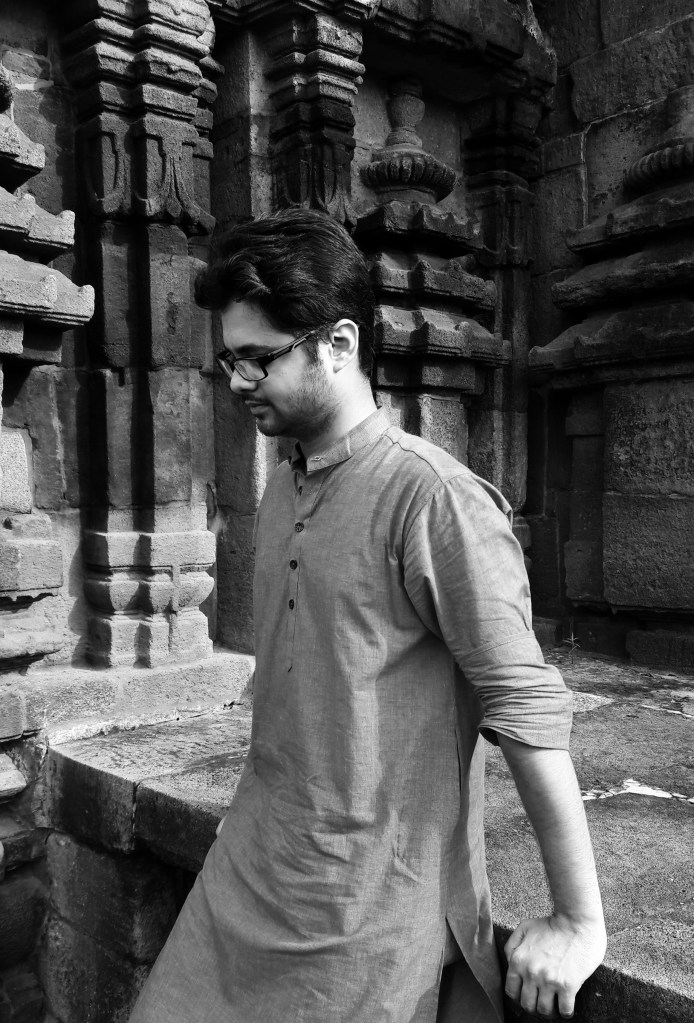
Ankit Raj Ojha is a poet, assistant professor of English, former software engineer and former rock band frontman from Chapra, Bihar, India. He has a PhD from IIT Roorkee, works with the Department of Higher Education, Haryana, and is editor at The Hooghly Review. Ankit’s writings are published or forthcoming in eleven countries including venues such as Poetry WalesRoutledgeJohns Hopkins University PressSahitya AkademiOutlook IndiaStanchionBriefly WriteThe Broadkill ReviewRoi Fainéant Press, and Dreich among others. He is the author of Pinpricks (Hawakal, 2022) and winner of the Briefly Think Essay Prize 2023.

See more on his Linktree, Twitter or Instagram. You can also buy his book, Pinpricks, here (India), here (rest of world) or directly from Ankit.

River of Life

John Ganshaw


Born into the stream of life with no set course, winding our way from one point to another. Flowing and trying not to drown, lay back and float with our feet up, relaxed on a river running its course. The rapids come every now and then, a waterfall here and there, but most of the time we just gently move so slightly. We wake each day and follow our path of existence, working, spending time with loved ones, and most of our time sleeping, dreaming of what could be. We seek comfort and for most, that means succumbing to what is safe and not seeking the adventure we long for, the pursuit of our dreams, in other words, to be protected by what we know. Life is meant to take risks, to not seek an end of one and the beginning of another but to embrace the entirety. To piece together the nuances of our existence. We look for the waterfalls and the rapids for it is there where the stories lie, where our mundane lives become adventures to share. Those moments when our hearts beat faster and lose our breath, caution is tossed to the wind, and seek the excitement of what lives in the shadows, out of the light. If we are truly lucky, so much adventure takes place that there is never an end, but a series of hidden paths and tributaries meant to explore, each one with its own story to be written.


Life is extremely short, with many forks for us to decide which way to go. We should choose the adventurous path, we may get bruised but we will have fulfilled our dreams.

The prompt provided a new journey to explore.  


After 31 years in banking, it was time for John Ganshaw to retire. New experiences enabled him to see the world through a different lens.

Poetry is the true art of getting better

Leanne Drain


Birds flee from cages; light restores energy, and darkness can be interpreted differently. But Poetry, somehow, always finds a way back out.

Poetry is therapeutic. It relies on consciousness and releases beautiful, thought-provoking ideas. It can be found in the darkest places but regained when the sun sets against the sky.

When does human life begin to end? Is it when poetry becomes a friend? For all we know, opposites attract, and poetry is a gift from the gods. 

Long live poetry! And life will end on that final note.


Inspiration is key, the eye of the beholder thought. Provoking memories came flooding through.


Leanne Drain enjoys writing with all her heart. She is currently studying creative writing at University East London.

The Person End of the Poem’s Beginning

Mark Goodwin


Descartes was poorly. He haunted Himself as a ghost in a bowl – a ‘cogito’ cut-off from his own body and the place-world healthy bodies entwine with. Descartes contorted his personhood into a spook carried in a skull by a vehicle of fallacious flesh. He believed his abstracted holy soul to be his corpse’s driver.

But body is all, just as life-world is all. World & body are equiprimordial. Body is part of world, made of the same actual flesh as world … and world is only felt and moved through by animated/animating body. They do not happen at the same time, they happen as the same time.

A body is a place of sorts, and is (through movement) crossed over and through with world’s places – as ‘chiasm’. The experience of this nexus of life can be called ‘mind’. Mind is the place place & body play … out/in …

So, all a body’s actions are as thought, because thought is as the flesh of world/body’s movement. And place is what we move through/with … with/through emotion. Place is all around and all through, and is that which places us.

Phenomenon-focused poets put feeling selves in actively imagined virtual places … places felt as poems. ‘Stanza’ means room and is a particular kind of spatialness, or roominess. In a moved-through house each room may embrace a person’s body and each room can be held in a person’s memories. It is through

the places that stanzas are that we can re member (our)selves


The lantern-like question Where does the person end and the poem begin? opened a door for me … allowing me to condense – through poetic compression – some of my reading-journeys across phenomenologies of embodied-mind & place


Mark Goodwin is a walker, balancer, climber, stroller … and … negotiator of places. He has published a number of poetry books & chapbooks. Find him on Twitter (@kramawoodgin) and Bandcamp.

The DNA of Poetry

Ilias Tsagas


Years ago, I woke to a poem revealed in my dream: the chaos of subconscious, the palace and bunker this is, with the infinite number of rooms, had dictated a poem in my sleep and I woke up glad I had a new piece of work acquired effortlessly.

But the dream that revealed the poem had a dark side. The plot was about someone who achieves extraordinary things in his sleep but loses them each time he wakes up. The catastrophe was irreversible and before I could write the idea down on paper I was so much immersed in the poem that I felt the need to sleep to preserve it. For a while, the line between my idea, the dream and the poem was blurred. 

I’m used to blurred lines now. Growing older means all the more puzzling about remnants of memory and what resurfaces it. My looking into new things mixes with shards of the past triggered in random ways. Remember that poem I read a few days ago? My interpretation of it has entered my poetry today, and my writing will no doubt find a corner in the readers’ palaces and bunkers. Readers, writers and poems are doing no more, no less than adding new pieces into the ancient DNA of poetry that will keep evolving with us and without us for as long as there is time.


Poetry has a long history and its DNA keeps evolving. My micro-essay aims to vibrate your e-book device and trigger you to think of this history and add into it.  


Ilias Tsagas is a Greek poet writing in English and in Greek. He works in the energy policy sector as a journalist and an academic.