Fire & Heat

Sarang Bhand


I would like to humbly disagree with the idea of a person/poet and poem being separate in the first place. Borrowing an analogy from Vedanta’s teaching of ancient seers, I would like to state that ‘As one cannot separate clay from the earthen pot, one cannot separate a poem from the person/poet.’

A person is the sum total of their ego which is limited to their experiences in life. It is these experiences of life that nourish thoughts and these thoughts in turn act as the catalyst that germinates a poem. Whether it is melancholy or joy, the degree of it is unique to the person experiencing these and the person/poet expresses these emotions in their unique voice in the form of a poem.

Maybe there is an element of commonality in the themes of experiences experienced by different persons and there is a commonality of emotions that we all experience as humans. Maybe that’s why we perceive a piece of poetry to transcend beyond the person/poet when it gets related by others. But the language used, the selection of words to craft that poem, and the intended meaning conceived within the poem still belongs to the person/poet who chose to express them under specific circumstances of their life experiences. And thus, in my humble opinion, a poem cannot be separated from the person who crafted it. A person/poet and the poem are inseparable as fire & heat. A poem cannot begin where the person ends.


It was an interesting prompt and almost instinctively I chose to respond on how I felt about the statement. I wanted to have an objective approach to support my instinct and thus I attempted to deduce the relation between a person/poet and their poetry. Keeping it brief was a bit challenging but then brevity is the sharpest arrow in a poet’s quiver.


Sarang Bhand is an entrepreneur working in the clean-tech space. When he is not troubleshooting projects, he likes to explore writing, photography & painting. See his bio here and writings here.

Who owns poetry?

Beattie


In 1963, Sylvia Plath died. Her estate passed to her husband, Ted Hughes. By 2003, Ted Hughes was dead and Frieda Hughes, their daughter, became literary executor of both estates.

In 2003, a film about Plath, Sylvia, was released. Frieda Hughes was not keen. She refused requests to take part and denied filmmakers the right to use Plath’s poetry. In her poem “My Mother,” Hughes writes of being asked to “give them my mother’s words / To fill the mouth of their monster / Their Sylvia Suicide Doll.”

My critique is not with Hughes’ assessment of the film. Sylvia leans heavily into the trope of Plath as a “witchy death goddess,” as identified by biographer Heather Clark. Gwyneth Paltrow, playing Plath, is perpetually nervous, brittle. I doubt that the presence of the poems would solve this issue, but their absence surely worsens it.

Rather, my critique is with the model of ownership. Frieda Hughes did not write those poems. I do not wish to single her out. I do not object to her profiting from Plath’s work, not least because of the repeated tragedy she has endured in being Plath and Hughes’ daughter. But I object to monopoly. In the absence of the poet herself, the poems live on in the reader. And I believe in the right of readers to respond to those poems, even when that response is a frankly terrible film.


I attended a workshop on ‘Plath as poetic inspiration’. Faber, managing Plath’s estate, only granted permission for a session *about* Plath. We could not look at Plath’s actual poems, only poems responding to her. This sparked questions about poetry and ownership. 


Beattie is a writer and lapsed drag queen from Merseyside. You can follow them on twitter (@poofter_pontiff).

Syllables’ Irreverent Borders

Thomas Mixon


There are moments when I’m something outside language. In these grunts, gasps, these gaps where, yes, there may be thought, but no words, there can be no poem. Poems may begin in spaces absent of intention, but they take shape in syntax.

I come to an end, so many thousand times a year. I pause, listening, my ears flexed, quivering as feee-beee morphs to something I call chirp, as whoooosh changes to bird, inside my mind. I fall asleep, I eat, conceive of nothing as I crunch my way through Corn Chex.

Whitman may have wanted the United States to be his poem, but a poem can’t be a place any more than I can. As I live inside a country, a poem is resident to syllables’ irreverent borders.

My favorite time to be a poet is while swimming – every third breath my head emerges from the pond. Sometimes I zone out, exist in images untethered to specific pitches. But often, the literal splashing rhythms conjure phrases, in an urgent triple meter. If I do not write it down, it’s still a poem, since there are nouns and verbs nestled together. I hesitate to call it order, or logical, but it isn’t random.

It was a phoebe, I was hearing. An animal we named after the noises that it makes. I reach my hand, sing out. But it’s gone. When I am in the ground, the poems I’ve made will still reverberate because they have a home, in sound.


A sentence is a set of steps next to a sometimes wobbly railing. If one of us falls, will the other reach out? Will we eschew carpentry, or learn to carry nails?


Thomas Mixon has fiction and poems published in RattleSundog LitAt Length, and elsewhere. You can find him on Twitter (@truckescaperamp).

Self-Portrait as a Poem

Adesiyan Oluwapelumi


I am sitting in my study, the words of Anne Carson’s book, Autobiography of Red, before me. My reading lamp sits illumined: my way of euphemizing that I’m merely reading a book and not divulging into the life of a seclusive persona.

As I read, I am overwhelmed by a myriad of emotions; happiness and sadness, death and life into a perfect mish-mash. I reason Carson could not have experienced this. How could she? She was a mortal with an elastic endurance!

The pages, as white as fleece, bleed the tears of a woman in agony and I can smell so clearly the putrid stench of crimson oozing.

Sometimes, I wonder if she was as honest as this – an open book. Did she want to publish this book or was her life just the right “fiction” readers wanted to feast their cinematic eyes upon?

All I know for sure is before me lies a woman supposed to be cremated, the pages her skin and the words her innards.

I am dissecting her, looking for something undefined. How could I find a story in a woman when she was the story?

I dig into her like an archeologist in search of buried secrets. I do not apologize for my discourteous infringement.

As I read, I imagine, if in a conversation, would she be as intimate and open as this.

But isn’t this where it bridges, the poem defying to be just a poem.


Poetry to me is more or less a confession, a metaphorical bloodletting. It defiles revealing the poet’s blood only and instead seeks to bleed


Adesiyan Oluwapelumi,TPC XI, is an African writer whose works particularly present a social commentary on the intersectionality between memory, language, identity, religion and selfhood.

Tracks, flight-paths and bee-lines

Karen Macfarlane


Where implies a place, a location, a point you can reach, and exist, and leave. While the ‘where’ of this question is obviously a metaphorical place, it can at least be imagined as though it were a physical one. Let’s suggest it might be a clearing in a big old wood, with lots of paths leading to and from it, from marked rights of way down to rabbit tracks, not forgetting flight-paths and bee-lines. The ways in and out of this clearing are important, because when we consider the person who begins and ends here, there is not only one person.

There’s the poet, who carried their poem along the pathways of their life to leave it here; and all the readers who have arrived on their own paths from different starting points. You could imagine the poem creating an image within this clearing, maybe a shaft of sunlight falling on an oak leaf on the forest floor. Every person who sees it will have their own viewpoint and this may change, depending on the path they arrived on today. And that brings me to my point: that this place will be constantly shifting a little, this point where the people involved in the poem begin and end, and the poem takes on a life of its own. Because all life exists in relation to the other lives around it; a poem, if it’s alive in any way, most of all.


The question immediately made me think of a physical place and I found it interesting to have a metaphor to explore the subject. I’ve worked in healthcare for 30 years and have to write very concise case notes, so writing briefly comes naturally.


Karen Macfarlane is studying for a BA in Creative Writing. Her poetry appears in magazines including Poetry Scotland, Spelt, Green Ink and The Poets’ Republic. See more.

Becoming Poetry

Ankit Raj Ojha


I toy with words on my phone in between lectures and am poked by colleagues: “Why can’t you just relax?” In my defence: I do relax; words are one of the ways. This I tell them. They are baffled: “All these poems you write, for free? You do have a job. Why not get a life too?” I half-reckon then abandon the urge to tell them that it’s often the way work and life are perceived: pigeonholing sires the need for the elusive work-life balance. As for my equation with poetry, I do it for the same reason birds fly, fish swim, and infants cry: the inescapable requisite, and the sheer joy and gratification it brings. It’s true that I look for paying magazines to rationalise the urge, but not always. It is a relief when words done for free make me skip meals. I recall Joey Tribbiani’s words: “There are no selfless good deeds”. The self here is the chance to be myself, if I am to repeat the cliché. So it’s no longer the point of something being a good deed or not if it is second nature. I think of the people deemed “a joy to be with,” and wonder if they are like poems. I long to be one, to attain a state where the person ends and the poem begins, where the two bleed in and out of each other until equilibrium sets in and the two are one; it is one. 


Expression is one of the greatest joys of being alive. When pondering over the person’s end and the birth of poetry, all I can hope for is an osmotic flow that melts the fence. 


Ankit Raj Ojha is a poet and assistant professor from Chapra, India. He is the author of Pinpricks (2022) and editor at The Hooghly Review.

Ankit’s essay is the winner of our Featured Essay prize and was awarded £20.

Briefly Think ~ 1

Where does the person end and the poem begin?

Briefly Think ~ Where does the person end and the poem begin?

Who owns poetry? Where does a poem begin? Can you catch the setting sun?

Briefly Think is a tiny new chapter for our little literary space. Open-ended, endlessly thoughtful, thought-provoking, provocative questions. With answers that can be non-answers, half-answers or, simply, answers.

After receiving an incredible response to our first call for submissions, we have chosen 15 essays that do something interesting, entertaining or troubling with the prompt. Each one sparkles, sizzles and stretches language and meaning this way, that way, those ways… whether reflecting on dreams, space, myth, language, politics, memory, time, art, language or all of these things at once.

A poem is space, alliteration, what happens after. It is a portable word game and patience and lines on a page. A person is place and essence and hope and risk. Personality, forgetful… forgiving: a bunch of water walking around making questionable choices.

Our contributors have created and crafted short essays that demand to be re-read. The accompanying quotes and word associations complete the picture, cast new light or contradict everything that has gone before.

Happy reading! Please do let us know what you think.

Daniel & Elinor


I

Ankit Raj Ojha, ‘Becoming Poetry’ (& Interview)

Karen Macfarlane, ‘Tracks, flight-paths and bee-lines’

Adesiyan Oluwapelumi, ‘Self-Portrait as a Poem’

Thomas Mixon, ‘Syllables’ Irreverent Borders’

Beattie, ‘Who owns poetry?’

II

Sarang Bhand, ‘Fire & Heat’

Lawrence Bradby, ‘Writers Making Space’

Jayant Kashyap, ‘On Beginnings: Person and Poem’

Ian Ledward, ‘Can you catch the setting sun?’

Debra Williams, ‘Ouroboros’

III

Halle George, ‘The Moment’

Ilias Tsagas, ‘The DNA of Poetry’

Mark Goodwin, ‘The Person End of the Poem’s Beginning’

Leanne Drain, ‘Poetry is the true art of getting better’

John Ganshaw, ‘River of Life’


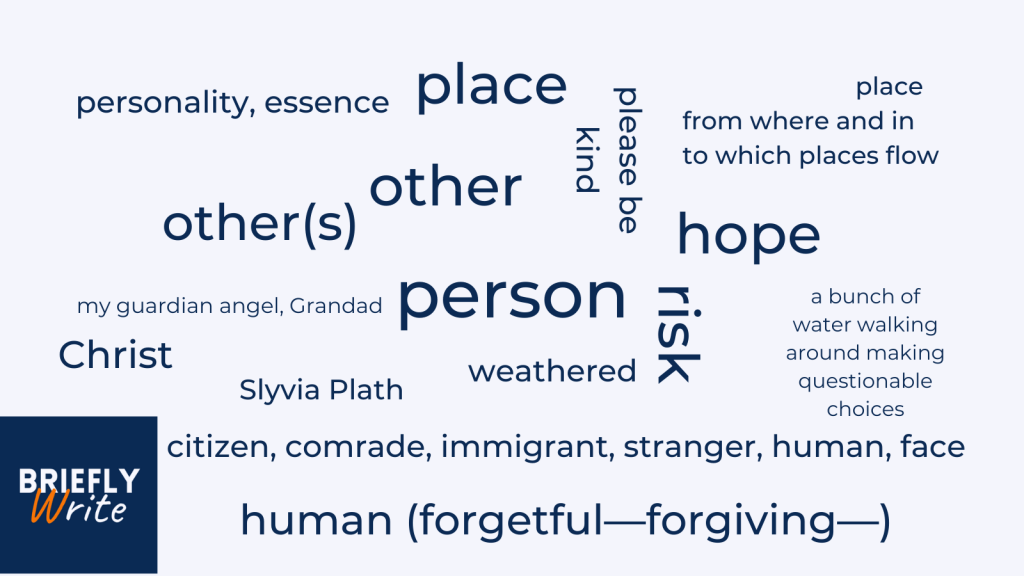
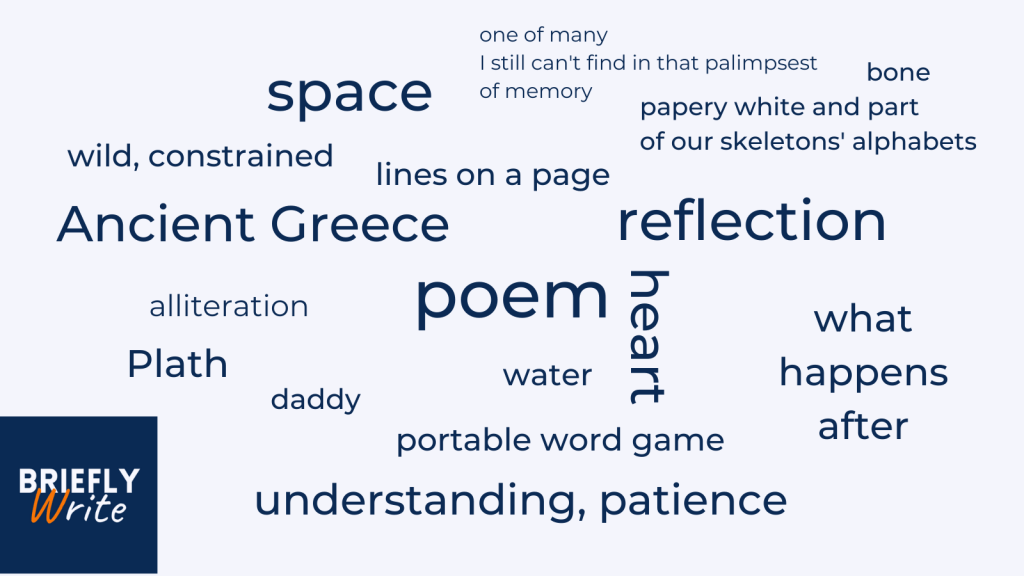
We asked our contributors to respond to the words PERSON and POEM with the first word or expression that came to mind. Here’s what they said…

Ankit Raj Ojha ~ weathered / water

Karen Macfarlane ~ personality, essence / wild, constrained

Adesiyan Oluwapelumi ~ Sylvia Plath / Daddy

Thomas Mixon ~ place / space

Beattie ~ Christ / Plath

Sarang Bhand ~ hope / reflection

Lawrence Bradby ~ citizen, comrade, immigrant, stranger, human, face / portable word game

Jayant Kashyap ~ human (forgetful—forgiving—) / understanding, patience

Ian Ledward ~ When I think these words, | turmoil fills my mind | with faces, things | and places left behind. | The Poem: one of many | I still can’t find in that palimpsest | of memory. People: please be kind.

Debra Williams ~ other / lines on a page

Halle George ~ a bunch of water walking around making questionable choices / what happens after

Ilias Tsagas ~ other(s) / Ancient Greece

Mark Goodwin ~ place | from where and in | to which places flow / bone | papery white and part | of our skeletons’ alphabets

Leanne Drain ~ my guardian angel, Grandad / alliteration

John Ganshaw ~ risk / heart


Want more Briefly?

Everything in between

Carla Sarett, She Has Visions (Main Street Rag, 2022)


Between ‘Once, dying bees fell on me as I slept naked’ and ‘All I have left is | my departure’ is Carla Sarett’s transformative debut collection that interrogates grief, reality, the realities of grief and the griefs of reality.

The collection, like the poet, is in search of meaning. Following a life-shaking moment of grief, the foundations of life and death are unstable; previously sturdy landmarks have been uprooted – or vanished. In the collection’s opening poem, the poet wonders, what if,

[…] I forget what I am supposed to do
with all of this living and dying
and everything in between

Throughout the collection, there are more questions than answers – and deliberately so. She Has Visions is full of places and empty spaces. ‘I slept through most of Idaho,’ the poet states, ‘I missed the Snake River, the cracked black | dunes the astronauts trained on’. In absence is presence and in the present is absence. In many cases, the landscape is still standing but has been hollowed out: ‘No one’s playing at Oracle Park’.

Sometimes betweenness becomes an end point: ‘I waited for you at baggage claim until there wasn’t any luggage | […] You got lost somewhere between Terminal A and Terminal B’. Everything in between is the emotion, the personal stories and struggles that get blurred by cold, hard facts.

Temporal vagueness goes hand in hand with spatial nothingness: ‘April is not the cruelest month | […] This month is’. Although details are left out, the reader feels their force with acute precision. Misplaced calendars and repeated reference to Times Square bring a hyper-awareness of time into further relief. Memory imposes distance at the same time it brings closeness, reinforcing that the remembered events happened ‘a lifetime ago’.

I woke up thinking of a poem I had written,
but forgotten.

Aphorisms abound – ‘goodbyes never happen once’; ‘Only the living | need space and time’; ‘Everything’s new here, fresh from ruins’ – though the language always maintains a freshness that defies old patterns. Like its surprising guest list – John Wayne, Greta Garbo, Hecuba – She Has Visions is a patchwork of reality, imagination and myth. It is a collection that will leave the reader changed too.


Carla Sarett, She Has Visions (Main Street Rag, 2022). Available here:


Conversation with Carla Sarett, author of She Has Visions

Daniel: She Has Visions explores many realities, with imagination, myth and memory all cleverly interwoven. When writing these poems, did you have an overall “vision” for what you wanted your debut collection to look like?

Carla: Many of these poems were written in the crucible of grief following the sudden death of my husband in December 2018. That year then flowed into the global lockdown for COVID. In that period, I changed into the woman who wrote these poems. No one has been more surprised than I at the change. This book is for Paul Messaris, forever and ever and ever.

D: One of the most interesting / intrusive / human aspects of reading poetry, for me, is gaining access to the innermost thoughts and feelings of another person. But literary devices and poetic masks can cloud the words and leave a reader unsure how to respond to the first-person voice. What are your views on how personal lived experience translates onto the page? Does making a “real” event / person / feeling into a poem obscure or illuminate them?

C: Meditation gives me a framework to think about “personal lived experience.” We feel alone in moments of grief or alienation; but these feelings are themselves shared.That is reality. Every moment is fleeting – we inhabit a sea of different feelings and thoughts. Grief, I learned, isn’t 24/7 – it ebbs and flows in random ways.

To me, a poem attacks the randomness of feelings; if they were orderly, they’d become an essay. A poem makes order from a clash of ideas and feelings. I take a tour of The Alamo, and I’m crying. I look at a Bronzino painting and I see my dead brother. My walks through city streets become wells of memory. The poems in She Has Visions (even the surreal ones) do contain “real” memories, but refracted through the lens of loss.

So, to your point that the first-person poetic voice can “obscure” experience – I think I’d say poetry is a form of changing the experience. In She Has Visions, I am changing loss into …well, whatever my new life is.

D: That’s very moving what you say about the randomness of grief. As you say, poetry, like grief, is a complicated landscape of both solitude and shared experience. Within this contradiction is a battle, apparent too in how you described poetry as ‘a clash of ideas and feelings’. How does this idea of combat present itself in your poetry?

C: I do feel that if there’s no clash, there’s no poem. I have to be grappling with some bit of paradox, as in many of my poems about paintings. In ‘Saint Sebastian’, I view the Mantegna, and afterward am seized with “my departure” – the image offered the sublime, but now I’m thinking about food.

So, on the one hand, we want to experience the pure present – but that moment is (paradoxically) crowded with memory. I think in a lot of the poems in She Has Visions, I am trying to sift through the layers of loss, whether they’re aesthetic, personal or cultural.

D: I get what you’re saying about the multiple layers of the (ever-shifting) present. I also think this applies to how we read and respond to poetry: we can react differently each time we approach a text from a different temporal or spatial reality. As you write new poems (and books), do you feel like you are “recording” a particular time and place? If so, where do extra-temporal “events” (visions and hallucinations) fit into this?

C: I don’t feel that I am recording in a journalistic sense as I write. I don’t worry, for example, what did I really wear? But I am building on incidents and the emotions that accompany them. A good example in She Has Visions is the poem, ‘The Fourth Floor’. I’m riding my condo’s elevator, feeling my age – and then drift into “visions” of burials of Bronze Age women. So, the colours and beauty of the burials become my focus. The leap (i.e. to the Bronze Age) is what my brain just “does” whether I’m writing or not.

D: That’s fascinating, thank you, Carla, for such insightful answers. I notice you’ve released two more chapbooks this year. Can you say something more about these?

C: I love chapbooks, and what they offer – continuous threads, a burst of writing. WOMAN ON THE RUN (Alien Buddha) is a set of poems inspired by the themes of film noir – danger, cities, loss and of course, femme fatales. The poems sit at the intersection of feminism and noir, and the tone is stark and edgy. Some micro-poems too.

MY FAMILY WAS LIKE A RUSSIAN NOVEL (Plan B Press) is a series of memoir poems about my childhood and my older brother’s death. The poems (often prose poems) swerve between the a child’s point of view, and an adult’s, between enchantment and knowing.

D: Thank you, Carla!

C: Thank you for these thoughtful questions. They made me reflect on the “why” of writing poetry.


Carla Sarett, She Has Visions (Main Street Rag, 2022). Available here:

Holding smoke

David Greenspan, One Person Holds So Much Silence (Driftwood Press, 2022)


One Person Holds So Much Silence is a poetic experiment with far-reaching sources, an evasive methodology – and eccentric yet riveting results. Dense in places, whimsical elsewhere, the collection is an unflinching but frustrating meditation on language, the body… and cigarettes.

For a debut collection, David Greenspan’s project is nothing if not ambitious. His landscape takes in Wyoming fields, ‘vulgar Florida’ and fragmentary, anonymous cities. The poetry is bold and lively; it seems, at times, to surprise itself – like a symphony orchestra, spontaneously and collectively choosing to move from playing Liszt to Lady Gaga then John Lennon… then lacrosse.

Encounters take place on ‘this illegible night’, where indistinct landmarks enclose the poetry in its own self-contained world. It is a world where the protagonists are small, often knowingly insignificant. Florida does not need its human storytellers; it is ‘home to countless endings of its own’.

The themes can be dark. ‘The first time my father cut himself’ is a challenging poem but one that moves the reader closer to some form of revelation. Some lines stand out, demanding to be re-read,

A seed had been planted
beneath his facial hair
and that isn’t the right place
for a seed […]

Amidst it all, the body – and, in particular, the tortured body – is central. The poet asks, ‘how many times can I pick out | my eyelashes before they stop | growing back’? Elsewhere, he evokes ‘Splotched yellow teeth softishly | decaying’ and states, ‘my skin has a zipper. Most days | I pick, pick, pick & is that nostalgia?’ Despite all this tearing, the body won’t stop expanding,

One day we’re going to die
& isn’t that alone enough of a reason
to sit here & watch our nails grow?

A bizarre Q&A-style poem, ‘Where are the worms in my mouth brother in your mouth’, occupies a dozen pages in the middle of the collection. What message can a reader pluck from these eclectic pages? The impossibility of answers? The futility of asking questions? Faced with the words, ‘Q: Dear selfish chemical, do not resuscitate’, on an otherwise blank page, it is hard to know where to begin.

The “real” Q&A, included at the end of the book, provides engrossing insight into a creative mind. ‘Poetry seems good at detecting/recording shades of uncertainty, multiplicity, expansiveness,’ David writes, in response to a question from interviewer Jerrod Schwarz. Ambivalence is certainly key. The mantra-like statements in ‘Three: The Dead’ are fitting: ‘we lived with memory | we have no answers’.

History and its smudginess are acknowledged throughout; the recurring ‘incomplete histories’ are some of the best poems. After memories, cigarettes are another prolific reference: ‘Our oldest friend nicotine’… ‘aluminium in my lungs’… ‘when we snuck out of class & smoked cigarettes’… ‘sour cigarettes’. The poems are as transitory as a puff of smoke; as enduring as the effects of smoking on the lungs.

Subtlety dwells within even the most jam-packed poems. In ‘Other Noise’, buried deep beneath the ocean, sidewalk, newsprint, tomatoes, pears, apple trees, Greek myths, concrete, ice cream, squirt guns, surgical plates, semiotics and paint thinner, are the haiku-esque lines,

we made a self
a fugitive choice
mirror of ache […]

These lines stand out for their slow, contemplative nature despite, or perhaps, because of, the abundance of imagery either side. In the Q&A, David confirms that isolation and context are at the forefront of his mind: ‘What is a specific line saying or doing when freed from the context of what comes before and after?’ This ‘self’, this ‘choice’, this ‘ache’… these are the silences held by one person.


David Greenspan, One Person Holds So Much Silence (Driftwood Press, 2022). Available here.

Control and chaos

Kris Spencer, Life Drawing (Kelsay Books, 2022)


Eclectic in its themes, subjects and forms, the poems in Life Drawing are bound together by the verve and verbal freshness of Spencer’s observations

Kris Spencer’s debut collection is chaotic and carefully controlled. Formally, the poems chop and change: classical odes sit side by side with free verse; sprawling lines reach across to prod the contours of narrow shape poems. Some poems contain recipes; others erasure and repetition, or enjambment and a jumble of references that span centuries and continents. All poems achieve a rhythm that keeps the reader turning pages.

The poet has a deep respect for odes but is not afraid to remodel and modernise. Part Two opens with a self-aware erasure poem, ‘Ode to Jean-Michel Basquiat in Which Certain Things Are Crossed Out’. In this poem, the self-effacing poet paints himself into the world by continually adding and removing lines even before the original has had time to settle. Brilliantly, in the closing lines – ‘This day is too light | Somebody SHUT the door’ – the erased verb could be an imperative in response to the light or an explanation for it. Through this ambiguity, Spencer creates more open doors than closed ones.

The ‘Ode to Jean-Michel Basquiat…’ also contains a stroke of genius in the positioning of an allusion to Beyoncé’s Single Ladies (Put a Ring On It) immediately before a crossed-out line from Hamlet’s address to Ophelia at the end of To be, or not to be. Such linguistic playfulness fills the pages of Life Drawing.

Alongside grandiose literary and classical allusions, small details of family life also nestle cosily into place. In ‘Enough’, the simple joys of the present are a refrain: ‘Today, we give our daughter some pencils… | Today, our son rides a bike…’. In these isolated instances, life is stripped back to its most basic foundations; the poet’s sincerity of expression propels the reader to adopt a childlike innocence too.

The intimacy between artist and subject suggested by the collection’s title courses through the poems’ veins. Life drawing requires attentive observation and a willingness to commit to seeing that which is right in front of us. Like an artist’s attempts to reduce the complexity and changeability of a real-life scene to a single (undoubtedly flawed) interpretation of it, the poet’s task is similarly imperfect.

Unsurprisingly, human bodies occupy large swathes of space in Life Drawing. Even so, some of the collection’s best poems have no human subject at all. One particularly interesting set of recurring images involves birds. The poet looks at birds with open eyes, steering clear of tired associations that plague too many animal poems. Instead, Spencer has a keen eye for observation and discovery, as well as a freshness of expression.

‘Magpies’, first published in Issue 6 of Briefly Zine, and ‘The Enormous Matter of Landscape’ provide contrasting examples of man’s destructive capabilities. In the former, humanity’s selfishness costs cackles their chance at life. The poem’s claustrophobic form, tragically paired with the image of the ‘plastic bag’, gives way to a much freer expanse in the latter. Nature has returned – ‘hills’, ‘old reeds’, ‘insects’ – accompanied by the poet’s much-loved ‘Brightness’. The human subject, ‘drunk | in the afternoon sun’, continues to embarrass himself, but now the panorama has zoomed out and rendered man an insect. Even if the inebriated poet is barely aware of wings soaring above him, he is at least self-aware enough to admit he does not control the surroundings: ‘I cannot say this is my place.’

A similar perspective-shift occurs in ‘We Need to Find a Forest’, one of the collection’s most subtly urgent poems,

In a moment, I see the world through my son’s eyes.
Following ants on the pavement,
crouched and earnest, he says:
They won’t ever know we are here.

The sincerity of the child’s words cuts deep. In a world on course for climate catastrophe, ‘with the light failing’, the poet cannot help but be affected by the innocence of his son’s remark. The title’s urgency comes from a stinging awareness of a future without the self and a recognition that chaos is close.

Indeed, the collection closes along similar lines, with ‘The Song of the Self’, a Sanskrit-inspired poem that sheds more light on the complexity of the human subject. ‘The Self lies beneath five layers, | felt through the scratch and flare of the Self’, the poet states enigmatically. As such, ‘When the five veils unpeel… | the Self lies revealed through the reflection of all that moves and changes’.

Life Drawing is a debut collection that doesn’t stop moving. Its poems flit between layers, keeping the reader guessing what is revelation and what is reflection. It is a collection that speaks to a changing world.


Kris Spencer, Life Drawing (Kelsay Books, 2022). Available here (US) or directly from the author (UK) via email: spencer.j.kris@gmail.com
Conversation with Kris Spencer, author of Life Drawing

Daniel: Life Drawing is a wide-ranging and far-reaching debut collection. For how many years were you sketching, shading, re-painting and putting the finishing touches to the book?

Kris: I started writing poetry a couple of years ago and soon became hooked! I wrote five poems in quick succession. Thought I was Auden. I was writing to myself; getting that great feeling we all get when we create something. I wrote all summer. Sent my poems off to journals but nothing was happening. I realised I was off the mark. But I think it was useful to have written this off-the-mark poetry.

Then I got three poems accepted. It gave me a boost, at the right time. I wrote some new poems. Through the Poetry Society, I was able to show these poems to Rachel Long. Speaking with Rachel was crucial. She gave me some great advice. More than this, she was able to share and communicate her joy of poetry. It was a huge boost. That’s been my approach since. Work, re-work, re-work again. And, then, when it all gets a bit gluey, I show my poems to another poet.

D: These are some really helpful points about the need for collaboration and conversation. Poetry is essentially dialogue: speaking to other poets always helps unstick things.

K: I found, for Life Drawing, the Ode poems were helpful too. They gave the collection a punctuation. The chapter quotes were also useful. And I worked with a great editor at Kelsay Books. She was involved, and had an excitement for the project.

I have also benefited from your feedback at Briefly Write. Useful, warm, authentic. By the way, how do you approach feedback on poems?

D: Thank you! First (and foremost), we read with great respect for the words on the page. Writing can be a deeply personal experience and, as readers, reviewers or critics, we should never underestimate this. Second (and contradictorily), we try to read without fear. After reading the same lines time and again, familiarity can cloud the poet’s ability to “see” their own words clearly. Fresh eyes can help with that. Third (and crucially), we do not try to “correct” anything or find the perfect solution. Poetry is subjective; every writer and reader bring unique layers of meaning to a poem.

K: It is so good to hear your reassuring answer. I recognise that warmth and respect from my own experience of working with Briefly.

D: One meeting point between the individual and collective is popular references: we might all know the same names but we have different experiences of and reactions to them. The range of references you call upon in Life Drawing is vast, from Confucius to Iggy Pop, Pikachu to Goya. What common threads hold together these diverse creators and creations?

K: I think we have to be careful. Firstly, to give our readers credit that they can delve into and get references. And, then, to also guard against things that are obscure or highfalutin’. I do try for this balance. Referring to a work or a person can work in a poem as imagery – it’s also pretty concrete. Undoubtedly, it can also help to authenticate a poem (whether the reader buys into this is another thing). I would not want to refer to something or someone just for effect. So, in that, there is an element of curating. I think a fair bit of how I write is about curating.

I also think it’s more than just wheeling out our heroes. I wrote a poem about Elvis. He means much less to me as a musician than, say, David Bowie. But there is more space around Elvis, and so I was drawn to writing about him, and Priscilla. I once visited Graceland. Carrying all my British irony. The reality was that there was no irony for my fellow visitors, or in all the diners and bars around the site. Just love and respect. It was a sharp lesson. So my poem has some sadness and ennui, but no irony or postmodernity. (I still haven’t seen the film but I suspect Baz Luhrmann went the same way.) I wrote an ode to Jean-Michel Basquiat which aimed to mimic one of his paintings. So that was pretty literal.

D: That’s a fascinating way of putting it. For everything we write, there are a billion possibilities of words, images and references we could use… but ultimately we must settle for a select few in each poem. Can you say a bit more about your experience of ‘curating’ your first collection? How did you decide the poems and messages you wanted to include or exclude?

K: I was interested in colour and light. In this collection not every poem ended this way but that was something that I fell back on, probably too much. Colour and light are my happy places in terms of imagery. For this collection, these were all the poems I had, and I was writing up to the wire. My choice of inclusion, for the most, was based on whether the poems had been taken up by a magazine or journal. I have a very poorly developed sense of what poems will work for other people. I get caught up in the act of writing.

Quite a few poems are about my children and my wife. There were some which were more experimental (in my head, at least). And then some that were about art and creativity. I put each group together as best I could, and then tried to find a bit of rhythm in how they were placed against each other.

It may all be moot, all this time spent curating. Whenever I pick up a poetry book, I start in the middle. I can’t read a lot of poems in one sitting. But I do go deep when I find something. It’s a bit like visiting an art gallery – after four or five great paintings I’m looking for the café. In terms of messaging, in a way I am writing for my children as adults (they are seven and nine, at the moment). So, even in the darker poems I want to communicate a respect for people (and words). And, I suppose, the importance of looking up and noticing things in the moment and on reflection.

D: Projecting your poems into the future raises some intriguing ideas about time. One of my favourite poems in the collection is ‘Imagine’, in which you hypothesise a (Lennon-inspired) utopia… without people. ‘Imagine you were the last person on Earth,’ the poet muses, with the power to bring eight billion humans back: ‘Would you do it?’ Do you have an answer to that question?

K: The answer takes us out of the realms of poetry! I think this has become a central question for us all. Are we humans inexorably flawed? We do terrible things, as a species. But we also do beautiful, kind and wonderful things. I am of a view that, for the most, we do those great things for ourselves. And yet as a teacher and father I have great hope in our young people.

It is in my lifetime and my generation where we have messed things up in terms of the environment: the rise of central heating in every room, motor cars, affordable foreign travel, plastic, globally sourced supermarket produce… supermarkets! And, yet, having said all this I would be reluctant to give up any of these (apart from maybe plastic and out-of-season raspberries) for the greater good. That’s the problem. I am the problem.

It’s going to be around 10 billion people by 2050. Then we stop growing. 25 years, or so, to make things better. I don’t see it. The world seems to be dividing rather than uniting. The future looks to be a chilling prospect. We must believe that science and technology have what it takes to get us out of trouble (if we can’t trust our governments) but science and technology got us here in the first place.

D: Let’s return to poetry then! One of my favourite poetic techniques is enjambment (where meaning spills over the end of a line). You use this to great effect in the title poem where you write, ‘Like Velásquez looking at | the Infanta Margaret Theresa’. In this way, the end of the line opens up a hundred possibilities for seeing differently. The reader is forced to pause (albeit momentarily) to ponder where the painter is looking… and it is fitting that the answer is one of the subjects of Las Meninas, his enigmatic perspective-shifting painting. To what extent do you use spaces outside the poem to change meaning within?

K: That’s a lovely question. Not least, because it was so daunting to me, when I first started out. The basics that you need to write a contemporary poem. You have it spot on – to my mind the white space around the poem is the key. Certainly, to lyric poetry. I think the shape of the poem is everything. If the lines are boxed that means one thing. If you have a line jutting out – why? I am no expert on enjambment. I am more interested in the shape of poem: if you scrunch your eyes up what does the poem look like on the page?

But there is no doubt that you can have bad line breaks, and also good ones which, as you say, open things up or suggest a question – or leave something hanging which might even suggest a second meaning. I like to write long, thin poems; when you have lots of short lines it is mostly about sensible breaks but sometimes you might happen on something that adds to the meaning and flow.

As an aside, one thing that amazes me is the power of the tercet. You write a long, dense, single stanza poem – redress it as tercets (or couplets) and suddenly the poem has some air and it looks fresh. Why is that? And I should end by saying Las Meninas deserves a poem on its own. Such a thing.

D: This has been an illuminating conversation. Thank you, Kris, for shining more light on your (brightly lit) poems. Any closing remarks?

K: How to close things up? I have found our dialogue to be a lovely thing – beyond that, it has been enriching. I say this selfishly, on a wholly personal level (I have written two poems since we started this, informed by what we have talked about). It makes me think of dialogue and collaboration in poetry. I have been helped by a number of very well established poets. I wonder if there is any other art form where one can have access to the great and the good so easily. And with such warmth. Ted Kooser says there is no money in poetry, that is what makes it great. But, we do need enough green in the system to keep journals and competitions – and poets – moving happily along. Have you any thoughts on what a sustainable future for poetry might look like?

D: ‘The future of poetry’ seems beyond the scope of our little literary space! There are a lot of things we want to achieve with Briefly Write but the fringes are a comfortable place for a small journal like ours. It’s great to hear, though, that our conversation has fuelled more poetry! Do you know where your poetic journey is going to take you next?

K: My thoughts are now on my next collection, which I know is not a foregone conclusion. That great uncertainty that we talked about earlier. I do think poetry gives us an excuse to look at things, an excuse to notice. And then, the writing of the poem gives us the chance to measure ourselves against the thing – are we up to communicating what we see? From my perspective and experience, one can only get close if you listen to where the poem is taking you rather than force or lead the meaning. Easier said than done, but one might think it is there for a moment. And, that’s more than worth all the trying.


Kris Spencer, Life Drawing (Kelsay Books, 2022). Available here (US) or directly from the author (UK) via email: spencer.j.kris@gmail.com