Fire & Heat

Sarang Bhand


I would like to humbly disagree with the idea of a person/poet and poem being separate in the first place. Borrowing an analogy from Vedanta’s teaching of ancient seers, I would like to state that ‘As one cannot separate clay from the earthen pot, one cannot separate a poem from the person/poet.’

A person is the sum total of their ego which is limited to their experiences in life. It is these experiences of life that nourish thoughts and these thoughts in turn act as the catalyst that germinates a poem. Whether it is melancholy or joy, the degree of it is unique to the person experiencing these and the person/poet expresses these emotions in their unique voice in the form of a poem.

Maybe there is an element of commonality in the themes of experiences experienced by different persons and there is a commonality of emotions that we all experience as humans. Maybe that’s why we perceive a piece of poetry to transcend beyond the person/poet when it gets related by others. But the language used, the selection of words to craft that poem, and the intended meaning conceived within the poem still belongs to the person/poet who chose to express them under specific circumstances of their life experiences. And thus, in my humble opinion, a poem cannot be separated from the person who crafted it. A person/poet and the poem are inseparable as fire & heat. A poem cannot begin where the person ends.


It was an interesting prompt and almost instinctively I chose to respond on how I felt about the statement. I wanted to have an objective approach to support my instinct and thus I attempted to deduce the relation between a person/poet and their poetry. Keeping it brief was a bit challenging but then brevity is the sharpest arrow in a poet’s quiver.


Sarang Bhand is an entrepreneur working in the clean-tech space. When he is not troubleshooting projects, he likes to explore writing, photography & painting. See his bio here and writings here.
Who owns poetry?

Beattie


In 1963, Sylvia Plath died. Her estate passed to her husband, Ted Hughes. By 2003, Ted Hughes was dead and Frieda Hughes, their daughter, became literary executor of both estates.

In 2003, a film about Plath, Sylvia, was released. Frieda Hughes was not keen. She refused requests to take part and denied filmmakers the right to use Plath’s poetry. In her poem “My Mother,” Hughes writes of being asked to “give them my mother’s words / To fill the mouth of their monster / Their Sylvia Suicide Doll.”

My critique is not with Hughes’ assessment of the film. Sylvia leans heavily into the trope of Plath as a “witchy death goddess,” as identified by biographer Heather Clark. Gwyneth Paltrow, playing Plath, is perpetually nervous, brittle. I doubt that the presence of the poems would solve this issue, but their absence surely worsens it.

Rather, my critique is with the model of ownership. Frieda Hughes did not write those poems. I do not wish to single her out. I do not object to her profiting from Plath’s work, not least because of the repeated tragedy she has endured in being Plath and Hughes’ daughter. But I object to monopoly. In the absence of the poet herself, the poems live on in the reader. And I believe in the right of readers to respond to those poems, even when that response is a frankly terrible film.


I attended a workshop on ‘Plath as poetic inspiration’. Faber, managing Plath’s estate, only granted permission for a session *about* Plath. We could not look at Plath’s actual poems, only poems responding to her. This sparked questions about poetry and ownership. 


Beattie is a writer and lapsed drag queen from Merseyside. You can follow them on twitter (@poofter_pontiff).

Syllables’ Irreverent Borders

Thomas Mixon


There are moments when I’m something outside language. In these grunts, gasps, these gaps where, yes, there may be thought, but no words, there can be no poem. Poems may begin in spaces absent of intention, but they take shape in syntax.

I come to an end, so many thousand times a year. I pause, listening, my ears flexed, quivering as feee-beee morphs to something I call chirp, as whoooosh changes to bird, inside my mind. I fall asleep, I eat, conceive of nothing as I crunch my way through Corn Chex.

Whitman may have wanted the United States to be his poem, but a poem can’t be a place any more than I can. As I live inside a country, a poem is resident to syllables’ irreverent borders.

My favorite time to be a poet is while swimming – every third breath my head emerges from the pond. Sometimes I zone out, exist in images untethered to specific pitches. But often, the literal splashing rhythms conjure phrases, in an urgent triple meter. If I do not write it down, it’s still a poem, since there are nouns and verbs nestled together. I hesitate to call it order, or logical, but it isn’t random.

It was a phoebe, I was hearing. An animal we named after the noises that it makes. I reach my hand, sing out. But it’s gone. When I am in the ground, the poems I’ve made will still reverberate because they have a home, in sound.


A sentence is a set of steps next to a sometimes wobbly railing. If one of us falls, will the other reach out? Will we eschew carpentry, or learn to carry nails?


Thomas Mixon has fiction and poems published in RattleSundog LitAt Length, and elsewhere. You can find him on Twitter (@truckescaperamp).

Self-Portrait as a Poem

Adesiyan Oluwapelumi


I am sitting in my study, the words of Anne Carson’s book, Autobiography of Red, before me. My reading lamp sits illumined: my way of euphemizing that I’m merely reading a book and not divulging into the life of a seclusive persona.

As I read, I am overwhelmed by a myriad of emotions; happiness and sadness, death and life into a perfect mish-mash. I reason Carson could not have experienced this. How could she? She was a mortal with an elastic endurance!

The pages, as white as fleece, bleed the tears of a woman in agony and I can smell so clearly the putrid stench of crimson oozing.

Sometimes, I wonder if she was as honest as this – an open book. Did she want to publish this book or was her life just the right “fiction” readers wanted to feast their cinematic eyes upon?

All I know for sure is before me lies a woman supposed to be cremated, the pages her skin and the words her innards.

I am dissecting her, looking for something undefined. How could I find a story in a woman when she was the story?

I dig into her like an archeologist in search of buried secrets. I do not apologize for my discourteous infringement.

As I read, I imagine, if in a conversation, would she be as intimate and open as this.

But isn’t this where it bridges, the poem defying to be just a poem.


Poetry to me is more or less a confession, a metaphorical bloodletting. It defiles revealing the poet’s blood only and instead seeks to bleed


Adesiyan Oluwapelumi,TPC XI, is an African writer whose works particularly present a social commentary on the intersectionality between memory, language, identity, religion and selfhood.

Tracks, flight-paths and bee-lines

Karen Macfarlane


Where implies a place, a location, a point you can reach, and exist, and leave. While the ‘where’ of this question is obviously a metaphorical place, it can at least be imagined as though it were a physical one. Let’s suggest it might be a clearing in a big old wood, with lots of paths leading to and from it, from marked rights of way down to rabbit tracks, not forgetting flight-paths and bee-lines. The ways in and out of this clearing are important, because when we consider the person who begins and ends here, there is not only one person.

There’s the poet, who carried their poem along the pathways of their life to leave it here; and all the readers who have arrived on their own paths from different starting points. You could imagine the poem creating an image within this clearing, maybe a shaft of sunlight falling on an oak leaf on the forest floor. Every person who sees it will have their own viewpoint and this may change, depending on the path they arrived on today. And that brings me to my point: that this place will be constantly shifting a little, this point where the people involved in the poem begin and end, and the poem takes on a life of its own. Because all life exists in relation to the other lives around it; a poem, if it’s alive in any way, most of all.


The question immediately made me think of a physical place and I found it interesting to have a metaphor to explore the subject. I’ve worked in healthcare for 30 years and have to write very concise case notes, so writing briefly comes naturally.


Karen Macfarlane is studying for a BA in Creative Writing. Her poetry appears in magazines including Poetry Scotland, Spelt, Green Ink and The Poets’ Republic. See more.

Becoming Poetry

Ankit Raj Ojha


I toy with words on my phone in between lectures and am poked by colleagues: “Why can’t you just relax?” In my defence: I do relax; words are one of the ways. This I tell them. They are baffled: “All these poems you write, for free? You do have a job. Why not get a life too?” I half-reckon then abandon the urge to tell them that it’s often the way work and life are perceived: pigeonholing sires the need for the elusive work-life balance. As for my equation with poetry, I do it for the same reason birds fly, fish swim, and infants cry: the inescapable requisite, and the sheer joy and gratification it brings. It’s true that I look for paying magazines to rationalise the urge, but not always. It is a relief when words done for free make me skip meals. I recall Joey Tribbiani’s words: “There are no selfless good deeds”. The self here is the chance to be myself, if I am to repeat the cliché. So it’s no longer the point of something being a good deed or not if it is second nature. I think of the people deemed “a joy to be with,” and wonder if they are like poems. I long to be one, to attain a state where the person ends and the poem begins, where the two bleed in and out of each other until equilibrium sets in and the two are one; it is one. 


Expression is one of the greatest joys of being alive. When pondering over the person’s end and the birth of poetry, all I can hope for is an osmotic flow that melts the fence. 


Ankit Raj Ojha is a poet and assistant professor from Chapra, India. He is the author of Pinpricks (2022) and editor at The Hooghly Review.

Ankit’s essay is the winner of our Featured Essay prize and was awarded £20.

Briefly Think ~ 1

Where does the person end and the poem begin?

Briefly Think ~ Where does the person end and the poem begin?

Who owns poetry? Where does a poem begin? Can you catch the setting sun?

Briefly Think is a tiny new chapter for our little literary space. Open-ended, endlessly thoughtful, thought-provoking, provocative questions. With answers that can be non-answers, half-answers or, simply, answers.

After receiving an incredible response to our first call for submissions, we have chosen 15 essays that do something interesting, entertaining or troubling with the prompt. Each one sparkles, sizzles and stretches language and meaning this way, that way, those ways… whether reflecting on dreams, space, myth, language, politics, memory, time, art, language or all of these things at once.

A poem is space, alliteration, what happens after. It is a portable word game and patience and lines on a page. A person is place and essence and hope and risk. Personality, forgetful… forgiving: a bunch of water walking around making questionable choices.

Our contributors have created and crafted short essays that demand to be re-read. The accompanying quotes and word associations complete the picture, cast new light or contradict everything that has gone before.

Happy reading! Please do let us know what you think.

Daniel & Elinor


I

Ankit Raj Ojha, ‘Becoming Poetry’ (& Interview)

Karen Macfarlane, ‘Tracks, flight-paths and bee-lines’

Adesiyan Oluwapelumi, ‘Self-Portrait as a Poem’

Thomas Mixon, ‘Syllables’ Irreverent Borders’

Beattie, ‘Who owns poetry?’

II

Sarang Bhand, ‘Fire & Heat’

Lawrence Bradby, ‘Writers Making Space’

Jayant Kashyap, ‘On Beginnings: Person and Poem’

Ian Ledward, ‘Can you catch the setting sun?’

Debra Williams, ‘Ouroboros’

III

Halle George, ‘The Moment’

Ilias Tsagas, ‘The DNA of Poetry’

Mark Goodwin, ‘The Person End of the Poem’s Beginning’

Leanne Drain, ‘Poetry is the true art of getting better’

John Ganshaw, ‘River of Life’


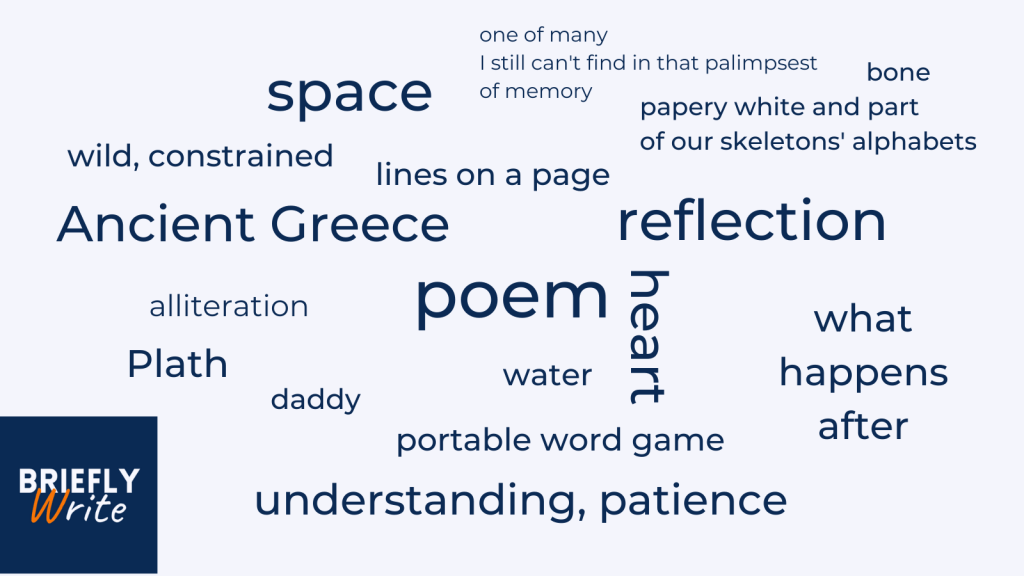
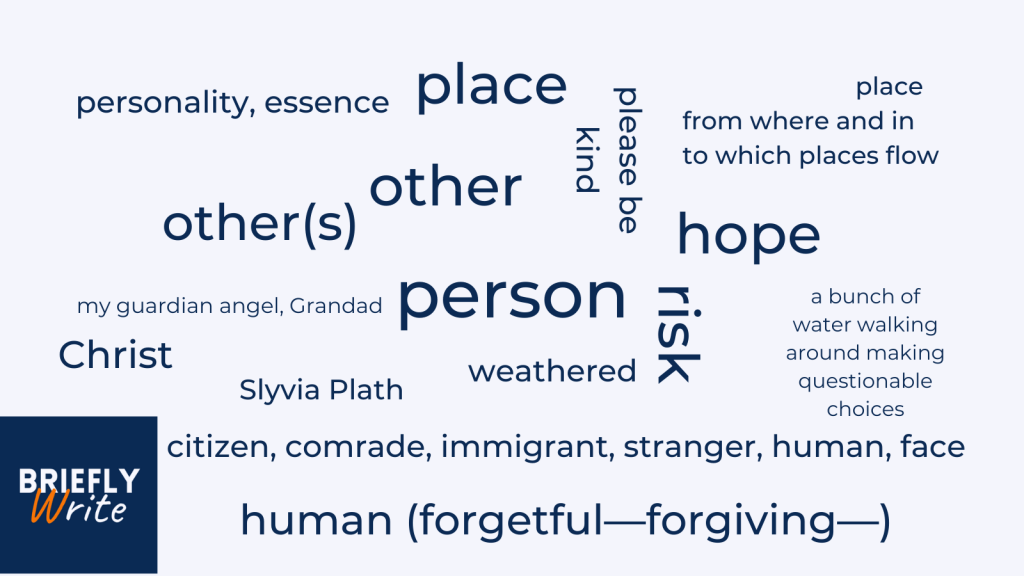
We asked our contributors to respond to the words PERSON and POEM with the first word or expression that came to mind. Here’s what they said…

Ankit Raj Ojha ~ weathered / water

Karen Macfarlane ~ personality, essence / wild, constrained

Adesiyan Oluwapelumi ~ Sylvia Plath / Daddy

Thomas Mixon ~ place / space

Beattie ~ Christ / Plath

Sarang Bhand ~ hope / reflection

Lawrence Bradby ~ citizen, comrade, immigrant, stranger, human, face / portable word game

Jayant Kashyap ~ human (forgetful—forgiving—) / understanding, patience

Ian Ledward ~ When I think these words, | turmoil fills my mind | with faces, things | and places left behind. | The Poem: one of many | I still can’t find in that palimpsest | of memory. People: please be kind.

Debra Williams ~ other / lines on a page

Halle George ~ a bunch of water walking around making questionable choices / what happens after

Ilias Tsagas ~ other(s) / Ancient Greece

Mark Goodwin ~ place | from where and in | to which places flow / bone | papery white and part | of our skeletons’ alphabets

Leanne Drain ~ my guardian angel, Grandad / alliteration

John Ganshaw ~ risk / heart


Want more Briefly?