I wish someone had said when I dived into that well of fear. Where were those Buddhist monks when I didn’t use the blue sink in the upstairs bathroom for years after a thermometer shattered and left numberless glass slivers and tiny balls of mercury—Death, a clinging partner, making me walk downstairs to brush my teeth & stay up all night sometimes alone with the darkness.
Sarah Dickenson Snyder’s collections include The Human Contract (2017), Notes from a Nomad (nominated for the Massachusetts Book Awards 2018), With a Polaroid Camera (2019), and Now These Three Remain (2023). She’s had Best of Net and Pushcart Prize nominations. Recent work is in Rattle, Lily Poetry Review, and RHINO. See more.
I think it might be Too hot to bake cookies but Let’s try something else let’s Try taking the night off or Building a pillow fort or Unraveling Thread by thread The ways our stories might Have overlapped had Things gone differently
Hana Damon-Tollenaere was shortlisted in the Briefly Write Poetry Prize 2023.
There was nothing. On the walk I unfolded both my arms, but not a single leaf would touch my greedy floating ribs. I knew I carried needs they were against. I carried needs. They were against my greedy floating ribs I knew not a single leaf would touch. I unfolded both my arms, but there was nothing on the walk.
Thomas Mixon has poems in miniskirt magazine, Rattle, Radon Journal, and elsewhere. He’s a Pushcart and Best of the Net nominee.
World bee day, it’s mother’s day, It’s a blue moon, it’s boba day, it’s national turtle day, it’s a Friday, it’s our anniversary, it’s the day we met, it’s your birthday, it’s your birthday again, it’s twenty years ago On this day, a picture On your phone: You were celebrating – God knows what. But still, Thank God you were.
Devaki Devay is a writer of poetry, fiction, and creative non-fiction. Their work can be found in several literary magazines, including Barren Magazine and Peatsmoke Journal, and has been included in Best Small Fictions 2023. Their debut poetry chapbook, LOOKING IN LIGHT, is out with Bottlecap Press.
face down on the street. All the way home I thought
about being lonely. I said hello to the old man in the lobby;
he told me my legs were lovely, that my husband had better
watch out.
Alice Louise Lannon is Scottish poet and writer of creative non-fiction, currently living in Vancouver, Canada. She holds an MLitt in Creative Writing from The University of Glasgow. Her publication credits include: Wet Grain, From Glasgow to Saturn, Querencia and Last Stanza Poetry Journal. At the moment, she is working on a book about the sea & storytelling & women’s narratives.
in a search of arms, I found pebbles along the way: unwanted truths that I threw back to the water
you are lonely
or maybe I misheard. How deep in the forest are we again? the clouds have gone green since, and the mud, perpendicular.
Begüm is an aspiring psychologist, who has been writing poetry for a few years now but only recently started to publicise her work. Most of her pieces are inspired by people she loves. She is now working on getting her first poetry book published.
Write 10 is the third instalment of Briefly Write‘s annual ten-word story competition. In 2021 and 2022, we followed a simple premise: Write 10 to Win 10. This year, we’re mixing things up a bit.
Theme: Destiny / History
The theme this year is Destiny/ History. Use this loosely or literally – the choice is yours (or is it?!).
We want to see creative interpretations of the prompt. We want to see a tiny story with a full narrative arc. Or a snapshot of a moment. Or a moment snapped and shot. MAKE. EVERY. WORD. COUNT.
More Winners, More Winnings
Send us ten words (plus a few more for the title). Send us a story that makes us fall out of our chairs, fall out with each other, fall into a daydream or fall head over heels. Choose your words carefully.
Then we will read them all. And again. Andagainandagainandagain. Then we will choose (carefully) the ones that fell just right… and reward them with praise, publicity and a few pound coins.
If you would like to help increase the prize pot, please consider supporting us here – every penny we receive goes towards paying writers and artists!
Competition Guidelines
Free to enter. One entry per person.
Only entries made using this form will be considered.
Story must be exactly 10 words and relate to the theme ‘Destiny / History’. Title is not included in word count.
Please do not submit work that is under consideration elsewhere. Once submitted, your entry cannot be withdrawn.
Opens: 10 December 2023. Deadline:21 January 2024 @ 23:59 GMT.
Entries judged anonymously. Editors’ decision is final.
Winning and shortlisted stories will be paid and published online. All entrants will be contacted by email.
Results published online by the end of March 2024. If this needs to change, an update will be provided here.
By entering Write 10, you are granting us first electronic rights only. Copyright reverts to the author upon publication.
If anything isn’t clear, send any queries to contact [at] brieflywrite [dot] com. Please do not email your entry.
Poetry competitions can be a controversial topic in the writing community. As a little literary space that hosts an annual Poetry Prize, even we have mixed feelings.
We want to do the best we can for writers and readers. That’s why, during the Briefly Write Poetry Prize 2022, we asked entrants to answer some questions about poetry contests. The responses we received helped shape this year’s competition. Here are the results.
Our respondents
In total, there were 412 responses. All were submitted anonymously and respondents were aware that their answers could not be traced to their entry.
Almost nine in 10 respondents (88%) had not previously submitted to Briefly Write in any form (including Briefly Zine and other competitions). Respondents were asked to answer the questions generally, not specifically for the Briefly Write Poetry Prize (except for the questions summarised in the next section).
Careful or casual?
Last year, the most popular ways that entrants found out about our competition were online listings pages (24%), Twitter (22%), search engines (17%), other social media (14%), the Briefly Write website (5%), word of mouth (3%) and Duotrope (2%).
More than four in 10 respondents (42%) wrote their entry specifically for the Briefly Write Poetry Prize, while 41% submitted a poem they had already written but had never sent to another journal or competition.
The vast majority (85%) read the guidelines carefully, though some went straight to the entry form (7%) or had only a cursory flick through the rules (7%).
Show me the money
Most respondents “never” pay to enter poetry competitions (46%), ahead of 26% who said they “sometimes” pay and 24% who “rarely” do so. Only 4% said they “often” pay, perhaps unsurprising given that the Briefly Write Poetry Prize is a free-to-enter competition.
In terms of prize pots, the result was conclusive: the most popular option was 1st – 50% // 2nd – 35% // 3rd – 15%, which received close to half of all votes (48%).
A similar option that extended to paying fourth and fifth place (1st – 35% // 2nd – 25% // 3rd – 20% // 4th – 15% // 5th – 5%) received almost a quarter of votes (22%).
The option of having five equal runners-up each winning a tenth of the prize pot (1st – 50% // Runners-up (x5) – 10% each) was favoured by 13% of respondents. Meanwhile, ten joint winners was chosen by only 6%, just ahead of winner takes all (6%).
The rest chose “Other” and offered a wide range of opinions, including one who said offering any prize money creates a “vicious circle”. Others suggested donating the prize money to charity or indicated that monetary reward made no difference to them.
Raising the funds
We have been clear since we started Briefly Write that we will never charge entry fees. Financial barriers should not stop people sharing their talents.
We do, however, rely on donations to pay our website costs and prize funds. Every penny we receive is spent directly on covering these costs: we don’t take a penny out for ourselves as editors. Each year, we have increased the prize pot of the Poetry Prize thanks to the generous support of our readers and writers – and we hope to keep doing so.
One option we have considered as a means of raising more funds whilst also providing extra value to entrants’ experience of the competition is to offer some add-on features. This could include things like short feedback or extra insights into the judging process.
Things that respondents said would add the most value to their experience of a poetry contest (besides winning) include:
A personalised email with very short feedback (54%)
An email with the results before they are publicly announced (31%)
An exclusive Judges’ Notes email (30%)
A bigger prize fund next year (27%)
Some 17% said that none of the above would encourage them to donate, while 14% said they would be donating purely to support the competition.
To theme or not to theme?
Overall, respondents preferred unthemed competitions (53%) to contests with a theme (33%). The remaining responses (“Other”) mostly expressed indifference on the issue. The result of this questions is, of course, likely to be skewed by the fact that respondents were answering after having entered an unthemed contest.
In a follow-up question, vague themes such as ‘Be inspired by X / interpret Y loosely’ (68%) comfortably beat specific themes like ‘Write a poem about X / using Y / in the form of Z’ (27%).
Don’t leave me hanging
As writers ourselves, we understand how frustrating it is to pour your heart and soul into a submission… and then never hear back. That’s why we email every entrant regardless of the outcome of their entry.
It does take a lot of time to send all these emails so we wanted to check it was worthwhile. We asked how much people valued receiving an email to say they haven’t won a competition before the results are announced publicly.
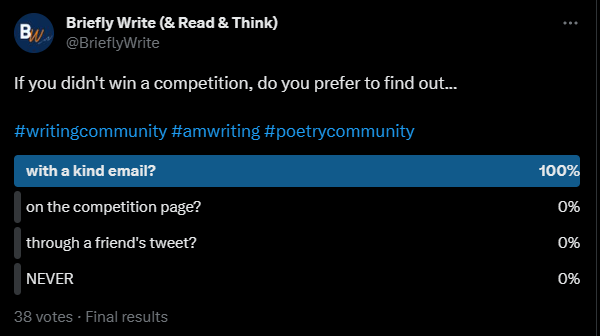
Some 62% chose “I really appreciate it and it makes a big difference to my experience of a competition”. For 31%, it was nice but not essential (“I appreciate being told but it doesn’t make that much difference to me”). Only 4% would “rather not be told if I haven’t won”. This result is supported by a recent Twitter poll we ran.
Those who chose “Other” made suggestions that could reduce the administrative burden such as an automated email to announce the winners. Multiple respondents said that no response is fine so long as this is clearly communicated in advance.
Prizes and publicity
In the event of winning a competition, two thirds wanted to make the most of the opportunity for publicity (62%), while 12% opted for “Just pay me the money”. The large number that chose “Other” reflects a flaw in the question: the intention was not to make people choose between publicity and money but to see whether they valued extra features such as interviews.
Many of the “Other” respondents said they want both prizes and publicity. Some repeated assertions that money shouldn’t mix with poetry or expressed the view that publicity and prizes are secondary to eyes on their writing: “I just want to be read”, “I want recognition for my work” and “I want to inspire people” were common answers.
In the follow-up question, the forms of publicity that winners would most appreciate included the chance to have their poem published in an anthology (75%), online publication (71%), promotion on social media (51%), an interview about the winning poem (43%) and an online feature about the poet (42%).
When all is said and done
Encouragingly, 82% said they would still read the winning and commended poems if they hadn’t won. Likewise, 79% said they read the Judges’ Notes when they don’t win a competition.
The most popular material to include in Judges’ Notes was “Insight into what made winning poems stand out” (87%) and “Insight into what made poems fall short” (55%).
An “Overview of common themes / styles / forms” was appreciated by 50%, while 41% were interested in statistics about the number of entries. The few’ “Other” suggestions we received included calls for statistics on the diversity of judges and entrants.
What are our key takeaways?
We were delighted with the level of response and thoughtful engagement our survey received. The answers reaffirmed our commitment to running accessible, free-to-enter competitions that treat all entrants with the respect they deserve.
This year, we implemented the prize pot that received an overwhelming number of votes (1st – 50% // 2nd – 35% // 3rd – 15%), despite our own instinct being to pay more writers a smaller amount. This is something we will review again for future competitions.
We will continue to email all entrants regardless of outcome. In the past two years, we have received only a handful of rude responses or arguments about why we were wrong to overlook a poem. Although rare, even these few are dispiriting.
That said, we do always welcome (polite) replies with thoughts or constructive feedback on the competition. And if you would like feedback on your poem, we offer that service too: Briefly Feedback.
If any writers or editors would like to discuss any aspects of the survey, we would be happy to provide more details. Comment below or email contact [at] brieflywrite [dot] com
We were once again blown away by the quality and variety of the poems in this year’s Poetry Prize. Mark Strand sums up our feelings well:
Ink runs from the corners of my mouth. There is no happiness like mine. I have been eating poetry.
But now the poems have been read and re-read and re-read, the arguments had, the heart-breaking decisions made. And we wanted to share a bit about what brought us to the winning and shortlisted poems we were so excited to share with you.
What follows is, inevitably, a personal take and nothing we say is supposed to be a “rule”: these are just our thoughts and reflections. We tried to include things that we, as poets submitting to other competitions, would find useful to know, and to cast some light on what can at times feel like an opaque process.
***
Moons and origami
There were some common themes in the poems we read. Covid was still influencing many poets. Grief and joy competed for dominance, while new beginnings started to bloom. Lovesickness remains hard to overcome.
Certain images also recurred: origami is a popular choice, as are roses, stars and grass. The moon still refuses to wane.
Using popular (stereotypical) images does not disqualify a poem. But you’re going to have to do something special with it to stand out!
If you’re writing an ode to origami, make sure you’ve considered all the connotations of folded paper. If you want to use the moon as a symbol, think carefully about what this is adding to your poem.
Vivid imagery makes a poem stand out
When reading through lots of poems, we found those which centred on a vivid and unique image had an easier job standing out. Being grounded in a concrete image can really make a poem pop and bring it to life. If a poem stays entirely at the abstract level and refuses to engage with anything real life, it can be harder to grab the reader’s attention and imagination. This can be in the form of an interesting metaphor or specific (relevant) details.
Standing out is not just about making an immediate impact. The winning poems often emerged in the later stages as those ones which dug in their claws and didn’t let us go. The vital hook, in many cases, was a wonderful image which we couldn’t get out of our heads.
Punctuation can be powerful
Punctuation can often be forgotten by poets focused on the bigger picture. But small can be mighty and we found that impactful or sloppy use of punctuation had the power to make or break poems.
Use commas, which help the reader navigate your poem, making it easier to read. And use fullstops. They can add drama. And flow. And if you’re feeling creative, experiment with colons: a beautiful image can follow. And dashes – though be a bit careful with these – to bracket off different parts of a poem.
Don’t feel the need to go big
Another thing we found was that a good poem doesn’t always need to be about the Big Themes. Often those that did strive for grandeur slipped into generalisation. We don’t want to put anyone off writing about Truth or Life or The Meaning of It All. But don’t feel like you have to. And only write BIG if you have something to say, such as bringing your own personal angle to these well-trodden topics.
Get out your red pen and be brutal with the cuts
A number of poems came across rather waffly and padded out and felt, well, like they could do with a brutal edit. Don’t be scared to make big cuts. One good place to look for edits is often at the beginning and end of a poem. It is natural to feel the need to start by setting the scene. But when your poem is so short, you don’t want to waste your first few lines describing the misty morning and the songbird’s warbling if they are not going to make a reappearance later in the poem. Jump straight into the action. Equally, resist the urge to add a last line neatly summing everything up. You’re not writing a school essay which requires the obligatory ‘In conclusion…’ to finish. Trust your reader. They don’t need to be handheld all the way through the poem.
Top tip: Set up a new file where you keep all the lines which don’t make the final version of your poem – they might just make the perfect springboard into a new piece!
Re-read, re-read, re-read
We know it’s obvious but it really is important to re-read your poem before submitting. Remember that to get through to the shortlist, a poem needs to be able to withstand many rounds of judging. It’s on these re-readings that the annoying little typo we were willing to overlook initially really starts to grate, the lack of internal coherence is exposed and a hastily chosen word finds it suddenly has nowhere to hide.
***
Here are four things you can do right away to get your poems straight back out there:
(1) Re-read your poem
(2) Re-edit. Have another look and see if there are any (small) tweaks you would now make. Is every word contributing to the overall effect of the poem? Have you thought carefully about line breaks and form?
(3) Re-submit. Find somewhere else to send your poem! Don’t delay: send it straight back out there to another competition or journal.
Then, (4) Bookmark this page ready for next year! The Briefly Write Poetry Prize 2023 will open next May/June. It will be FREE to enter again… and we’d love to read another entry from you.
Hinge of the fridge, fingernail. Trace sand & a dancing dress. Hair up. Last dance—burgundy crushed on velvet, smiling. First dance—white at the mid- night thighs, borrowed fit. My mouth a row—clavicles bare, pins. Cat back in. Thumbs tack in. Pebbles tracked in. & grandmother curls—blue, black, silver.
Sherre Vernon (she/her/hers) is the author of two award-winning chapbooks: Green Ink Wings and The Name is Perilous. Sherre has been published in journals such as TAB and The Chestnut Review, nominated for Best of the Net, and anthologized in several collections including Fat & Queer and Best Small Fictions. Flame Nebula, Bright Nova, her full-length poetry collection, is available at Main Street Rag.

 Briefly Write