Atmospheric Froth

Irene Cunningham


I think what makes this image is the remnant of the old popular fashion emporium – What Every Woman Wants. What a statement to leave in an empty building. I snapped the pic from a moving bus, realising that they were about to demolish the block. Memories of Glasgow, a derelict tenement on Argyle St which has been replaced. That sang, Space, to me. It was manipulated slightly on PicsArt. Most cities/towns will be different for our grandchildren, not the same environment we grew up in. In my late teens I bought a new dress every weekend from there for a pound, and danced the evening away up in the Sauchiehall St night-clubs.


Irene Cunningham has had many poems in many magazines and anthologies over the decades. In 2019, Hedgehog Press published, SANDMEN: A Space Odyssey, a poetry conversation with Diana Devlin. In 2022, Dreich Press published her first solo chapbook, No Country for Old Woman. She moved to Brighton last year.

Out of Eden

Kara Dunford


Endometriosis overwhelmed my body, pervading
the garden of my organs with its angry weeds.

Surgery came, and it reaped all that it could,
leaving me to feel the void, to water
the empty plots with my tears alone.

The world wanted me to be the gardener: to sow, to nurture, to tend.
The world expected my harvest.

Like Atlas, I held up the sky, shouldering
the cosmos’ disappointment as I fell short
of the way I’m supposed to be.

Perhaps someday I’ll forgive the stars.
Perhaps someday I’ll grow a flower, maybe two, in the garden of my worth.


Kara Dunford (she/her) is a writer living in Washington, DC. Her work can be found or is forthcoming in Brave Voices Magazine, Fahmidan Journal and boats against the current, among others. She serves as Poetry Editor for Overtly Lit. Find her on Twitter (@kara_dunford).

Untitled

Lena Barton


All of this is no more significant

than the trace of a lizard

on a cold stone. 


Lena Barton is at university reading Russian and is currently working on a collection of translations of early 20th century Russian poetry.

Grounded

Christie Borely


I fell off the apple tree. An air-clawing spectacle halted by a rotten thud. Jostled limbs rained soft leaves and premature fruit to the earth around me. In the first landed moment, a crick stinging through my neck, I thought I might be dead. In the next, I wondered why I wasn’t. The third brought a huffy, childish feeling – tugged away by resigned adultness. The branches near my face sway their resentment at me, indicting my meddling, bumbling, inconsiderate humanhood. Guilty conscience brought defiance to my bones, blame to my pouted lip. Where was God? Where was justice? That I, scrambling, clawing my way to the top, should be shoved down by a minute’s distraction. A vain bubble inflates in my chest. It presses on my throat to roar. I scream. I stamp. I see. A swinging orb, red in front of me. In the whirlwind’s eye I recognise it as a gift. And suddenly I am sweet as it, and shy to take. And undeserving pops the bauble in my breast.


Christie Borely is an attorney, emerging writer and poet from the twin islands of Trinidad and Tobago. Her multi-ethnic heritage is made up of East Indian, West African and French Creole ancestry. She aspires to tell vivid, poignant stories that convey a philosophy of inner peace and strength in community. Her writing has been published in Rebel Women Lit and Derailleur’s The Rail.

Wheretime

Ben Lockwood


An old bird flies over an old road, as a man drives west through the countryside. He drives to a town that is unremarkable, neither large nor small, and its signpost lies face down in the grass.

As he drives, the man sees no cars, nor bicycles, nor vehicles of any kind. He drives down a street with no lines, and he sees no unbroken windows nor intact doors.

He turns on the radio, but no stations are nearby, so he hears no voices, nor music. No lights illuminate the buildings, and when he rolls down his window, no scents stream from the restaurants.

His view is a sea of gray asphalt and brown-boarded windows until he comes to an overpass at the edge of town spray-painted with the words:

what makes space a place?

Somewhere else the bird flies over a patch of woods as a woman runs along a trail. She has run it many times, for different reasons: sometimes for time, sometimes for clarity. Today she runs it for memory.

At the end of the trail, where the dense forest transitions to a neighborhood, sits a house. It’s a modest house, where once a man with a cat lived. In the woman’s youth she smiled when she saw the old man working in the yard, and she laughed when she saw the cat darting between the fence posts. Today she will see neither.

She is out of breath when she reaches the trailhead, but she realizes she does not want to linger near the house with no man and no cat, so she pushes herself on as the dirt trail gives way to paved sidewalk, and the house is nearly behind her when she notices the words beneath her feet, written in chalk:

where do places go when they change?

Away from here, the bird flies over a man throwing pieces of glass and concrete into a dumpster. He stands where there once was a school, but soon will be something else.

The man was not here when the school was, so he does not know the building or what was in it. He did not learn here, or laugh, or cry, or fight. He did not say goodbye to one life here, and hello to another. He did those things elsewhere.

Rock and glass crunch under his boots as he walks, and when all he sees is stone and debris he can’t imagine that anything ever happened here until he notices the old wooden desk with the words carved into the grain:

is where i’m from still there now?

The old bird sees none of this, or perhaps all of it. On it flies, gliding over the winds of time and space.


Ben Lockwood is a Ph.D. candidate in the Geography Department at Indiana University. He studies a lot but doesn’t know very much. 

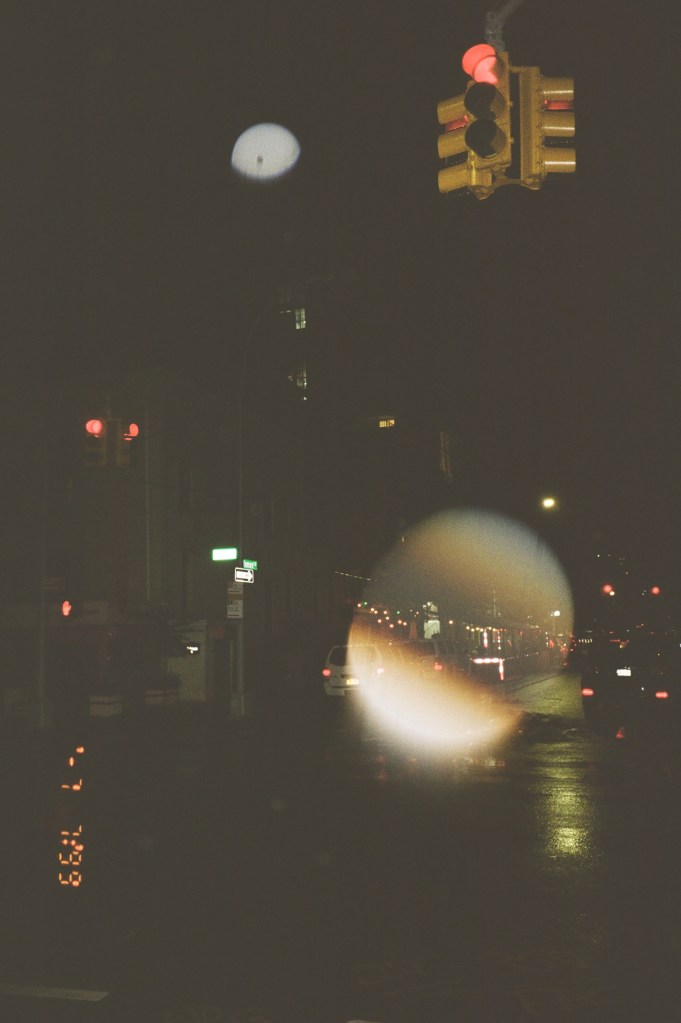
terrible ghost

bedfordtowers


This photo was taken on a walk after a concert in Brooklyn New York a few months ago. When I was thinking about which photographs would fit with the theme of Empty Space, I picked this one because I believe it captures the feeling of the empty NYC streets that are usually filled with cars and people. Instead the streets are occupied by the rain and the occasional pedestrian.


bedfordtowers is a film photographer based in Scranton Pennsylvania. He has worked with musicians in New York City and Los Angeles and has been published in over a dozen magazines and zines.

My Son Who Dares to Climb a Crane

Katie Coleman


I click on your channel after your mother’s gone to bed. The video freezes, and the wind blows off your cap. We share the same thick hair. Way back, I used to do a decent Elvis impression. I’d swing my hips like the King and never listen to the things people said. Your balance must’ve been rock solid to climb that crane. I used to surf down the aisles of British Midland trains, checking tickets like I was riding waves. This video misses your heart shaped sign-off. But still, I picture you at the top, just like the King.


Katie Coleman’s short fiction has appeared in The Ilanot Review, Bending Genres and Potato Soup Journal. She has a master’s in creative writing and works as a teacher in Phuket, Thailand. She can be found on Twitter (@anjuna2000).

Unhinge the World

Michael Penny


by taking the door off
and removing open and closed

getting a handle on things
by having no handle.

Walk through the frame
that’s empty for passage

but full of destination.
Once done, there’s no shutting

and you have to take it all
whatever is and was

and you, so present.


Michael Penny was born in Australia but moved to Canada at an early age. Since then he has published five books, and he now lives on an island near Vancouver.

Extract from Here and There

Samaré Gozal


I thought about how one day, probably soon, he’d be carried out of these rooms.

The space would not register his departure, let alone his infinite absence.

The walls would remain still and mute, awaiting the removal of the lamps and wardrobes

and the cup and spoon he was holding in his hand at that very moment.

One by one the objects would leave the space and soon there’d be no traces of him

other than a picture of him and one of Ola staring into a black and white sun.

A shaky hand reached for the sugar bowl in the centre of the table. Two spoons full and

a seemingly ceaseless stirring commenced. Round and round. I didn’t know where to go

so I sat down in my wet coat. He put a cup in front of me and poured. ‘Why is there

even sugar in this bowl? You’re not supposed to have any sugar at all.’ I felt a piercing

pain in my head. As if a hundred needles were about to be pressed against my eyelids.

I pushed the cup away and leaned back.


Samaré Gozal is an Iranian born Swedish filmmaker who has primarily worked as a director and producer in Ramz since 2005. Samaré  holds an MA in Political Science from the University of Lund in Sweden after which she started her film studies at the European Film College in Denmark. Since then she has been working on a variety of audio and writing projects internationally.  

Into the Void (Glasgow, 2018)

Ignatius Primadi


When I arrived in Glasgow, I started the trip by visiting Necropolis and ended the day in The Lighthouse. I was awed by the city gloom, the architecture of the city of the dead, and the lifeless ambiance. To some extent, The Lighthouse was empty but charming. I could feel the dullness of the void. Yet, I could also embrace the beauty of the spiral staircase. Most importantly, the silence reminded me of mortality. 

These elements really fill the hollow of the Lighthouse from top to bottom or vice versa, depending on your perspective.


Ignatius Primadi is a mundane and reflective writer who enjoys visual poetry and has written personal poems since 2008. Fond of romanticism, his imagination is influenced by music, photography and science.