I toy with words on my phone in between lectures and am poked by colleagues: “Why can’t you just relax?” In my defence: I do relax; words are one of the ways. This I tell them. They are baffled: “All these poems you write, for free? You do have a job. Why not get a life too?” I half-reckon then abandon the urge to tell them that it’s often the way work and life are perceived: pigeonholing sires the need for the elusive work-life balance. As for my equation with poetry, I do it for the same reason birds fly, fish swim, and infants cry: the inescapable requisite, and the sheer joy and gratification it brings. It’s true that I look for paying magazines to rationalise the urge, but not always. It is a relief when words done for free make me skip meals. I recall Joey Tribbiani’s words: “There are no selfless good deeds”. The self here is the chance to be myself, if I am to repeat the cliché. So it’s no longer the point of something being a good deed or not if it is second nature. I think of the people deemed “a joy to be with,” and wonder if they are like poems. I long to be one, to attain a state where the person ends and the poem begins, where the two bleed in and out of each other until equilibrium sets in and the two are one; it is one.
Expression is one of the greatest joys of being alive. When pondering over the person’s end and the birth of poetry, all I can hope for is an osmotic flow that melts the fence.
Ankit Raj Ojha is a poet and assistant professor from Chapra, India. He is the author of Pinpricks (2022) and editor at The Hooghly Review.
Ankit’s essay is the winner of our Featured Essay prize and was awarded £20.
Who owns poetry? Where does a poem begin? Can you catch the setting sun?
Briefly Think is a tiny new chapter for our little literary space. Open-ended, endlessly thoughtful, thought-provoking, provocative questions. With answers that can be non-answers, half-answers or, simply, answers.
After receiving an incredible response to our first call for submissions, we have chosen 15 essays that do something interesting, entertaining or troubling with the prompt. Each one sparkles, sizzles and stretches language and meaning this way, that way, those ways… whether reflecting on dreams, space, myth, language, politics, memory, time, art, language or all of these things at once.
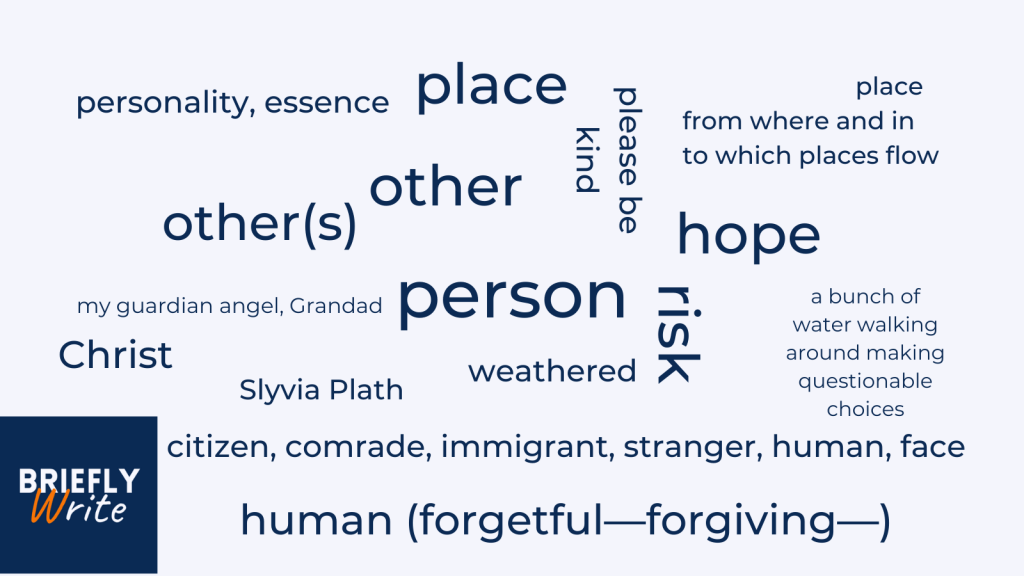
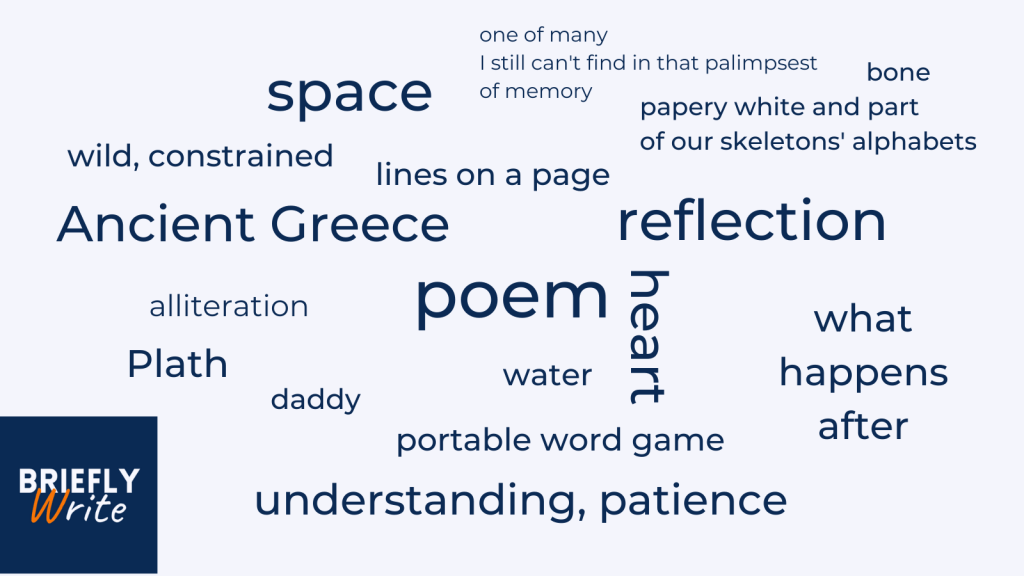
A poem is space, alliteration, what happens after. It is a portable word game and patience and lines on a page. A person is place and essence and hope and risk. Personality, forgetful… forgiving: a bunch of water walking around making questionable choices.
Our contributors have created and crafted short essays that demand to be re-read. The accompanying quotes and word associations complete the picture, cast new light or contradict everything that has gone before.
Happy reading! Please do let us know what you think.
Lawrence Bradby ~ citizen, comrade, immigrant, stranger, human, face / portable word game
Jayant Kashyap ~ human (forgetful—forgiving—) / understanding, patience
Ian Ledward ~ When I think these words, | turmoil fills my mind | with faces, things | and places left behind. | The Poem: one of many | I still can’t find in that palimpsest | of memory. People: please be kind.
Debra Williams ~ other / lines on a page
Halle George ~ a bunch of water walking around making questionable choices / what happens after
Ilias Tsagas ~ other(s) / Ancient Greece
Mark Goodwin ~ place | from where and in | to which places flow / bone | papery white and part | of our skeletons’ alphabets
Leanne Drain ~ my guardian angel, Grandad / alliteration
Carla Sarett, She Has Visions (Main Street Rag, 2022)
Between ‘Once, dying bees fell on me as I slept naked’ and ‘All I have left is | my departure’ is Carla Sarett’s transformative debut collection that interrogates grief, reality, the realities of grief and the griefs of reality.
The collection, like the poet, is in search of meaning. Following a life-shaking moment of grief, the foundations of life and death are unstable; previously sturdy landmarks have been uprooted – or vanished. In the collection’s opening poem, the poet wonders, what if,
[…] I forget what I am supposed to do with all of this living and dying and everything in between
Throughout the collection, there are more questions than answers – and deliberately so. She Has Visions is full of places and empty spaces. ‘I slept through most of Idaho,’ the poet states, ‘I missed the Snake River, the cracked black | dunes the astronauts trained on’. In absence is presence and in the present is absence. In many cases, the landscape is still standing but has been hollowed out: ‘No one’s playing at Oracle Park’.
Sometimes betweenness becomes an end point: ‘I waited for you at baggage claim until there wasn’t any luggage | […] You got lost somewhere between Terminal A and Terminal B’. Everything in between is the emotion, the personal stories and struggles that get blurred by cold, hard facts.
Temporal vagueness goes hand in hand with spatial nothingness: ‘April is not the cruelest month | […] This month is’. Although details are left out, the reader feels their force with acute precision. Misplaced calendars and repeated reference to Times Square bring a hyper-awareness of time into further relief. Memory imposes distance at the same time it brings closeness, reinforcing that the remembered events happened ‘a lifetime ago’.
I woke up thinking of a poem I had written, but forgotten.
Aphorisms abound – ‘goodbyes never happen once’; ‘Only the living | need space and time’; ‘Everything’s new here, fresh from ruins’ – though the language always maintains a freshness that defies old patterns. Like its surprising guest list – John Wayne, Greta Garbo, Hecuba – She Has Visions is a patchwork of reality, imagination and myth. It is a collection that will leave the reader changed too.
Carla Sarett, She Has Visions (Main Street Rag, 2022). Available here:
Conversation with Carla Sarett, author of She Has Visions
Daniel:She Has Visions explores many realities, with imagination, myth and memory all cleverly interwoven. When writing these poems, did you have an overall “vision” for what you wanted your debut collection to look like?
Carla: Many of these poems were written in the crucible of grief following the sudden death of my husband in December 2018. That year then flowed into the global lockdown for COVID. In that period, I changed into the woman who wrote these poems. No one has been more surprised than I at the change. This book is for Paul Messaris, forever and ever and ever.
D: One of the most interesting / intrusive / human aspects of reading poetry, for me, is gaining access to the innermost thoughts and feelings of another person. But literary devices and poetic masks can cloud the words and leave a reader unsure how to respond to the first-person voice.What are your views on how personal lived experience translates onto the page? Does making a “real” event / person / feeling into a poem obscure or illuminate them?
C: Meditation gives me a framework to think about “personal lived experience.” We feel alone in moments of grief or alienation; but these feelings are themselves shared.That is reality. Every moment is fleeting – we inhabit a sea of different feelings and thoughts. Grief, I learned, isn’t 24/7 – it ebbs and flows in random ways.
To me, a poem attacks the randomness of feelings; if they were orderly, they’d become an essay. A poem makes order from a clash of ideas and feelings. I take a tour of The Alamo, and I’m crying. I look at a Bronzino painting and I see my dead brother. My walks through city streets become wells of memory. The poems in She Has Visions (even the surreal ones) do contain “real” memories, but refracted through the lens of loss.
So, to your point that the first-person poetic voice can “obscure” experience – I think I’d say poetry is a form of changing the experience. In She Has Visions, I am changing loss into …well, whatever my new life is.
D: That’s very moving what you say about the randomness of grief. As you say, poetry, like grief, is a complicated landscape of both solitude and shared experience. Within this contradiction is a battle, apparent too in how you described poetry as ‘a clash of ideas and feelings’. How does this idea of combat present itself in your poetry?
C: I do feel that if there’s no clash, there’s no poem. I have to be grappling with some bit of paradox, as in many of my poems about paintings. In ‘Saint Sebastian’, I view the Mantegna, and afterward am seized with “my departure” – the image offered the sublime, but now I’m thinking about food.
So, on the one hand, we want to experience the pure present – but that moment is (paradoxically) crowded with memory. I think in a lot of the poems in She Has Visions, I am trying to sift through the layers of loss, whether they’re aesthetic, personal or cultural.
D: I get what you’re saying about the multiple layers of the (ever-shifting) present. I also think this applies to how we read and respond to poetry: we can react differently each time we approach a text from a different temporal or spatial reality. As you write new poems (and books), do you feel like you are “recording” a particular time and place? If so, where do extra-temporal “events” (visions and hallucinations) fit into this?
C: I don’t feel that I am recording in a journalistic sense as I write. I don’t worry, for example, what did I really wear? But I am building on incidents and the emotions that accompany them. A good example in She Has Visions is the poem, ‘The Fourth Floor’. I’m riding my condo’s elevator, feeling my age – and then drift into “visions” of burials of Bronze Age women. So, the colours and beauty of the burials become my focus. The leap (i.e. to the Bronze Age) is what my brain just “does” whether I’m writing or not.
D: That’s fascinating, thank you, Carla, for such insightful answers. I notice you’ve released two more chapbooks this year. Can you say something more about these?
C: I love chapbooks, and what they offer – continuous threads, a burst of writing. WOMAN ON THE RUN (Alien Buddha) is a set of poems inspired by the themes of film noir – danger, cities, loss and of course, femme fatales. The poems sit at the intersection of feminism and noir, and the tone is stark and edgy. Some micro-poems too.
MY FAMILY WAS LIKE A RUSSIAN NOVEL (Plan B Press) is a series of memoir poems about my childhood and my older brother’s death. The poems (often prose poems) swerve between the a child’s point of view, and an adult’s, between enchantment and knowing.
D: Thank you, Carla!
C: Thank you for these thoughtful questions. They made me reflect on the “why” of writing poetry.
Carla Sarett, She Has Visions (Main Street Rag, 2022). Available here:
David Greenspan, One Person Holds So Much Silence (Driftwood Press, 2022)
One Person Holds So Much Silence is a poetic experiment with far-reaching sources, an evasive methodology – and eccentric yet riveting results. Dense in places, whimsical elsewhere, the collection is an unflinching but frustrating meditation on language, the body… and cigarettes.
For a debut collection, David Greenspan’s project is nothing if not ambitious. His landscape takes in Wyoming fields, ‘vulgar Florida’ and fragmentary, anonymous cities. The poetry is bold and lively; it seems, at times, to surprise itself – like a symphony orchestra, spontaneously and collectively choosing to move from playing Liszt to Lady Gaga then John Lennon… then lacrosse.
Encounters take place on ‘this illegible night’, where indistinct landmarks enclose the poetry in its own self-contained world. It is a world where the protagonists are small, often knowingly insignificant. Florida does not need its human storytellers; it is ‘home to countless endings of its own’.
The themes can be dark. ‘The first time my father cut himself’ is a challenging poem but one that moves the reader closer to some form of revelation. Some lines stand out, demanding to be re-read,
A seed had been planted beneath his facial hair and that isn’t the right place for a seed […]
Amidst it all, the body – and, in particular, the tortured body – is central. The poet asks, ‘how many times can I pick out | my eyelashes before they stop | growing back’? Elsewhere, he evokes ‘Splotched yellow teeth softishly | decaying’ and states, ‘my skin has a zipper. Most days | I pick, pick, pick & is that nostalgia?’ Despite all this tearing, the body won’t stop expanding,
One day we’re going to die & isn’t that alone enough of a reason to sit here & watch our nails grow?
A bizarre Q&A-style poem, ‘Where are the worms in my mouth brother in your mouth’, occupies a dozen pages in the middle of the collection. What message can a reader pluck from these eclectic pages? The impossibility of answers? The futility of asking questions? Faced with the words, ‘Q: Dear selfish chemical, do not resuscitate’, on an otherwise blank page, it is hard to know where to begin.
The “real” Q&A, included at the end of the book, provides engrossing insight into a creative mind. ‘Poetry seems good at detecting/recording shades of uncertainty, multiplicity, expansiveness,’ David writes, in response to a question from interviewer Jerrod Schwarz. Ambivalence is certainly key. The mantra-like statements in ‘Three: The Dead’ are fitting: ‘we lived with memory | we have no answers’.
History and its smudginess are acknowledged throughout; the recurring ‘incomplete histories’ are some of the best poems. After memories, cigarettes are another prolific reference: ‘Our oldest friend nicotine’… ‘aluminium in my lungs’… ‘when we snuck out of class & smoked cigarettes’… ‘sour cigarettes’. The poems are as transitory as a puff of smoke; as enduring as the effects of smoking on the lungs.
Subtlety dwells within even the most jam-packed poems. In ‘Other Noise’, buried deep beneath the ocean, sidewalk, newsprint, tomatoes, pears, apple trees, Greek myths, concrete, ice cream, squirt guns, surgical plates, semiotics and paint thinner, are the haiku-esque lines,
we made a self a fugitive choice mirror of ache […]
These lines stand out for their slow, contemplative nature despite, or perhaps, because of, the abundance of imagery either side. In the Q&A, David confirms that isolation and context are at the forefront of his mind: ‘What is a specific line saying or doing when freed from the context of what comes before and after?’ This ‘self’, this ‘choice’, this ‘ache’… these are the silences held by one person.
David Greenspan, One Person Holds So Much Silence (Driftwood Press, 2022). Available here.
The Brian Blessed belch I once found hilarious is reverberating around my parents’ tiny dining room and I catch your expression which says ‘yes-I’m-burping-without-restraint-because-I-reject-society’s-arbitary-conventions-and-don’t-care-if-I-am-embarrassing-you-because-I-am-being-real’ and your forearm is crumpling my mum’s best napkin and it still bears the lyrics of adolescent rebellion and as the flabby bass note sustains the room shrinks and shrivels and it’s not my family’s revulsion I feel but my own despair curdling in the warm juice of your gob-hole and if you will never meet me halfway I may as well stay where I am and where are your principles now you’ll accept work from ‘any-posh-cunt-stupid-enough-to-fork-out’ and I hate you using women’s body parts as shorthand for vile people and you are powering the belch through to its foghorny climax and your moth-eaten Anarchy t-shirt is clinging to your second trimester beer-baby when I’m the one who should have a bump to nurture rather than a man-child who suckles himself nightly on homebrew and conspiracy theories and homebrewed conspiracy theories from the safety of a skip-dived swivel chair encrusted in crow shit which is the only thing you have contributed to our so-called home and your booming Brian bugle is diminuendoing and the ribbity undernote is moving to the fore and as your lungs finally empty I realise the burp is not the only thing to have tapered off and a foggy silence reclaims the air and I think about my cosy teenage bedroom and Mum’s spag bol and later I will tell you if you really want to live in an echo chamber how about an empty flat with dodgy wi-fi and a crap-stained plastic throne and then my once enchanting man you can sit on it and swivel down down down into the murky depths of your very own lonely rabbit hole.
Lucy Goldring is a Northerner hiding in Bristol. Lucy has a story in Best Microfiction 2022 and features in Dr Tania Hershman’s 2023 charity flash anthology. She’s been shortlisted by the National Flash Fiction Day three times and twice selected for their anthology. Find her on Twitter (@livingallover) and her website.
I was a bonnie wee lassie growing up in Glasgow. My Dad taught me not to be sectarian when it came to football. Hatred doesn’t mix well with anything, he said, passing me the ball in a moment of shared joy. I was a bonnie wee lassie with a Dad who showed me how to live.
Lament
Bagpipes are traditional at a Scottish funeral, but I’d never buried my Dad before. Melodies aching of bleak hills and glens left me standing, alone, by a cold mountain, scanning the empty landscape to find him there again.
Lizzie Eldridge is a writer, actor and human rights activist from Glasgow. She has two published novels, as well as poems, CNF, stories and flash fiction, and she cares deeply about language, truth and social justice.
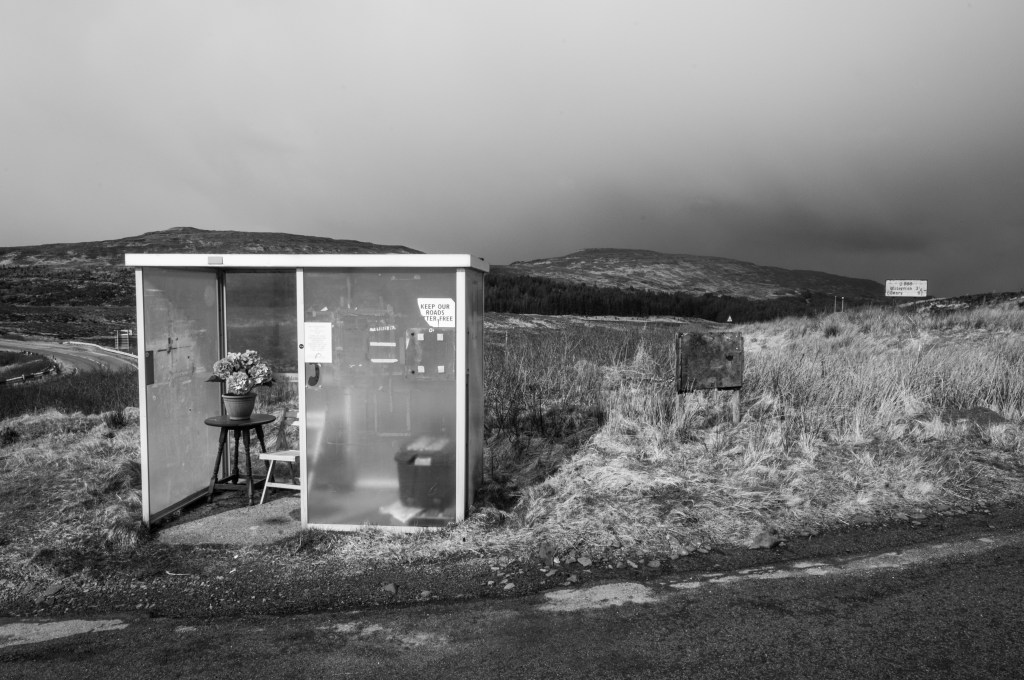
Alastair Jackson has spent the last 18 months photographing & travelling around his native Hebrides of Scotland, putting together enough work for a book-length publication. Concurrently, he has been accumulating images of the slightly odd, unique things he has seen by these island roadsides. These images are part of a small series, ‘Strange Currencies’. Alastair likes to move between and amongst different genres of art, and his first book with poet Kenneth Steven was longlisted for the Highland Book Prize in 2019. He also published a zine, ‘Futures Past & Present’ with ADM Publishing in 2021. Find his website here.
Georgina Titmus is a 60-something Cornwall poet and carer. Her work has appeared in South, The Journal, The Frogmore Papers, Fenland Poetry Journal, Orbis, The Moth and others. She has twice been shortlisted in the Bridport Prize.
That part of town where the snow never melts all winter. Cackle-crows chatter something that could be your name. Your body a prayer. Your body a comma, a hyphen, a dash. When I knew you, your hands were never colder than mine.
Other Worlds Than This
After their son dies, Helena’s husband becomes an astronaut. Finds a spacesuit online, buckles the helmet over his head. He sits on their rooftop and stares up at the stars, mumbles. Helena thinks he must see their son’s face there. She is in the quiet kitchen, holding an empty plate and a naked fork, listening to the scrabble of her husband’s hands digging into the rooftop tile. He is talking about building rockets, she thinks, he is talking about taking to the sky.
Cathy Ulrich doesn’t know anybody with hands colder than hers. Her work has been published in various journals, including Black Fork Review, Wigleaf and Pithead Chapel.
dusk dies around our ears, sometimes a hare crosses my path its fawny grey barely visible in wheaten grass and gloom, late afternoon, midwinter birches
wild nights and soft, and a breath that can be all we have and hope, and hope. hope falling, hope sighing.
wild nights and soft, two faces in disco lights, and eyelashes between heavy seed pods and half-laugh sighs.
next hope, next hope
this is someone else’s laundry, someone else’s life and we get to do this gladly we live in the eaves of our desires and we get to do this gladly even through hurt, even through pinpricks we get to do this gladly.
certain grey joy
in your dead mouth there is also hope love lies in places a new snow, even now, barely seen falls, still
Annie McCann-Gomm is a grad student, waitress and writer in the Netherlands. She studies and writes about the anthropology of the environment, thinking about how we can live with the earth and each other.




 Briefly Write