He would like me better if I wrote about trees or lamented on leaves or mused on moss.
When you grow up in a city you don’t have the language to show fervour for forests.
I like a crunchy leaf as much as the next person. But that’s not enough.
Galia Admoni is Head of English at a school in London. She has poems in Bad Lilies, Anthropocene, Atrium, Streetcake and others. She is forthcoming in both Under your Pillow and Sex Tape Digest anthologies. She has lectured at Shakespeare Institute, BFI, British Library and is committee member for the London Association-Teaching of English. Her debut pamphlet will be published in 2024. Follow her on Twitter (@galiamelon).
I can’t stop looking at the naked shape of his head. Ghosts of curls collect in his collar. For a moment I think I can see the outline of the man he will become, in the twist of his mouth as he concentrates on the scissors snick of his reflection. I hold my breath, all the time trying not to grab handfuls of cuttings, to fill my pockets with blond.
Jennie E. Owen’s writing has been widely published online, in literary journals and anthologies. She teaches Creative Writing for The Open University and lives in Lancashire with her husband and three children. She is a PhD student at Manchester Metropolitan University, focusing on poetry and place.
I want to lie on bare concrete, spread arms and fingers, and once more inhale the mingled smells of your menthol cigarettes and motor oil, hold still until my limbs turn cold, until I hear the clatter of billiard balls across a felted table. And when I get up, I will be eight years old, running for coffee. Mugs balanced carefully, I’ll tiptoe down the narrow stairs.
Aimee R. Cervenka is a writer, climate activist, and professional baker. Her poetry has appeared in Poet Lore, Ascent, Slab, and others, and was selected as a runner up in Headway Quarterly’s Winter 2020 Writing Contest. She currently lives in Spokane, Washington, with her husband, dog, and two rabbits.
Judging the Briefly Write Poetry Prize 2022 was a joy, a delight, an inspiration… and a headache.
In every poem is a little piece of the self; in every stanza, a light that illuminates a life. Every word is an opening to new worlds. We read, re-read and re-read every poem submitted to the Poetry Prize because every entry was worthy of careful re-reading.
Popular themes this year included love, hope, loneliness and revenge. Flowers, friends and poetry all played starring roles; trees, coffee and the sky at night were close behind. Every voice added something unique.
Poetry is a conversation and we hope our choices spark discussion. We hope you’ll agree with some of our picks… and would love to hear what you think in the comments below. Feel free to reflect on the poems and congratulate the winning poets!
We are so grateful for the support and love shown to our little literary space. Thank you… and you and you and you.
Gaynor Beesley * Creana Bosac * Jonathan Chan * Ion Corcos * Jennifer R. Edwards * Carl Farrell * Donna Faulkner (née Miller) * Lindsey Harrington * Kerry J Heckman * Jennifer Ruth Jackson * Helen Kay * Keith Li-Bouchard * Mina Malik * Miruna Marin * Tony Maude * Ed Meek * Emily Munro * Muiz Opeyemi Ajayi * Aly Rhodes * Shana Ross * Abdulrazaq Salihu * Nnadi Samuel * Kay Sfictos * Hibah Shabkhez * Ana C. H. Silva * Jenniska Small * Sally Jane Tate * Chidiebere Udeokechukwu * Candace J. Williams * Angela Zimmerling
Our editors will get to the heart of your poem or story. We’ll provide incisive, insightful comments on form, structure, word choice, style and impact. We’ll also ask questions that invite you to take the poem or story further.
What you’ll get:
Personalised response to your poem or story
Tailored suggestions on style, impact and technique
Questions and prompts to stimulate further reflection
Friendly and helpful feedback from editors who care
Chance to send follow-up questions and discuss the work further
We ask for a contribution of £12 per poem (up to 24 lines) or story (up to 600 words). Every penny we receive goes directly to paying (1) website costs, (2) writers.
For longer pieces, get in touch (contact [at] brieflywrite [dot] com) for a personalised quote.
How do I get my feedback?
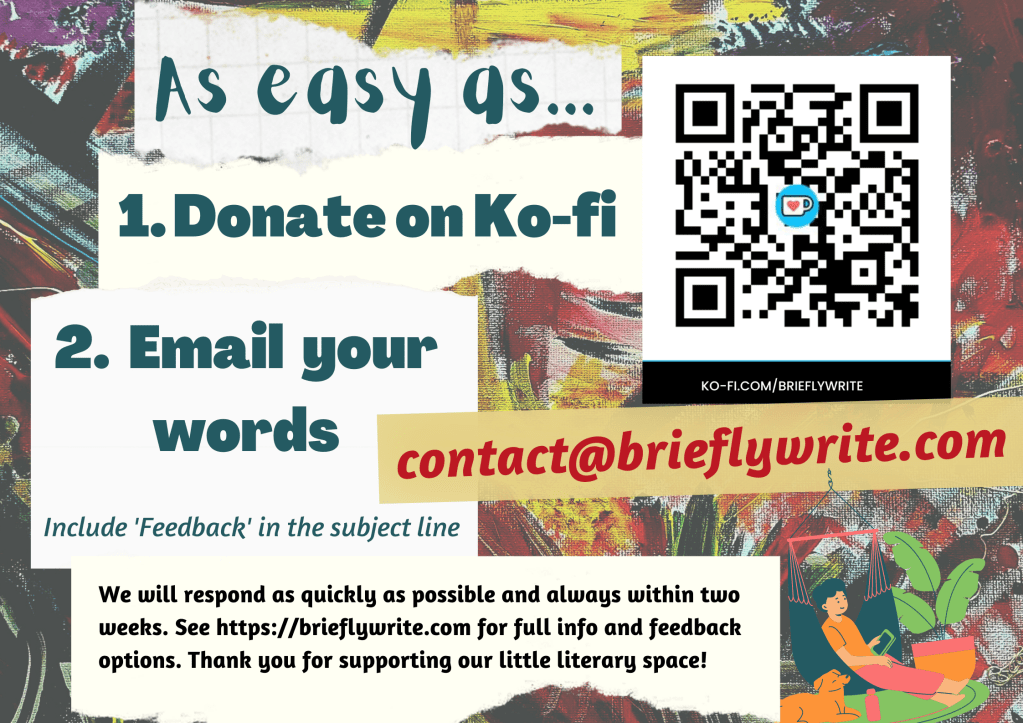
1. Make your donation on our Ko-Fi page. Leave a note in the comments box stating that you are paying for feedback.
2. Email your work to contact [at] brieflywrite [dot] com in a word doc or in the body of the email. Please make sure your name matches the name you used to donate (or tell us if they don’t!) so we can cross-check.
3. Sit back (and keep writing!) for up to two weeks while we read, review and write our responses to your work. We’ll return it as quickly as possible without compromising on quality. And we will, of course, keep you updated if there are any delays.
**PLEASE NOTE: Writing sent through Briefly Feedback is not eligible for publication in Briefly Zine or for entry in any Briefly competition. We can, however, recommend other journals, publishers or competitions we think might be a good fit for the piece, if desired.**
Thank you for supporting our little literary space!
Michelle Marie Jacquot, Afterglow (Michelle Marie Jacquot, 2022)
How can we measure the pandemic years? Lives lost. Loaves baked. Or through poetry?
In the ‘Foreword’ to ‘Afterglow’, Michelle Marie Jacquot invites her reader to imagine ‘late May of 2022’ – the dying embers of the coronavirus pandemic or flaming birth of learning to live with the virus. The poet is ‘sitting on a concrete floor in a little white room out in the middle of the desert, surrounded by almost nothing’. Aware of the vagueness of her setting, she feels compelled to add, ‘Mercury is in retrograde, if that means anything to you’. Such uncertain temporal and spatial surroundings neatly set (or, perhaps, unsettle) the scene for the poems that follow.
Fate and the struggle to find one’s place in an uncaring universe continue to trouble Jacquot. In her previous collection, ‘Deteriorate’, this manifested itself mostly through a personal battle with social media. The influence of lockdown makes the focus of ‘Afterglow’ more metaphysical.
Before blurs with after, just as dark thoughts mix with triviality. These are ‘sometimes silly, sometimes sad, sometimes hope-filled poems’, the poet notes. Box sets and jam on toast might sweeten existential musings, but the mood is overwhelmingly dark. In ‘I Used to Have Dreams’, she laments:
I had a dream once
I don’t anymore
Often, before and after are subsumed by an inescapable present. ‘I’m frozen in this flat/ with both my personalities’, she writes in ‘Split Ends’. Symbolic meant-to-be moments also fall flat: she describes herself as ‘born on Christmas Eve in a Seventh-day Adventist Church hospital that doesn’t serve coffee’.
The quality of the poetry slips as the collection progresses, with many poems feeling decidedly unpolished. But that is kind of the point, it seems. The collection is, as the poet forewarned, ‘an odd time capsule’. An all-caps rant about religion follows close behind the poetic epiphany that ‘I’ve never seen Santa Claus and God in the same room, not once’. Absurdity reigns towards the end of the collection, a fitting memento of a maddening era.
Interspersed with insanity are self-help mantras, which is perhaps no coincidence. ‘Let yourself sit quiet/ Hear the wind inside your lungs’, the poet urges in ‘Gökotta’, shortly before she discovers that “Lennon” rhymes with “Heaven” in ‘A Place I’d Like to Go’.
Such varied insights into the poet’s thoughts reveal the strange and, at times, torturous experience of living in one’s own mind. Solitude is a precondition for mental plurality, which comes to the fore in ‘Imagine’, another Lennon-tinged poem:
I dare you to imagine A place where everything goes right One where the voices in your head Only tell stories that you like
Brief reflections on nature in ‘Spring’ provide a glimpse into the outside world. But the collection is an introspective romp through the dark, twisting halls of the inner mind. The resulting poetry isn’t always pretty – but it is a revealing and relatable record of a difficult two years.
Michelle Marie Jacquot, Afterglow (Michelle Marie Jacquot, 2022). Available here.
Melanin Sun (–) Blind Spots is a poetic experience / experiment / excommunication in which a self-effacing poet fights to escape the echo chamber she yearns to inhabit. Awarded the 2022 Florence Kahn Memorial Award by the National Federation of State Poetry Societies, the collection is a bereaved daughter’s attempts to define herself and her skin.
From the start, the self shifts incessantly. When discussing race, the poetic voice is impersonal in search of personality: ‘It seems that I find myself coming out/ as biracial’ (Just a Brown Girl’s Glass Box). The poet needs to find herself – and finds herself needing poetry.
Yet language obscures the search. The opening poem, ‘Reverberation/Redaction’, sings of instability: words are crossed out, concealed and clouded. Pretence reigns supreme; death is sugar-coated and draped in oversized clothes. In ‘Alibi’, one of the collection’s best poems, bagginess becomes an ‘undersized coat’ – then returns to being an ‘oversized suit’.
This constant flip-flopping characterises the duality of the poetic voice, which is as complex and interlacing as the braids she wears: ‘half rooted in [redacted], half on sale for $7.99’. ‘Alibi’ is framed between the explanation / confession / apology, ‘I looked up a list of Black girl braids before writing this’, which makes the poem drip with the feeling of insufficiency. But it also screams resolve: ‘Ask the photo on the shelf/ with books I’ve never finished/ he’ll tell you; he’ll testify. I said it again. And again.’
Throughout the collection, betweenness manifests itself abundantly. With religion, there is a failure of performance: ‘I could never get myself to believe in God’ (Just a Brown Girl’s Glass Box). Musicality too is an ever-present ambiguity. At times, the poetry is knowingly beautiful: ‘wet warmth dresses the trees like tapestry’. But music can also be a burden; in ‘Black Pinocchio Jazz-Cat Drummer’, the father is ‘Limping from his backpack of songs’.
The absent father figure comes back time and time again. In ‘Nectar | Names’, ‘the spiral peel of his name’ spills down the page; in ‘Driveway, 5/03/20[redacted], ‘he gardens./ His silhouette fluttering like dark chiffon’. The reverberating echo chamber is contradiction in its most literal sense: a space where the poet speaks against herself.
Younge’s poetic space is a multitude of multitudes. Her language is constantly evolving and every line has the capacity to turn a poem upside down as suddenly as day can become night. In ‘Some Things Aren’t Meant to be Metaphors’, the poet suggests that ‘“like” carves a/ crawl space, but there’s not enough room to hide unless/ you make a home in the shadows’. Melanin Sun (–) Blind Spots is at home between shade and sun. The collection is a truly accomplished debut.
Danae Younge, Melanin Sun (−) Blind Spots (2022). Available here.
Three weeks ago, we released the winners of the inaugural Briefly Write Poetry Prize. If you haven’t yet read the winning and commended poems, you can do so here.
Now the dust has settled, we thought it would be a good time to share a few brief observations from the judging process. We hope this will shine a light on our decision making and provide greater insight into our aesthetic.
The Cambridge English Dictionary defines “to judge” as:
To form, give, or have as an opinion, or to decide about something or someone, especially after thinking carefully…
We can confirm that:
We thought very carefully about our choices
We were deciding about something (a poem) not someone (a poet) – we read all entries anonymously
The following points aim to reveal some of the factors that helped us form our opinion of the poems we read.
Judges’ Notes
As with any competition, a dozen different judges might pick a dozen different winners. Nothing we say below is supposed to be a “rule”: these are just our thoughts and reflections on reading 1,412 poems and picking our favourites.
Think carefully about your idea. No matter how beautifully you craft your poem, if you’re not inspired by what you’re writing it will probably show. Give us something authentic, something you care about, something that only you could write. When we’re reading so many poems, those quirky snapshots which illuminate the poet’s own unique experience are usually the ones that shine through.
Avoid the obvious. This follows on from the previous point: make your writing unique. We had hundreds of poems about heartbreak, love, dogs or poetry. These can all be interesting topics – if that’s what speaks to you, knock our socks off with a brilliant heartbreak ballad. But remember you will be competing to stand out among hundreds of very similar poems.
Make every word count. This may sound like a cliché, but it’s not: when it came down to the final decisions, some brilliant poems missed out on the longlist or shortlist due to a single word that seemed hastily chosen or badly placed. You should know why you’ve chosen every word. This doesn’t need to be a ‘poetic’ justification: “it just feels right” can be a perfectly valid reason. But when a rose is described as “beautiful” or a night’s sky as “dark” in three consecutive entries, we can’t help feeling like the poets missed a chance to sparkle.
Don’t over-write. This might seem contradictory to number 3, but it’s not: we want well-worked not over-worked. Often, when people try to write in a ‘poetic’ style, the result is an overly embellished poem that lacks authenticity. If you want to write like Shakespeare, that’s fine… but we still want to hear your voice. Use rhyme or don’t use rhyme – both techniques can be used creatively and to great effect – but please don’t feel like you need to use rhyme just because that’s what your Year 9 English teacher said a poem has to do.
Let it breathe. We read a lot of poems that didn’t quite feel ready, work that could have been improved with a little more time and care. The Poetry Prize was open for three months and we recommend you wait a few days (or weeks or months) after writing your poem before you send it. We read generously but a sloppy, typo-laden entry will not make a good impression. Check line breaks, word choice, rhythm. Speak your poem out loud to make sure it sounds how it does in your head.
Don’t forget the title. A surprising number of poems were called ‘Untitled’. It’s fine if that’s your thing, but when you only have ten lines to impress, the title can do a lot of work.
Choose a good title! Several promising poems were let down by slap-dash, irrelevant or uninteresting titles. A strong title can be tantalising, tingling, informative and intriguing. Use it to tease our poetry senses: a title gives you the opportunity to set the stage, to tweak and play with the reader’s emotional state. Don’t give it all away before we’ve read the poem and don’t try to be too ‘out there’ for the sake of being ‘out there’. But do make the most of the opportunity to excite us in the first few words.
Think big. As well as individual word choice, think about the larger structure. Can you use line breaks creatively or disruptively? Is the layout important to the message? If a poet does not think enough about the overall effect, a beautiful poem can become dense with too many unrelated images.
Get the ending right. Poets often stress over the opening lines, but very few poems were turned down based on a poor opening alone. More often it’s the final lines that let a piece down. It’s very tempting to hammer home the key points at the end – but doing so usually results in a sense of over-writing. Trust your reader: if you’ve constructed a beautiful metaphor about a juniper bush and your first love, leave it to blossom in the reader’s imagination – don’t destroy the image by explaining that the juniper now reminds you of those idyllic days and you’re feeling sad you’ll never get to re-live them.
Valerie Nieman’s latest novel, In the Lonely Backwater, joins To the Bones and three earlier novels as well as three poetry collections, including Leopard Lady: A Life in Verse. A graduate of West Virginia University and Queens University of Charlotte, she is an NEA recipient, a former journalist and professor of creative writing.
Sometimes I am fearful that I will live in that room
and there will be no windows
no gaps in the wall
nothing
a mirror
nothing.
Eamonn McKeon is a writer from Purley, South London. He graduated from the University of Warwick with an MA in Writing in 2021, and is currently a PhD candidate. He mostly writes prose fiction, but has spent a great deal of time reading and writing poetry in the past year.


 Briefly Write