Poetry competitions can be a controversial topic in the writing community. As a little literary space that hosts an annual Poetry Prize, even we have mixed feelings.
We want to do the best we can for writers and readers. That’s why, during the Briefly Write Poetry Prize 2022, we asked entrants to answer some questions about poetry contests. The responses we received helped shape this year’s competition. Here are the results.
Our respondents
In total, there were 412 responses. All were submitted anonymously and respondents were aware that their answers could not be traced to their entry.
Almost nine in 10 respondents (88%) had not previously submitted to Briefly Write in any form (including Briefly Zine and other competitions). Respondents were asked to answer the questions generally, not specifically for the Briefly Write Poetry Prize (except for the questions summarised in the next section).
Careful or casual?
Last year, the most popular ways that entrants found out about our competition were online listings pages (24%), Twitter (22%), search engines (17%), other social media (14%), the Briefly Write website (5%), word of mouth (3%) and Duotrope (2%).
More than four in 10 respondents (42%) wrote their entry specifically for the Briefly Write Poetry Prize, while 41% submitted a poem they had already written but had never sent to another journal or competition.
The vast majority (85%) read the guidelines carefully, though some went straight to the entry form (7%) or had only a cursory flick through the rules (7%).
Show me the money
Most respondents “never” pay to enter poetry competitions (46%), ahead of 26% who said they “sometimes” pay and 24% who “rarely” do so. Only 4% said they “often” pay, perhaps unsurprising given that the Briefly Write Poetry Prize is a free-to-enter competition.
In terms of prize pots, the result was conclusive: the most popular option was 1st – 50% // 2nd – 35% // 3rd – 15%, which received close to half of all votes (48%).
A similar option that extended to paying fourth and fifth place (1st – 35% // 2nd – 25% // 3rd – 20% // 4th – 15% // 5th – 5%) received almost a quarter of votes (22%).
The option of having five equal runners-up each winning a tenth of the prize pot (1st – 50% // Runners-up (x5) – 10% each) was favoured by 13% of respondents. Meanwhile, ten joint winners was chosen by only 6%, just ahead of winner takes all (6%).
The rest chose “Other” and offered a wide range of opinions, including one who said offering any prize money creates a “vicious circle”. Others suggested donating the prize money to charity or indicated that monetary reward made no difference to them.
Raising the funds
We have been clear since we started Briefly Write that we will never charge entry fees. Financial barriers should not stop people sharing their talents.
We do, however, rely on donations to pay our website costs and prize funds. Every penny we receive is spent directly on covering these costs: we don’t take a penny out for ourselves as editors. Each year, we have increased the prize pot of the Poetry Prize thanks to the generous support of our readers and writers – and we hope to keep doing so.
One option we have considered as a means of raising more funds whilst also providing extra value to entrants’ experience of the competition is to offer some add-on features. This could include things like short feedback or extra insights into the judging process.
Things that respondents said would add the most value to their experience of a poetry contest (besides winning) include:
- A personalised email with very short feedback (54%)
- An email with the results before they are publicly announced (31%)
- An exclusive Judges’ Notes email (30%)
- A bigger prize fund next year (27%)
Some 17% said that none of the above would encourage them to donate, while 14% said they would be donating purely to support the competition.
To theme or not to theme?
Overall, respondents preferred unthemed competitions (53%) to contests with a theme (33%). The remaining responses (“Other”) mostly expressed indifference on the issue. The result of this questions is, of course, likely to be skewed by the fact that respondents were answering after having entered an unthemed contest.
In a follow-up question, vague themes such as ‘Be inspired by X / interpret Y loosely’ (68%) comfortably beat specific themes like ‘Write a poem about X / using Y / in the form of Z’ (27%).
Don’t leave me hanging
As writers ourselves, we understand how frustrating it is to pour your heart and soul into a submission… and then never hear back. That’s why we email every entrant regardless of the outcome of their entry.
It does take a lot of time to send all these emails so we wanted to check it was worthwhile. We asked how much people valued receiving an email to say they haven’t won a competition before the results are announced publicly.
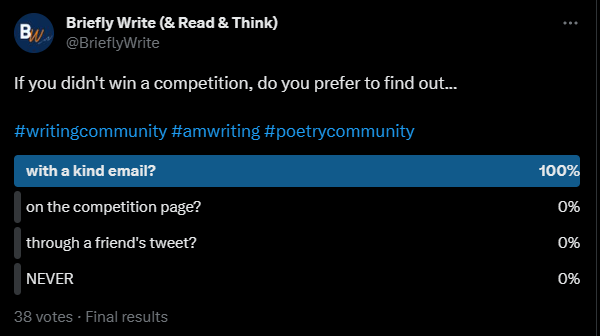
Some 62% chose “I really appreciate it and it makes a big difference to my experience of a competition”. For 31%, it was nice but not essential (“I appreciate being told but it doesn’t make that much difference to me”). Only 4% would “rather not be told if I haven’t won”. This result is supported by a recent Twitter poll we ran.
Those who chose “Other” made suggestions that could reduce the administrative burden such as an automated email to announce the winners. Multiple respondents said that no response is fine so long as this is clearly communicated in advance.
Prizes and publicity
In the event of winning a competition, two thirds wanted to make the most of the opportunity for publicity (62%), while 12% opted for “Just pay me the money”. The large number that chose “Other” reflects a flaw in the question: the intention was not to make people choose between publicity and money but to see whether they valued extra features such as interviews.
Many of the “Other” respondents said they want both prizes and publicity. Some repeated assertions that money shouldn’t mix with poetry or expressed the view that publicity and prizes are secondary to eyes on their writing: “I just want to be read”, “I want recognition for my work” and “I want to inspire people” were common answers.
In the follow-up question, the forms of publicity that winners would most appreciate included the chance to have their poem published in an anthology (75%), online publication (71%), promotion on social media (51%), an interview about the winning poem (43%) and an online feature about the poet (42%).
When all is said and done
Encouragingly, 82% said they would still read the winning and commended poems if they hadn’t won. Likewise, 79% said they read the Judges’ Notes when they don’t win a competition.
The most popular material to include in Judges’ Notes was “Insight into what made winning poems stand out” (87%) and “Insight into what made poems fall short” (55%).
An “Overview of common themes / styles / forms” was appreciated by 50%, while 41% were interested in statistics about the number of entries. The few’ “Other” suggestions we received included calls for statistics on the diversity of judges and entrants.
What are our key takeaways?
We were delighted with the level of response and thoughtful engagement our survey received. The answers reaffirmed our commitment to running accessible, free-to-enter competitions that treat all entrants with the respect they deserve.
This year, we implemented the prize pot that received an overwhelming number of votes (1st – 50% // 2nd – 35% // 3rd – 15%), despite our own instinct being to pay more writers a smaller amount. This is something we will review again for future competitions.
We will continue to email all entrants regardless of outcome. In the past two years, we have received only a handful of rude responses or arguments about why we were wrong to overlook a poem. Although rare, even these few are dispiriting.
That said, we do always welcome (polite) replies with thoughts or constructive feedback on the competition. And if you would like feedback on your poem, we offer that service too: Briefly Feedback.
If any writers or editors would like to discuss any aspects of the survey, we would be happy to provide more details. Comment below or email contact [at] brieflywrite [dot] com
 Briefly Write