Except, Grass

Zary Fekete


It’s time to cut the grass.

Except have I spent any time to consider each blade? Never mind each blade, have I spent time thinking about even one? Was I there, down on my chest in the black earth, to see the first moment the tiny, green tendril touched the outside air? If I had been and if I had stayed down there, what else might I have seen? I would have seen that first tendril joined by a chorus of others. I would have seen small burrowing ants marching through the forest of green stalks, following the pheromones to their maze somewhere else in the yard far below. I would have seen the dandelion which grew next to the green blade, temporarily shading it from the sun while the breeze flew across the fields.

I could have stayed there these past weeks and been a part of that smaller world. Smaller but no less vibrant and busy than my large one, in fact, perhaps more busy and in many ways more important. That smaller world touches the whole spinning blue globe in more vital ways than does my feeble meanderings through newspaper headlines and internet search terms and generally useless scrolling.

It’s not too late. I could do it. The black earth is down there waiting for me.

Except I might get my hands dirty…


Zary Fekete grew up in Hungary, has a debut chapbook of short stories out from Alien Buddha Press and a novelette (In the Beginning) coming out from ELJ Publications, enjoys books, podcasts, and long, slow films. Twitter: @ZaryFekete.

Dendrology

Allison Renner


She wasn’t sure if she was looking out or they were staring in, watching her stay in one place for so long she put down roots, felt each skin cell harden and become rigid, causing her to stand up straight—her mother would be proud—and look straight ahead. With a quick glance you’d think she was brimming with confidence, regal, but closer inspection shows her eyes darting back and forth, trying to see everything as if that would prepare her for what’s to come, when the ground crumbles between her toes and she’s the only thing left standing on the landscape, and even then she is slowly wasting away.


Allison Renner’s fiction has appeared in Ellipsis Zine, Spartan, Six Sentences, Rejection Letters, Atlas and Alice, and Misery Tourism. Her chapbook Won’t Be By Your Side is out from Alien Buddha Press. She can be found online and on Twitter (@AllisonRWrites).

Reading ‘Wise Children’ in a hotel lobby

Mike Farren


Newcastle, May 1992

I am reading about twins when you walk in,
expected, but immediately part of a tableau

from myth – from an Old Master’s interpretation
of myth – where every part of the picture,

every colour, every fold of every garment,
every cheap ornament, every passer-by

are charged with meaning because they
are being looked at. I am in the picture

but I am looking at the picture, Dora
and Nora Chance are looking at the picture,

Angela Carter, though three months dead,
is looking at the picture, where I sit on a grey

sofa in the lobby of a chain hotel, in a black
denim jacket, reading about twins and look

up, and the one who will be my chosen
twin walks in, says hello and shifts the world.


Mike Farren is a poet, editor and publisher based in Shipley, West Yorks. He has 3 pamphlets, most recently Smithereens (4Word) and is one of the hosts of Rhubarb open mic.

I heard them howling and barking in the distance

Molly Knox


for gran

and so I got startled thinking they introduced wolves but it turned out to just be his dog. i think they’re gonna introduce wolves. up north. it’s yet to be approved. have to get permission from the crofters, the farmers, the great hills too. do you think it’s better now the clouds have come over?

       if we glare long enough into the patterns on beech trees, the answer will reveal itself. i’d forgotten how beech trees are. sometimes these things keep to themselves. hiding in the edges of grass with mice in wee houses. i read they’re saying tasmanian devils are dying out. i keep thinking they can claw it back. because somehow i keep reading about them.

see, we are used to counting the birds on the garden fence. we used to feed the imaginary chickens, lost your pram in the long grass. sparrows, tits, sometimes crows. those won’t be going anywhere,

surely. what do you bet we get home before the rain comes on? sorry, had to look up the difference between a crow and a whatsyoucallit recently. found out I’d gotten it all wound wrong. like trying to do a cardy up in the wind. counting foxglove leaves alphabetically. they’re saying you don’t know the difference between daffodils and poppyseeds. i can hear it now. if you listen closely enough you can tell the beech tree is hanging to the banking and no more. it’s humming between the light between the leaves: between us. in the end, I think that’s the trouble, with what comes next.

not enough hear it. the road will go down when the winter comes.


Molly Knox is a recent Music graduate of Durham University. She is starting her MA at Durham in Ethnomusicology this autumn. They are a Pushcart Prize and the Best of the Net nominee. Their work can be read in The Braag, Ink, Sweat and Tears, and Wrong Directions.

live

Dila Toplusoy


‘the job of the living is to live,
the job of the dead is to die,’

says our teacher
in front of the village graveyard, covered with olive groves –

a place where we do not belong
yet –

we all know we are bound to change roles,
the way those olives are bound to become oil.

sooner or later, we will be the subjects
of the latter statement –

but until then, the job description is
golden clear.


Dila Toplusoy is an Istanbul-born poet whose work has appeared or is forthcoming in Skylight 47, CERASUS, t’ART, La Piccioletta Barca, Sky Island Journal, Needle Poetry and Amethyst Review, among others. She is a content editor at ARCCA Magazine and holds a first-class honours degree from University of the Arts London.

Table manners

Tayiba Sulaiman


There’s rules at home, but not like yours. No knives or forks or elbow bans. Our rule is that when offered food, you always take what’s nearest to you, not what’s tastiest, biggest, best. We don’t scour a plate for the biggest slice, never reach across for the richest pudding. We take what’s closest.  

After tea, we’d sit at your feet to eat the fruit you’d peel for us – a love song in Vitamin C – and we’d climb under the table to play that game, waiting together for unwitting segments of tangerine to come calling. You’d say one of our names, then slowly lower a piece into view, singing to what I realise now is the tune of ‘How Much Is That Doggie In the Window?’: 

IIIIIIIIIIII’m only a poor little baby orange, 
I hope you’re not going to

– eat me! 

On the last two words, each piece would be snatched down and devoured, and every time we’d fall about in peals of laughter amongst the crumbs. 

So we terrorised the local fruit bowl, grew almost as fast as the price of fresh produce, and read in the papers of the people eating at high tables with blunt silver knives. In my mind’s eye, we sit at their feet, watching them reach over platter after platter after platter. Even despite the angle, it’s not a flattering view. Instead, I imagine you up there, peeling tangerines just out of sight. You, asking us to wait our turn. You, asking: how much is that world in the window, where we cry tears of laughter when our siblings get their share? I know it is real, I saw it – the gold in your hand, the gold in our mouths. I know that world is real because I saw it under the table. 


Tayiba Sulaiman is a writer and translator from Manchester. She works at a literary agency in Oxford and is currently completing a translation mentorship with the National Centre for Writing. 

Issue 11 – January 2024

What next? What comes after THIS and THAT and THESE and THOSE?

In our submission call in July, we stressed that ‘WHAT NEXT?’ was a loose theme. Submitters treated it that way. We read hundreds of AFTERS and THEREFORES and AS A RESULTS. But we also saw WHAT IFS? and WHY NOTS? and WHERE ARE WE GOINGS?

From hundreds of diverse and thought-provoking predictions, warnings and possibilities, Issue 11 formed. Our 16 brilliant writers and artists reflect on snapshots of a future and the future of snapshots. The results are enthralling, escapist, engaged and enlightening.

One of our favourite things about micro fiction and micro poetry is the way it continues to give something new on each re-read (or re-listen). We hope these poems, stories and artworks won’t be static. We hope they travel forward with the reader into whatever comes next…

Daniel & Elinor


WHERE?

Tayiba Sulaiman, ‘Table manners’

Mike Farren, ‘Reading Wise Children in a hotel lobby’

Rucha Virmani, ‘Late Spring in the Anthropocene’

Kiley Brockway, ‘Haunted’

Molly Knox, ‘I heard them howling and barking in the distance’

AIR

Seán Street, Two Poems

Mia Kelly, ‘The New Highway, 1972. Walsh Norrel. Black and white photograph.’

Dila Toplusoy, ‘live’

Jacelyn Yap, ‘Once a Home’

Allison Renner, ‘Dendrology’

Lawrence Bradby, ‘Empty-handed’

RE

Suzanne Hicks, ‘Believe Me’

Jayant Kashyap, ‘A breeze in the midst of rain—’

Lei Kim, Two Poems

Zary Fekete, ‘Except, Grass’

Sambhu Nath Banerjee, ‘Next? A Dismal Destiny’

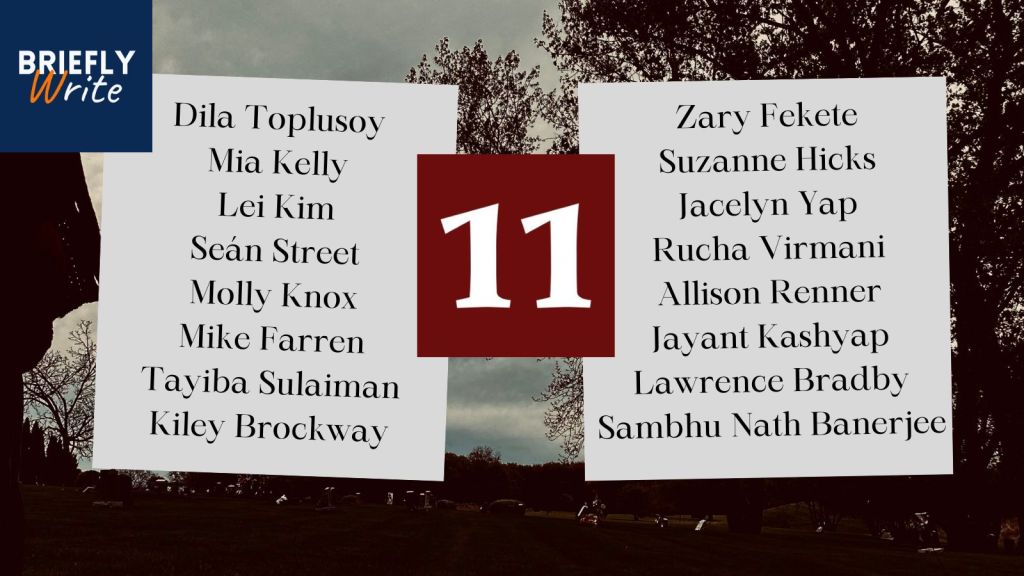
Briefly Write Issue 11 contributors - Mike Farren / Molly Knox / Lei Kim / Allison Renner / Jayant Kashyap / Rucha Virmani / Tayiba Sulaiman / Kiley Brockway / Zary Fekete / Mia Kelly / Jacelyn Yap / Lawrence Bradby / Seán Street / Suzanne Hicks / Sambhu Nath Banerjee / Dila Toplusoy

Big little news…

We are proud to announce that we are now paying all contributors to Briefly Zine. Thank you to everyone who has supported us on our journey so far.

Briefly Zine in 2024

Submissions for Issue 12 will open in April 2024, with an expected publication date of July. We will announce details for Issue 13 (themed) later in the year.

Poetry Prize

We recently announced the results of our third annual poetry prize. You can read all the winning and shortlisted poems here: Briefly Write Poetry Prize 2023. Our next competition will open in May 2024.