Last month, Ankit Raj Ojha won the Featured Essay prize in the inaugural edition of Briefly Think for his essay, ‘Becoming Poetry’. His reward? Some more questions to answer.

In response to the prompt, Where does the person end and the poem begin?, Ankit wrote compellingly about his relationship with poetry (‘the inescapable requisite’) and the possibility of a perfect state of equilibrium between poet and poem. The following conversation delves deeper into these topics, as well as spinning off in a few new directions.
You can find out more about Ankit and his writing here. And stay tuned for the THINK 2 prompt, which will be released later this year.
Daniel: Your essay stood out for its beautifully concise composition and fascinating, multi-faceted content. As you write, language can be a tool for play (‘I toy with words…’) and pay (‘It’s true that I look for paying magazines’). So, first question: did play or pay prompt you to write ‘Becoming Poetry’?
Ankit: Surely not pay; I didn’t see a win coming around the time I was writing the essay. Your prompt, I believe, was intriguing enough to stop me in my tracks and ‘make me skip meals’. I had come across it on Twitter and had almost dismissed the thought of reflecting on it, for at that time I could barely sustain a single thought long enough to produce a coherent piece.
But then I got into a chat with writer friends on Twitter on a similar topic, found myself uttering things that would later form some of the essay’s ideas, and was quick to delete my public tweets upon realising that I did want to write a previously unpublished piece on your prompt. Nothing is created in vacuum. This is how ‘Becoming Poetry’ came to be.
D: That’s true: poetry is always, in some way, a conversation or collaboration. The concept of previously unpublished is itself fraught given that words are always recycled, reconfigured, replayed, renovated (though plagiarism, of course, is real and harmful).
Your essay features words spoken (‘“Why can’t you just relax?”’) and unspoken (‘I half-reckon then abandon the urge to tell them’), which, to my mind at least, resembles a poet choosing what to set down and what to leave out. The deleted tweets are part of the story too: those fleeting words wiped away like they were never there. So, I guess the question is: how do you deal with all these silent and noisy influences when writing a poem? Are you conscious of the words you are choosing to ignore when you choose the ones you write?
A: I’m glad you asked this. It’s true: thoughts gush in from everywhere; words follow suit. Sometimes it’s the other way round: you have a word or phrase that tastes so good you are desperate to use it, so you devise thoughts to sneak the word into your poem. As for me, I have grown up largely on novels, and my feelers still come to rest on fiction (note to self to read more poetry). The consequence is that I often turn to narrative poetry. Some of my early poems I found a bit verbose and had to edit post publication for future reprints and for my own sanity.
I still love storytelling in verse, for the love of the form and also because it suits my diverse schedule that at present forbids long-term courtship with prose, allowing only short poetic flings. But I am now more conscious of practising restraint and refinement. I assume every writer has to go through the Clark-Kent-as-a-schoolkid phase where the young Superman must learn to wade through voices in his head, shut out the noise, and focus on what really matters. Sometimes you have to part with beloved words or thoughts for the greater good. Some of the jilted words may turn up another day, in another poem; the forsaken await their turn forever. The writing process, therefore, is every bit as stringent as it is spontaneous. Even the stream of consciousness insists on the chisel, for epiphanies too have to be tinkered with while writing.
D: That’s fascinating and really insightful what you say about the stream of consciousness. Poetry often feels more “personal” than prose, more intimate or even intrusive. When writing and editing your poems, do you ever think about how much of yourself you might be “giving away”?
A: If I may digress before approaching the question: intrusive is the word, yes. For me the poem almost always writes itself, and that too when it wants to, triggered either by heightened emotions or a recollection of past stimuli. I have a hard time consciously creating poetry from scratch. That’s why I struggle at prolificity – something I need to work on improving.
We were speaking of intrusiveness. When a potential poem does intrude, quotidian constraints melt away and I find myself skipping meals and chores – as I mentioned earlier – until I am at least done with the first draft, if not the final version. This fixation is possible because it’s personal: most of my poems are born of lived experiences and emotions, if not mine, then of those I observe around me. The rudiments of the human soul, I believe, bind us across space and time. This is the reason we feel writers we know nothing about: we rejoice in their victories; we are shattered even if it is their tragedy.
Coming to your question, every poem out in the world is somebody “giving away” a part of themselves. There are, of course, those “private” unpublishable pieces we create, safekeep and turn to for catharsis. Barring that forbidden zone, I think I am comfortable giving myself away, knowing there are takers who sing the same song. A poet, after all, is an acquitted gossipmonger. Now who wouldn’t want that licence?
D: A worthy digression! Has the experience of editing The Hooghly Review altered your view(s) on what is “personal” in poetry? I’m thinking especially about the magazine’s focus on ‘individuals and their lived experiences’.
A: Well, editing THR has rather reinforced my understanding of the “personal” in poetry. Let me illustrate this using the phrase you just quoted.
Whenever I read poems for THR, or any poetry in general, I often find the “personal” expressed in ways beyond what is usually termed a personal poem. A personal poem is, of course, an individual narrating their lived experiences. But it doesn’t necessarily have to appear personal; that’s the beauty of poetry, or of any art form. A characteristic of good art, as I am learning, is to defamiliarise our experience of reality, so that by the time we have managed to decipher the contents on the page, the revelation is both uncanny and reassuringly familiar.
Even the stream of consciousness insists on the chisel, for epiphanies too have to be tinkered with while writing.
Ankit Raj Ojha
As I said before, the reason we identify with writers and their works we know nothing about is because we see us and our own experiences in them. We are wired this way – to think and feel alike, and empathise with our fellow beings, possibly because of the collective unconscious we share, which Carl Jung says is the public folder of all memories, impulses and emotions common to humankind. I am also reminded here of Joseph Campbell, who said, ‘Myths are public dreams, dreams are private myths’. Campbell surely felt the same way about humans – all of us feel and dream and create our myths alike.
That said, I do look for ‘individuals and their lived experiences’ at THR. But I welcome and marvel at the myriad ways personal tales can be recounted. Be it a confessional poem, a defamiliarised story, a surreal painting with words, the poet’s private lessons repackaged and served didactically, an inner battle projected upon the world to appear universal, a grand narrative scaled down to an adventure in the mind, or anything else that enthrals the reader with its singular way of telling a personal story: I appreciate the chance to read it all and learn.
D: Art, dreams, the universal… you’ve covered a lot in a short answer! I agree about reading and re-reading and learning. There are so many books, so many poems: too much to read in a thousand lifetimes. So, I guess that brings us back to your essay and the colleagues who ask, ‘Why can’t you just relax?’ and your response, ‘I do relax; words are one of the ways’. Does becoming poetry involve an acceptance of the limitations and incompleteness of our relationship with words?
A: Nassim Nicholas Taleb has pointed out that unread books are far more valuable than read ones; he calls the former the antilibrary, saying that the unread pile keeps one humble and driven by curiosity. So, my answer is a yes. To be able to read everything is never the point; that’s a mad proposition. As readers and writers we can best serve literature by doing our bit, howsoever small it is. Remember what Borges said of storytelling, ‘Writing long books is a laborious and impoverishing act of foolishness: expanding in five hundred pages an idea that could be perfectly explained in a few minutes. A better procedure is to pretend that those books already exist and to offer a summary, a commentary.’
A poet, after all, is an acquitted gossipmonger. Now who wouldn’t want that licence?
Ankit Raj Ojha
Although I can’t afford to dismiss the longer form as Borges does, I would very much like to extend the analogy to the act of reading. You cannot read it all, but you can sample the entirety of it all in the select few. Now, selecting the select few requires one to be thorough, which is why I try to read widely across cultures, geographies, genres, identities, and so on. A writer is, first and foremost, a reader, and becoming poetry entails that you accept your reading limitations and still do your best while you are at it. By tasting some you taste it all. The “some”, however, must keep growing.
D: Those are very wise words… and an inspiring way to approach the TBR pile! This whole conversation has been hugely enriching; thank you, Ankit, for providing such fascinating insights into your writing, reading and editing. Any final thoughts to add on poetry, people, endings… or beginnings?
A: I’m equally delighted, Daniel. Talking with you has been a rewarding experience; thank you for the intriguing questions.
As for final thoughts, I have found, so far, that a writer’s life, even when peopled, is a lonely affair. Spending time with oneself helps observe the world and weave meaningful madness from random strands. As I am a believer in all things cyclical, I do not perceive definitive endings and beginnings. An experience for me can lead to a poem; poetry, in turn, may sire an experience seen in the poem’s hue. Art mirrors life; life mirrors art. But all of this is, of course, my opinion. To each their own.
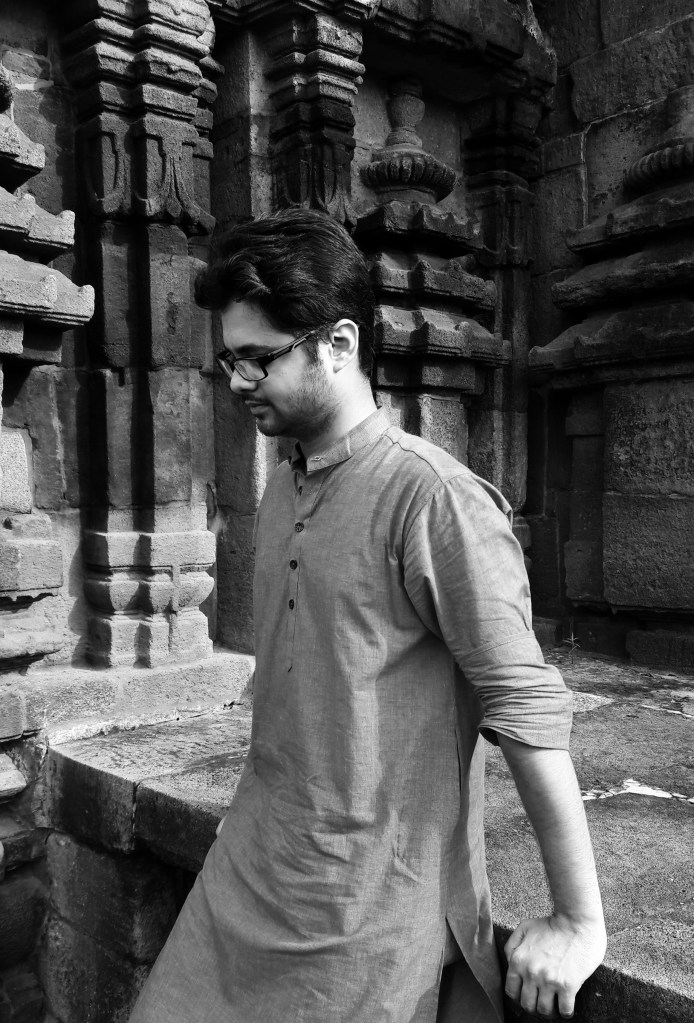
Ankit Raj Ojha is a poet, assistant professor of English, former software engineer and former rock band frontman from Chapra, Bihar, India. He has a PhD from IIT Roorkee, works with the Department of Higher Education, Haryana, and is editor at The Hooghly Review. Ankit’s writings are published or forthcoming in eleven countries including venues such as Poetry Wales, Routledge, Johns Hopkins University Press, Sahitya Akademi, Outlook India, Stanchion, Briefly Write, The Broadkill Review, Roi Fainéant Press, and Dreich among others. He is the author of Pinpricks (Hawakal, 2022) and winner of the Briefly Think Essay Prize 2023.
See more on his Linktree, Twitter or Instagram. You can also buy his book, Pinpricks, here (India), here (rest of world) or directly from Ankit.
 Briefly Write