Empty-handed

Lawrence Bradby


I left the house without my phone.
My daughter needed it
for me to leave her on her own.
So beyond these words
there’s no record of the view
I’m looking at:
the cram of orange, peach and white
buildings from far left to far right
the mega-crane, the freight wagons
labouring in their smallness
the swifts scything and scooping
the hot thick air above.


Lawrence Bradby writes poems, short prose texts and essays. He likes the gap between speech and writing. Since October 2020 he has lived in Portugal. He writes a blog about learning a new language and trying to find a way to belong

Next? A Dismal Destiny

Sambhu Nath Banerjee


'Next? A Dismal Destiny' by Sambhu Nath Banerjee.

Burgeoning population is the number one enemy for sustainability of life on this earth. It propels disharmony and complete bedlam in peaceful coexistence of man and environment. All these calamities and extremities that we are experiencing of late across continents are because of the thermodynamic disequilibrium brought about by human interference. More and more modernity and dependence on artificial intelligence are causing isolation from Nature. Days are not far when poets and authors would embark on a parched and barren land, starved of elements to pursue their creativity.


A teacher and a researcher, Sambhu Nath Banerjee (Ph.D. CU) from Kolkata, India is passionate about travelling, photography and writing. His works appear in Cafe Dissensus, Muse India, Borderless and 3 Elements. His photograph has found place in the exhibition 2023 Kolkata, organised by ‘Srijan’ SBI Officers’ Association.

Once a Home

Jacelyn Yap


'Once a Home' by Jacelyn Yap

The photo was taken in Komatsu, Japan, in late winter earlier this year. I can’t help but wonder about the past inhabitants, and their life after leaving this house. Do they know how the current inhabitants (mostly withered plants) have grown into this place that was once a home to them? 


Jacelyn Yap (she/her) recently started focusing on her art proper, having persevered through an engineering major and a short stint as a civil servant. Her artworks have appeared in adda, Chestnut Review, The Lumiere Review, Barren Magazine, and more. She can be found here and on Instagram (@jacelyn.makes.stuff).

Believe Me

Suzanne Hicks


I’m fairly certain that I once saw a giant snowflake, large and lacy white like the intricate ones you crocheted that adorned the tree at Christmas, except this one fell from the sky, the size of the tip of a pin at first but as I watched out the window it grew and grew until it was the size of my hand, and even bigger until it was the size of yours, and in that moment I thought it was the most amazing sight I’d ever seen, which it was until you took me to the restaurant by the river to eat fish and hushpuppies dipped in honey as we sat outside and I stared at the long outline under the murky water and reached out for your hand as I whispered, Nessie, and I’d never been so scared until the day I realized you were the only person I could tell something like that to who would believe me, because you did, didn’t you?


Suzanne Hicks is a disabled writer living with multiple sclerosis. Her stories have appeared in Milk Candy Review, Atlas and Alice, Maudlin House, Roi Fainéant Press, New Flash Fiction Review, and elsewhere. Find her online and on Twitter (@iamsuzannehicks). 

Two Poems

Seán Street


Seasonal

I said to Summer,
you burn too hot for comfort.
Said Summer, your choice.

I said to the Spring,
how many leaves are there left?
Said Spring, ask Autumn.

I said to Winter,
you are just a duration.
Said Winter, you too.

Breaking News

It happens on ordinary days,
a bored pencil tapping a glass, 
but the morning post’s leaking in,
the desk light intent as a heron 
and downstream an angle-poise bird aims 
through indifferent reflections.


Seán Street’s recent prose includes Wild Track: Sound, Text and the Idea of Birdsong (Bloomsbury, 2023). His latest poetry collection is Journey Into Space (Shoestring Press, 2022). 

A breeze in the midst of rain—

Jayant Kashyap


takes the clouds to the water boats
in Venice / to the streets

in Mawsynram; the birds are gathered
into their nests / and the boys

are called to the rooftops;
the farmer holds in his hands

his bag of seeds— the breeze
takes him to the fields, scatters

them amidst the drops of rain—
the rain amidst which the breeze

is bittersweet / is ambiguous
like a sunflower that loves a day

in the sun and hates too much of it
yet /


The last time Jayant Kashyap’s work appeared in Briefly Zine, one of the poems was nominated for Sundress Publication’s Best of the Net. Since then, his work has appeared in POETRY, Magma and Poetry Wales, among others.

Late Spring in the Anthropocene

Rucha Virmani


She looks at her daughter sleeping on her lap
and smiles, her heart a hollow cave aching

with love. Outside, a fog settles in, reducing
the naked birch to the silhouette of a life once

lived, its invisible leaves rustling — the elegiac
echoes of a lost lullaby. Ravens sit still on branches, 

waiting for erasure, and the air ripens with the scent
of life turning to something else. The heat ruptures

the skin that had sewn them together. A fig falls
and bursts. — She lets her hands land on her empty

lap, while the wind traces the blurred body
of a daughter that has outgrown her mother’s arms.

Note: ‘…the air ripens with the scent | of life turning into something else’ is based on the last line of Aria Aber’s poem ‘Waiting for Your Call’


Rucha Virmani is the founder of The Climatopia Project (Twitter: @TheClimatopia) that aims to use the power of creative writing for climate activism. She has been published by The Teenager Today and longlisted by Young Poets Network. Her work is forthcoming in The White Cresset Arts Journal. She was selected to participate in Ellipsis Writing’s Summer 2022 workshops.

Two Poems

Lei Kim


Lost

I spotted something
during my morning walk
in the park
under the shadows of trees
black as the wondering night:
a wing
a single wing

I almost reached out
to hang it on a bush
just like someone did
the other day with a child’s cap
found on the grass

Cemetery Rules

No Flowers,
when the cemetery announced,
people were devastated, but a little girl
brought a pebble, flat and pretty,
with words written on it, for her grandmother.

Soon, pebbles with thoughtful words
piled upon the graves, some were tossed, displaced,
then, another came;
No Flowers and Pebbles,
Anything Decomposable within Three Days.

It’s longing that invents uncanny ways of love,
she placed an empty jar beside her lover’s gravestone,
removed the cap, waited a while, and left with it.
One asked about her ritual; speak into the empty jar,
whisper, joke, or simply my love, whatever,

then seal it and let it loose, lungfuls of longing.


Lei Kim is a poet and translator living in France. She translated Lee Jangwook’s poetry collection, Request Line at Noon (Codhill Press, 2016), and received the Modern Korean Literature Translation Award.

Haunted

Kiley Brockway


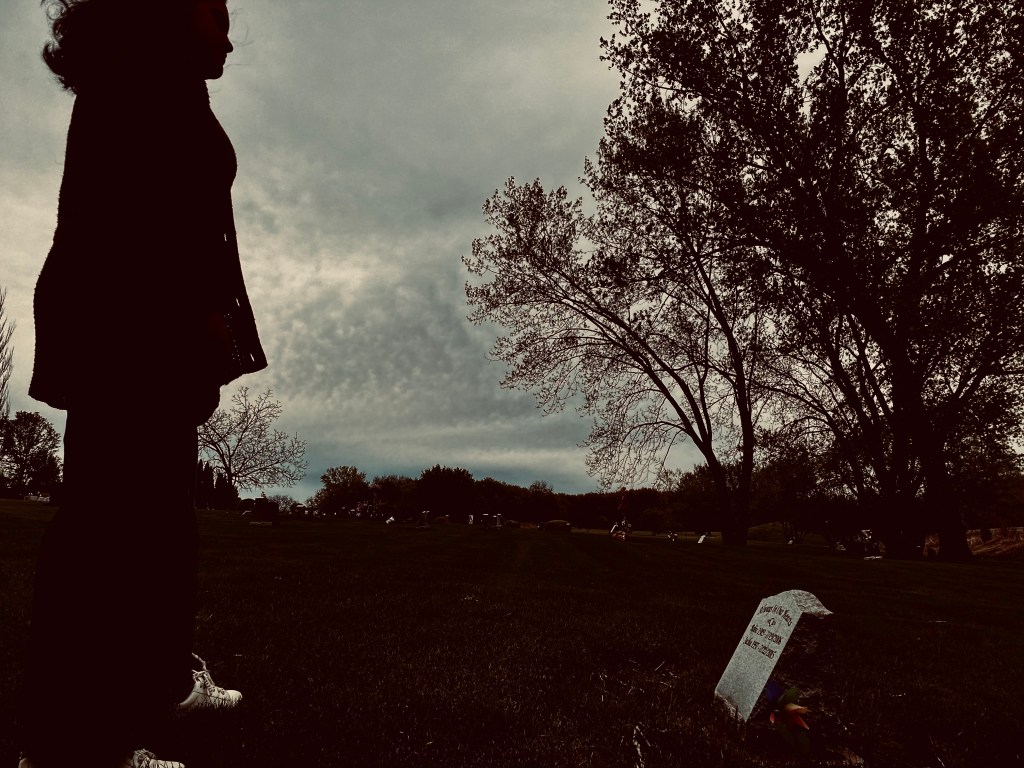
To “haunt” is to be pulled back, to remain in grief for a memory. To consider what might be next when you are still cornered in the past is an impossible task. So is it best to forget and move forward, or remember and remain?


Kiley Brockway is a poet and photographer. She can be contacted at kiley.brockway@gmail.com.

The New Highway, 1972. Walsh Norrel. Black and white photograph.

Mia Kelly


I was marching with the Right to Grow Movement of the 2060s—swishing a homemade flag, everything wet from the thaw. We were scattering seeds from stolen pouches. We expected a police blockade. Failing to encounter trouble, we were more unnerved than emboldened.

Instated in this gallery, Norrel’s photograph makes the highway worth admiring. Fresh asphalt, granular and shining. A gelatin silver sky. It’s a century before our seeds and graffiti, and a flock of blossoms have alighted on the branches of a tree. Razor wire gathers on a wall.


Mia Kelly is an emerging writer working from Boorloo/Perth, Western Australia. She has been published in Westerly and Pulch.