Interview with Elizabeth M. Castillo

Following our review of Not Quite An Ocean, we spoke to Elizabeth M. Castillo about writing, water… and whether words should be left to do their own thing.

Daniel: In one of the opening poems, we read, ‘To write, dear lady, is to dig’. For how long were you digging Not Quite An Ocean… and what did you find?

Elizabeth: In all honesty I actually wasn’t digging at all! The opportunity arose to have a manuscript published with the wonderful Nines Pens Press, so I sort of gathered the few sundry poems I had out in the wilderness and tried to coax them into some sort of shape… to no avail!

Then I reached a point, probably a year ago, where I found myself feeling very exhausted from channelling so much of my energy into finding work opportunities and promoting my writing, without actually doing much actual creating. I was burnt out and craving renewal, and so I decided to take time off the aspects of indie publishing that were draining me, and focus on doing more writing.

D: I think this is something all writers feel at times!

E: I went through my notes, and found a good number of poem stubs… fragments, lines, images, I had jotted down to be made into something later. I set out determined to craft them into something, and was pleasantly surprised at how much material just seemed to flow out of me! ‘Love Song’, ‘In Summer I Am Beautiful’, ‘In Which Bertha Mason Cannot Sleep’, ‘Body, i love you’ and a few other poems were all conceived this way.

It was such a satisfying process… writing with the only constraint being that a complete poem needed to exist in the world once I was finished. I didn’t worry about form, or whether something like it already existed, or whether it was literary enough. I just wrote. And I ended up being very happy with the result.

D: That sounds like a liberating process! Your answer goes straight to the heart of the pros and cons of the publishing world: the chance to get your work read balanced against the pressures and time-drain of constantly seeking opportunities and submissions calls. Overall, how important would you say the lit mags that first published your poems are in the task of bringing together a collection like this?

E: Lit mags are so essential to the process! For writers, they are one of the first lines of confirmation that your work will appeal to readers. The way they showcase your work can also be helpful: I never considered my work particularly feminist until it was accepted and published alongside explicitly feminist pieces, for example.

They are also one of the first avenues by which your readers can find and engage with your work. Many places also do such an excellent job championing writers and their projects even outside the lit mag, by promoting their work on social media, or hosting readings, reviews, or interviews like this one. No indie writer has a publicist, an agent, or even a marketing budget, so we need all the help we can get.

Lit mags are so crucial in platforming of diverse voices in publishing. I remember being so discouraged when I first started looking for places to publish my poetry and seeing the same 10-15 names who had all been to the same five schools and been published by the same publishers… mostly white, mostly male, mostly from a social class that usually has the sort of disposable income that makes writing poetry a viable career choice because chances are you’re able to pay your bills from another financial source.

I don’t fit in to those genres in any respect, and am grateful for the lit mags out there that have introduced me to writers and artists like myself, who have stories to tell but very little space in which to tell them! If small presses are the vital organs of the indie publishing world, then lit mags are surely the lifeblood keeping the whole machine working properly.

D: Absolutely! The feminist angle is certainly one of the key themes I took away from Not Quite An Ocean. I was also struck by how the collection asks so many questions: ‘What do we have to do for you to stop killing us?’ and ‘Who will hold the ocean?’ are two that I found especially powerful. Do you think of poetry as a prompt for self-reflection? Can poetry really inspire people to change their behaviour?

E: You know, I’d not noticed that before! I suppose where there is a desperate need for an answer, or even better, a solution, asking a question outright just feels like the most impactful course of action.

But I am very wary of prescribing anything to my readers, be it self-reflection or any other, more concrete action. As an artist, my job is open the way for the reader, by inviting them in to explore whatever realm it is I have pitched my creative tent, so to speak…

It’s not my job to compel my readers to care about the ocean, rather to show them how she suffers at all of our hands. Whether that prompts action, compassion, self-reflection or any other reaction, is outside of and well beyond me.

D: I get what you’re saying about not hammering the point home. Even so, I read the collection as a desperate plea to protect the oceans and all its inhabitants. What impact did you hope to have with Not Quite An Ocean?

I hope people read it, love it and support my work, as well as Nine Pens who are doing such an amazing job. I hope other writers who see how aggressively I have promoted this little book are encouraged to do the same with their wonderful art. I hope women, people who have suffered, mothers and all those who give and give, read it and feel a little less alone.

D: As a writer with many strings to your bow, I wondered how your writing process differs for different genres and styles. Is the way you approach poetry much different to how your write prose?

E: Poetry tends to fall out of me, starting with a line or an image, maybe even a title that sits for a bit until I come back to it and shape it into a whole “thing” in its own right. Very occasionally I’ll birth a poem from start to finish.

My approach to prose is different because I feel less confident writing it. Short form prose is quite intimidating, so I either whack it out in one go or start and then leave it to gather dust for far too long! With my novels, I’ll write the occasional scene as it pops into my head, but mostly I need to sit with my outline in sight and just chip away at it, trusting that the sparkle will come through when it’s time for editing.

Though I must say the more I write, and the more I read, especially the sort of writing that I love, the more I see that the line between poetry and prose is a very blurry one. I have pieces that I’m still not sure about whether they fall into prose, poetry, creative non-fiction, memoir… and that’s not necessarily a bad thing. Why constrain art to a specific form? Surely the substance is what truly matters in the end?

D: It’s an interesting question about constraining art or letting it do its own thing. Form is the mode of transport but, as you say, the message is what matters most. I suppose it’s similar with structuring a collection: the decision to classify the poems into four sections partly constrains them but also allows more connections and layers to develop. How did you go about deciding which poems belonged in which ocean?

E: I like to categorise things in my creative life: I have three pen-names for the three genres I write; my first poetry book Cajoncito was divided into three chapters of Love, Loss & Madness, and my other poetry manuscript is also divided into three chapters. Maybe it’s a dyspraxic thing? I don’t know…

For Not Quite An Ocean, I was getting very frustrated with the poems as I couldn’t find a nice, mixed balance I was happy with. I tried ordering them by length, by theme, by overarching metaphor, by tone even, but nothing felt right. Then during a geography lesson with my daughters, whom I homeschool, the idea of the four oceans suddenly came to me.

There’s no deep metaphor in the ascribing of poems to ocean chapter: it was more for my own sense of organisation, as well as which poems were complementary when set side by side. The Indian Ocean is filled with very close, personal poems, as it is my ocean, the one I grew up in and feel most at home in. The Arctic is the coldest and most barren, as are the poems there-within. The Pacific hosts the poems written in any relation to Chile or Latin America and the time I spent there, and the Atlantic to life and lived experience here in Europe.

D: It’s always so insightful hearing a writer talking through their process. You seem to have found a successful balance between planning and organising without over-planning and killing those flashes of inspiration that make art spontaneous and authentic. After Not Quite An Ocean, do you already have your next project all mapped out?

E: ProjectSSSS! I subscribe to Joni Mitchell’s concept of crop rotation… lots of different crops growing at the same time, and I rotate the time and attention I devote to each of them.

I’ve just founded an arts association here in France called La Maisonnette through which I’ll be offering poetry and other creative workshops and retreats, so I’ll be working on that. I’m also chipping away at my novel: a gothic retelling of Elizabeth Gaskell’s North and South that I will publish under the pen name Elizabeth Hades. And I’ve got a few kids’ picture books I need to polish and submit.

I’ll also be offering more writing and creativity workshops and courses in the near future. I am a teacher at heart, and connecting with other creatives is something I am so very passionate about! I may not have as many formal writing credentials as some other writers, but I believe the best teachers are often self-taught, and I have garnered a wealth of knowledge on networking, promotion and art-life balance that I feel many writers would find useful.

I’m also looking into doing more reading work: I’m currently tweaking my home studio from which I’ll record my children’s poetry podcast, as well as a couple of audiobooks, including one for Not Quite An Ocean and my debut, Cajoncito. And finding a home for my matrescence-themed poetry manuscript, as well as finishing my hybrid memoir/flash/poetry manuscript on growing up in Mauritius.

D: Wow, you are busy… thank you for taking the time to respond so thoughtfully to these questions! Final one: do you have a favourite poem (or stanza or line) in Not Quite An Ocean?

E: I do! Although there are quite a few I’m fond of, I must say ‘The Other Woman’ is my favourite poem I’ve ever written of all time ever and ever to infinity!!! And the last line is an absolute banger:

Your ears twitch and you shudder,
neck craning to see what you and I
must learn the hard way:
the deadliest thing in here is me.

D: Agreed! It was great speaking to you, Elizabeth: thank you again for your insightful answers.


Read our review of NQAO here: Briefly Reviews – Who will hold the ocean?

Buy the book from Nine Pens here: Not Quite An Ocean by Elizabeth M. Castillo

Conversation with Ankit Raj Ojha

Last month, Ankit Raj Ojha won the Featured Essay prize in the inaugural edition of Briefly Think for his essay, ‘Becoming Poetry’. His reward? Some more questions to answer.

In response to the prompt, Where does the person end and the poem begin?, Ankit wrote compellingly about his relationship with poetry (‘the inescapable requisite’) and the possibility of a perfect state of equilibrium between poet and poem. The following conversation delves deeper into these topics, as well as spinning off in a few new directions.

You can find out more about Ankit and his writing here. And stay tuned for the THINK 2 prompt, which will be released later this year.


Daniel: Your essay stood out for its beautifully concise composition and fascinating, multi-faceted content. As you write, language can be a tool for play (‘I toy with words…’) and pay (‘It’s true that I look for paying magazines’). So, first question: did play or pay prompt you to write ‘Becoming Poetry’?

Ankit: Surely not pay; I didn’t see a win coming around the time I was writing the essay. Your prompt, I believe, was intriguing enough to stop me in my tracks and ‘make me skip meals’. I had come across it on Twitter and had almost dismissed the thought of reflecting on it, for at that time I could barely sustain a single thought long enough to produce a coherent piece.

But then I got into a chat with writer friends on Twitter on a similar topic, found myself uttering things that would later form some of the essay’s ideas, and was quick to delete my public tweets upon realising that I did want to write a previously unpublished piece on your prompt. Nothing is created in vacuum. This is how ‘Becoming Poetry’ came to be.

D: That’s true: poetry is always, in some way, a conversation or collaboration. The concept of previously unpublished is itself fraught given that words are always recycled, reconfigured, replayed, renovated (though plagiarism, of course, is real and harmful).

Your essay features words spoken (‘“Why can’t you just relax?”’) and unspoken (‘I half-reckon then abandon the urge to tell them’), which, to my mind at least, resembles a poet choosing what to set down and what to leave out. The deleted tweets are part of the story too: those fleeting words wiped away like they were never there. So, I guess the question is: how do you deal with all these silent and noisy influences when writing a poem? Are you conscious of the words you are choosing to ignore when you choose the ones you write?

A: I’m glad you asked this. It’s true: thoughts gush in from everywhere; words follow suit. Sometimes it’s the other way round: you have a word or phrase that tastes so good you are desperate to use it, so you devise thoughts to sneak the word into your poem. As for me, I have grown up largely on novels, and my feelers still come to rest on fiction (note to self to read more poetry). The consequence is that I often turn to narrative poetry. Some of my early poems I found a bit verbose and had to edit post publication for future reprints and for my own sanity.

I still love storytelling in verse, for the love of the form and also because it suits my diverse schedule that at present forbids long-term courtship with prose, allowing only short poetic flings. But I am now more conscious of practising restraint and refinement. I assume every writer has to go through the Clark-Kent-as-a-schoolkid phase where the young Superman must learn to wade through voices in his head, shut out the noise, and focus on what really matters. Sometimes you have to part with beloved words or thoughts for the greater good. Some of the jilted words may turn up another day, in another poem; the forsaken await their turn forever. The writing process, therefore, is every bit as stringent as it is spontaneous. Even the stream of consciousness insists on the chisel, for epiphanies too have to be tinkered with while writing.

D: That’s fascinating and really insightful what you say about the stream of consciousness. Poetry often feels more “personal” than prose, more intimate or even intrusive. When writing and editing your poems, do you ever think about how much of yourself you might be “giving away”?

A: If I may digress before approaching the question: intrusive is the word, yes. For me the poem almost always writes itself, and that too when it wants to, triggered either by heightened emotions or a recollection of past stimuli. I have a hard time consciously creating poetry from scratch. That’s why I struggle at prolificity – something I need to work on improving.

We were speaking of intrusiveness. When a potential poem does intrude, quotidian constraints melt away and I find myself skipping meals and chores – as I mentioned earlier – until I am at least done with the first draft, if not the final version. This fixation is possible because it’s personal: most of my poems are born of lived experiences and emotions, if not mine, then of those I observe around me. The rudiments of the human soul, I believe, bind us across space and time. This is the reason we feel writers we know nothing about: we rejoice in their victories; we are shattered even if it is their tragedy.

Coming to your question, every poem out in the world is somebody “giving away” a part of themselves. There are, of course, those “private” unpublishable pieces we create, safekeep and turn to for catharsis. Barring that forbidden zone, I think I am comfortable giving myself away, knowing there are takers who sing the same song. A poet, after all, is an acquitted gossipmonger. Now who wouldn’t want that licence?

D: A worthy digression! Has the experience of editing The Hooghly Review altered your view(s) on what is “personal” in poetry? I’m thinking especially about the magazine’s focus on ‘individuals and their lived experiences’.

A: Well, editing THR has rather reinforced my understanding of the “personal” in poetry. Let me illustrate this using the phrase you just quoted.

Whenever I read poems for THR, or any poetry in general, I often find the “personal” expressed in ways beyond what is usually termed a personal poem. A personal poem is, of course, an individual narrating their lived experiences. But it doesn’t necessarily have to appear personal; that’s the beauty of poetry, or of any art form. A characteristic of good art, as I am learning, is to defamiliarise our experience of reality, so that by the time we have managed to decipher the contents on the page, the revelation is both uncanny and reassuringly familiar.

Even the stream of consciousness insists on the chisel, for epiphanies too have to be tinkered with while writing.

Ankit Raj Ojha

As I said before, the reason we identify with writers and their works we know nothing about is because we see us and our own experiences in them. We are wired this way – to think and feel alike, and empathise with our fellow beings, possibly because of the collective unconscious we share, which Carl Jung says is the public folder of all memories, impulses and emotions common to humankind. I am also reminded here of Joseph Campbell, who said, ‘Myths are public dreams, dreams are private myths’. Campbell surely felt the same way about humans – all of us feel and dream and create our myths alike.

That said, I do look for ‘individuals and their lived experiences’ at THR. But I welcome and marvel at the myriad ways personal tales can be recounted. Be it a confessional poem, a defamiliarised story, a surreal painting with words, the poet’s private lessons repackaged and served didactically, an inner battle projected upon the world to appear universal, a grand narrative scaled down to an adventure in the mind, or anything else that enthrals the reader with its singular way of telling a personal story: I appreciate the chance to read it all and learn.

D: Art, dreams, the universal… you’ve covered a lot in a short answer! I agree about reading and re-reading and learning. There are so many books, so many poems: too much to read in a thousand lifetimes. So, I guess that brings us back to your essay and the colleagues who ask, ‘Why can’t you just relax?’ and your response, ‘I do relax; words are one of the ways’. Does becoming poetry involve an acceptance of the limitations and incompleteness of our relationship with words?

A: Nassim Nicholas Taleb has pointed out that unread books are far more valuable than read ones; he calls the former the antilibrary, saying that the unread pile keeps one humble and driven by curiosity. So, my answer is a yes. To be able to read everything is never the point; that’s a mad proposition. As readers and writers we can best serve literature by doing our bit, howsoever small it is. Remember what Borges said of storytelling, ‘Writing long books is a laborious and impoverishing act of foolishness: expanding in five hundred pages an idea that could be perfectly explained in a few minutes. A better procedure is to pretend that those books already exist and to offer a summary, a commentary.’

A poet, after all, is an acquitted gossipmonger. Now who wouldn’t want that licence?

Ankit Raj Ojha

Although I can’t afford to dismiss the longer form as Borges does, I would very much like to extend the analogy to the act of reading. You cannot read it all, but you can sample the entirety of it all in the select few. Now, selecting the select few requires one to be thorough, which is why I try to read widely across cultures, geographies, genres, identities, and so on. A writer is, first and foremost, a reader, and becoming poetry entails that you accept your reading limitations and still do your best while you are at it. By tasting some you taste it all. The “some”, however, must keep growing.

D: Those are very wise words… and an inspiring way to approach the TBR pile! This whole conversation has been hugely enriching; thank you, Ankit, for providing such fascinating insights into your writing, reading and editing. Any final thoughts to add on poetry, people, endings… or beginnings?

A: I’m equally delighted, Daniel. Talking with you has been a rewarding experience; thank you for the intriguing questions.

As for final thoughts, I have found, so far, that a writer’s life, even when peopled, is a lonely affair. Spending time with oneself helps observe the world and weave meaningful madness from random strands. As I am a believer in all things cyclical, I do not perceive definitive endings and beginnings. An experience for me can lead to a poem; poetry, in turn, may sire an experience seen in the poem’s hue. Art mirrors life; life mirrors art. But all of this is, of course, my opinion. To each their own.


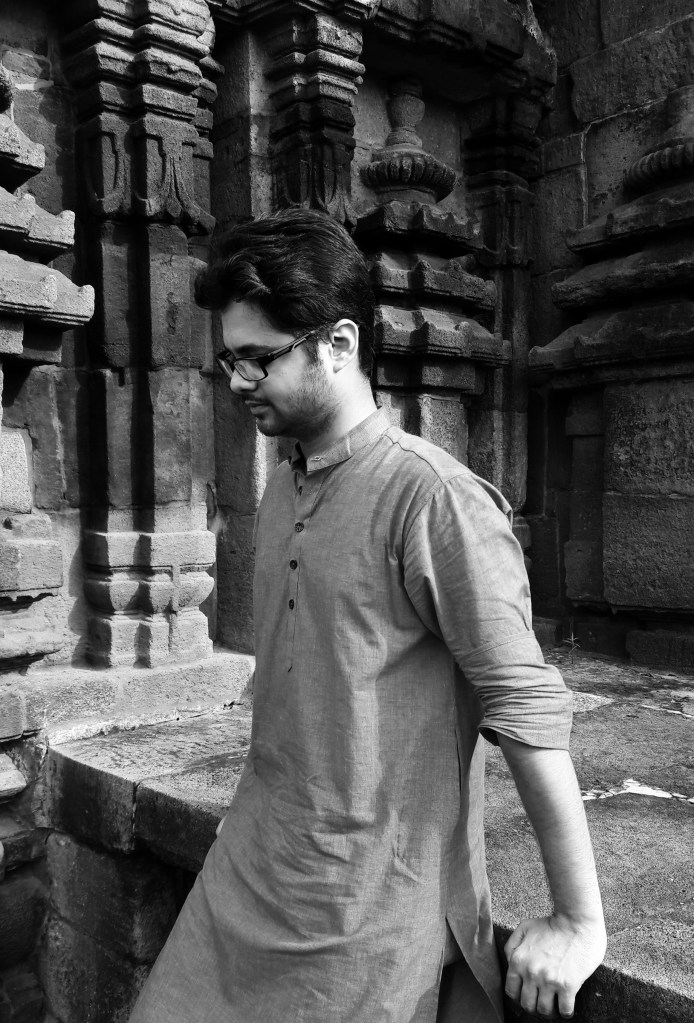
Ankit Raj Ojha is a poet, assistant professor of English, former software engineer and former rock band frontman from Chapra, Bihar, India. He has a PhD from IIT Roorkee, works with the Department of Higher Education, Haryana, and is editor at The Hooghly Review. Ankit’s writings are published or forthcoming in eleven countries including venues such as Poetry WalesRoutledgeJohns Hopkins University PressSahitya AkademiOutlook IndiaStanchionBriefly WriteThe Broadkill ReviewRoi Fainéant Press, and Dreich among others. He is the author of Pinpricks (Hawakal, 2022) and winner of the Briefly Think Essay Prize 2023.

See more on his Linktree, Twitter or Instagram. You can also buy his book, Pinpricks, here (India), here (rest of world) or directly from Ankit.