N Judah St.

Lu Knight


When everything feels wrong, you try to fix it – or move on or even ask for help. They prepare you to problem solve all throughout your school years – trying is better than giving up and giving up is better than admitting that you need help – because who would want to help the little dirty girl that’s been on this bus for hours on end?

I’ve watched adults come and go and come and go. I’ve watched them drag their noisy families up the stairs of the bus as their children point fingers at me. I’ve counted the times we passed N Judah Street. Seven times I’ve thought about getting off this bus. Seven times I’ve remained on this bus, digging my nails into the skin of my hand.


Lu Knight is a creative writing student at Appalachian State University. 

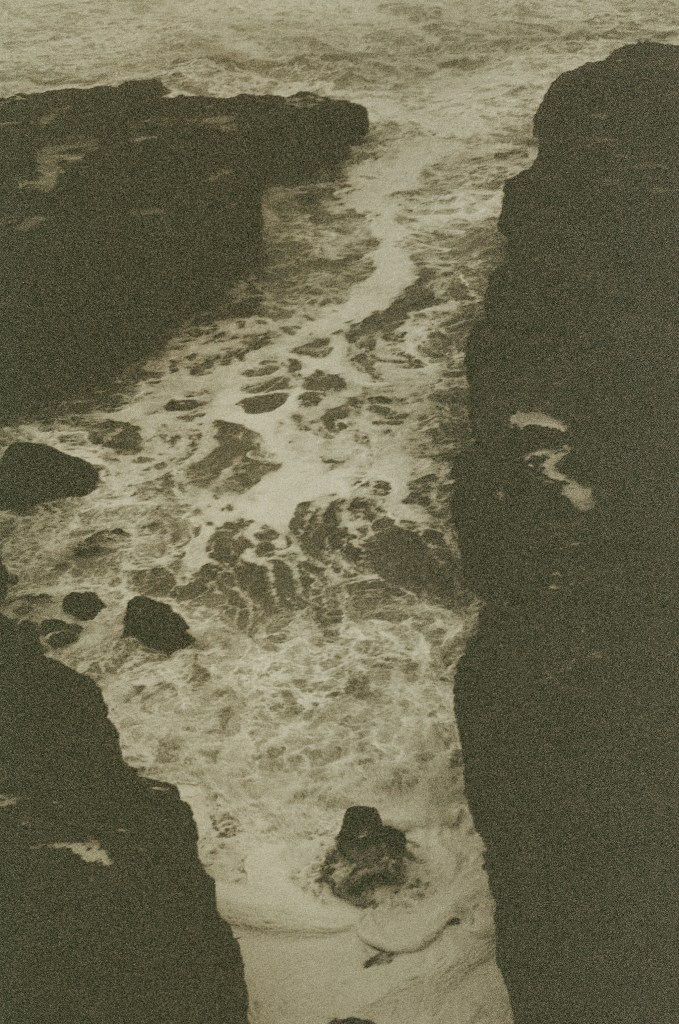
Two Photos from ‘Graveyard of the Gods’

Raye Hendrix


Acolyte #1

Furrow #2

These photos were taken on the Oregon coast near sunset as a storm was beginning to blow mist in from the ocean, which, combined with the expired film, resulted in a pleasant, almost silkscreen-like effect in the form of large, prominent grain. The title is inspired by a man who was praying aloud at the water’s edge for hours (pictured in “Acolyte #1”). He and I were the only two on the bluffs that day, and the solitude and his spirituality, coupled with the incoming gray storm, lent a powerful yet peaceful aura to the area, which reminded me of being in a cemetery – but for something much larger than us.


Raye Hendrix is a writer and photographer from Alabama. Raye is the author of the poetry chapbooks ‘Every Journal Is A Plague Journal’ (Bottlecap Press) and ‘Fire Sermons’ (Ghost City Press). She is the winner of the 2019 Keene Prize for Literature and Southern Indiana Review’s 2018 Patricia Aakhus Award. Their written work appears in Poetry Daily, American Poetry Review, 32 Poems, The Adroit Journal, and others, while their photography appears in North American Review, Olney Magazine, Press Pause Press, and various newspapers. Raye is the Poetry Editor of Press Pause Press and co-edits DIS/CONNECT: A Disability Literature Column from Anomalous press. Raye is currently a PhD candidate at the University of Oregon. Find out more here.

Loving Him Epiphany

Jesse Saldivar


He said,

     I feel so loved
     around you

So that must mean I love him. 
How true,
that must be

if even I cannot see
our course we run –

inches make the love-journey!
In this country culture we endure
the othering of love –

The tongue that tastes true-love
discerns the gaslight

I shout theater! I shout
love is out there.


Jesse Saldivar is an undergraduate writer studying at the University of California, Davis. They have one poem published in issue five of Oakland Review and one short story published in Open Ceilings. They love writing with concern for space, history, love, and queerness. 

Two Photos

Claire Nora


Tides of Sunshine and Peace


In the Eye of the Sky


Claire Nora is 25 years old. A bored poet living in the city of Lagos (Nigeria), she loves writing, taking pictures, reading and thinking. She believes in the simplicity of life and the Chaos of being subtle. When she isn’t doing any of the things above, she’s studying law in a lawless Country. Find her on Twitter (@Clairenora1).

County Fair

Edward Hagelstein


Edward Hagelstein has published short fiction in various publications. He lives in Hawley, Pennsylvania.

Sirena

Isaiah Duey


Dear Kuya,

Papa told me a story about sirenas last night. He said they wreaked havoc after setting foot on human land and should have just stayed on the sea. He said being with them is contagious, that I could get their fins and that’s bad because their very existence is a sin. Are fishes sinful, too? Is that why people eat them? I don’t think I’d fancy sirenas for dinner because I actually like the luster of their tail. I think they shine in the moonlight or when the moon pulls the tide, though I’m not sure. But I don’t tell Papa about this, Kuya. Because sometimes I’d hear him pray I don’t get fins. He said he can already see my skin having flecks of scales on them, and that I might have been infected so he’s started a treatment to get rid of them. He lets me take swigs of his beer, like a man he said. I’m guessing beer is some sort of medicine, but I’m not sure about this either, Kuya. I still like chocolate milk best. On days the sun accents my scales, Papa would scrape them off my face like prepping a tilapia to be fried on a skillet. My face, arms, and legs burn from all the scraping, Kuya. But Papa said we must do this to make sure I don’t leave for the sea, too.

Anyway, enough about me. What’s it like in the sea, Kuya? I hope you’re having fun.

Your brother,
Chito


Isaiah Duey loves mermaids and the stories they hold. Her work has appeared in Five Minutes, 101 Words, and Versification. She hails from a country in Southeast Asia where she lives with her calico cat named Anya.

Making it better

Tim Love


When she cuts her knee in her grandad’s garden and cries, he carries her in and sits her on the settee, rubbing her leg.

“It’s a strange thing, crying,” he says, “Some people cry because they’re happy. Some people watch sad movies to make themselves cry.”

Confused, she stops crying and twists her hair like her mother does.

“When I’m sad,” he says, bringing his laptop over and sitting next to her, “I type ‘lollipop'”. He slides the laptop over. “Go on,” he says, “Try it.”

She wants to show off. She knows it has a double L.

“See how easy it is? Try it again.”

She types it three times, faster and faster.

“I like raspberry ones,” she says, “They’re blue, because red ones are strawberry. Blue’s my favourite colour.”

He remembers the lollies in the freezer and brings her a blue one, taking the laptop away because he doesn’t want it to get sticky.

“That was the last one,” he says. “Your gran used to keep an assortment in the freezer. I’d better buy some more. Maybe they do packs of blue ones.”

She makes the lolly last, watching him as he types faster and faster.


Tim Love’s publications are a poetry pamphlet, ‘Moving Parts’ (HappenStance) and a story collection, ‘By all means’ (Nine Arches Press). He lives in Cambridge, UK. His poetry and prose have appeared in Stand, Rialto, Magma, Unthology, etc. He blogs.

Sewing

Dominik Slusarczyk


Do you discard? 
You know you could mend instead? 
Here: 
Let me show you how to sew. 
All you need is 
This little needle. 
The thread appears where 
You want it to die for you. 


Dominik Slusarczyk is an artist who makes everything from music to painting. He was educated at The University of Nottingham where he got a degree in biochemistry. He lives in Bristol, England. His poetry has been published in Dream Noir.

suitcase dream

Emily Munro


1.

toy guns
one looked like a bird
I didn’t bother to fold the clothes

2.

the plastic bag
given by my mother
apples: cooking below, eating on top
and slices of dry bread

3.

which of it was mine
my children’s
my husband’s?


Emily Munro is a writer, archive curator and filmmaker based in Glasgow. Her writing explores themes around the environment, anxiety and parenting as well as our ambivalent relationship to the past in the Anthropocene. She was longlisted for the 2023 Caledonia Novel Award and the 2022 Briefly Write Poetry Prize.

Street Ghosts

Mark Valentine


On the way to the old alabaster works,
on a hot day, the river brown and slow,
buzzards above the hill, the air still,
we came upon the overgrown mosaic
made by local children years ago,
a picture-book plan of their world:
cars, ponies, trains, church, school,
mostly succumbing to the red mud,
the bright tiles cracked or chipped;
an abandoned tableau, zest now lost,
its artists grown up and gone away,
streets haunted by dandelion ghosts.


Mark Valentine lives in Yorkshire and likes second-hand bookshops, vegan food, canal walks, small towns, and village hall flea markets. His work has appeared in PN ReviewAgendaM58Finished CreaturesRacemeVolumeAtrium and in a chapbook, Astarology (Salo Press, 2021).