The Power of Group

Ben Nardolilli


dodging upcoming webinars and poetry month sales,
along with conversations about the dangers
of conflict photography  – what day is it again?
last Tuesday now feels like a classic – remembering
when the voice of tired out workers included me

now my stories are set among swings,
as I collect colored glass in the parks while reviewing
superstitions before interviews, it’s something
for the weekend, flashing all my resources on Friday
while saying live and let live to news and events 


Ben Nardolilli currently lives in New York City. His work has appeared in Perigee Magazine, Red Fez, Danse Macabre, The 22 Magazine, Quail Bell Magazine, Elimae, The Northampton Review, Local Train Magazine, The Minetta Review, and Yes Poetry. He blogs here and is trying to publish a novel.

Junebug

Simea Stevens


I remember that porch. I remember we were sitting on its steps that summer, when I asked Mama about the house. 

“What about the house?” she asked.

“It’s broken.”  

“Oh hon…” She trailed off, but her eyes finished the sentence. So blue, so bright, so full of hurt. She wrapped her arms around me.

“Well June, you see…” She stopped to think for a second, but hung onto me too tight, squeezing my shoulders as if she could wring my doubts right out of me. “It may be broken, but it’s still alright. Windows don’t need glass for you to see outside of ‘em.”

“Mama, this isn’t just about the windows.” 

They were part of it, that was true. I might’ve jumped when they were shattered, but I didn’t care enough to feel anything about it. I just sighed, that house had a mean draft before the window came down.

She sighed.

“What do I always say, June? We might not have it all, but we’ve got all we need.”

But this wasn’t enough for me. Somehow, she sensed it. Back when she had a good head, she was all there and then some. 

“Now listen, Junie. Sure our fridge doesn’t work right, but really that’s just fine. I’m out of a job too. And your father’s just like our washer.”

I knew she was getting at something, but I just didn’t know what. I felt myself almost smiling, even though I didn’t want to be. I swallowed that smile and turned to look at her.

“Mama, what washer?”

“Exactly. And what father? But we get along just fine without both.”

She paused for a second to think, eyes momentarily fixed in the distance, before she continued.

“Now, I know we don’t have enough beds, but sharing with your sister can’t be too bad. ‘Specially now that she never sleeps at home.”

She looked down to avoid my gaze and started smoothing her dress of non-existent wrinkles before she added, “We’ve got it all between the five of us. Don’t need a chimney when we’ve got your brothers. And I’m a regular old doormat. Two more problems solved.”

After that a pause hung in the air. Mosquitoes idly drifted by, knowing well enough not to land on us.

“I guess so” I said, choking on nothing, but the humidity of June and the bitter truth. My mama had a way of dressing things up to make them seem pretty. She’d always do a good job, making herself look like a princess each time she managed to find a date. It still wasn’t enough. Those men never loved her and I never loved my home the way we all should have. Its emptiness crept into me at a young age, making it hard to breathe. I never really had a breath of fresh air ‘til I was hours north, in a state I had never been before. Maine and some clarity, a mental state just as foreign to me as the physical. 

I took my first breaths in a hospital just outside of Charleston, an hour or so from my hometown of Cairo. I don’t remember this, but my Mama tells me it was so. My father was there, and so was my sister. Lori tells me I was so pink, I scared her. 

I couldn’t help but wonder if I was pink the moment I stepped off that bus and took the first breath that I ever remember taking.


Simea Stevens enjoys writing stories about others in the first person while writings bios about herself in the third. Currently, she’s working on her first full-length novel and continues to write poems and short stories. Contact can be made through simeastevens@gmail.com or by visiting her new website

Blind Retribution

Ogedengbe Tolulope Impact


A fire is burning in a distant land
And we hear that some young men
Are being undressed by fire.
They say these men
Are seeds bearing their father’s crosses
With scars of terrific moments.
They say their fathers’ fathers
Cast sharp spears of inhumanity
And threw wars onto several doors.
They say their forefathers
Left cruel marks on many walls
With blasts of human wickedness
And that the retribution of nemesis
Is only a tit for tat.


Ogedengbe Tolulope Impact is a Nigerian poet. He is a chemical engineering graduate from the prestigious Obafemi Awolowo University, Ile-Ife. His poem ‘Tell them’ was shortlisted at the 7th Korea-Nigeria poetry feast 2017. His works have been published in Duane Poetree, Pangolin review, Amandasteelwriter, Words Rhymes & Rhythms, Literary planet, Wax poetry and art magazine, Porridge magazine, Parousia Magazine, Subsaharan magazine and elsewhere. He tweets @fruitfulimpact.

Feeding Tom

Emma Cariello


When the sun has finally set for good, I go out back and feed Tom. It has to be right when the sky’s the color of ink, and preferably no stars. If there are stars, he’s liable not to show up. I only gleaned this pattern after many a night of waiting for him to come out when the moon was brilliant and stars speckled the sky like dandruff. Those nights I would wait with his meal in hand at the edge of the wood like an idiot. But when the sky was quiet, he’d always come.

The kids were supposed to be in bed by that hour, but sometimes I’d look back at the house and see the little thumbprints of their faces against an orange square of light. On the nights I had to feed Tom, the kids would seldom come near me the next morning. I’d fix their breakfast and feel their eyes on the back of my head, peeking around the corner. Once I left the kitchen, I’d quietly climb halfway up the stairs and watch them chew in silence. Supposing a stair creaked, they would scatter like mice. 

The wood looked different in the daytime; friendlier, I suppose. Green, brown, and gold, plentiful timber and plenty of game to be had. But I knew what was in there, or rather who, and would warn the kids profusely not to enter. Well one day Geoff didn’t much feel like heeding my warning. His ball rolled in amongst the trees, and he ran after it. I came out to do some chore or another just in time to see him traipsing out, ball under his arm. 

Gave him a good lashing for that. Made sure his sister saw, too. I told him next time his ball rolled out he better just let it rot out there, lest he want to be rotting instead. 

Tom was hungry again that night, calling for his food just a few hours before Geoff passed on, God rest his little soul. His sister had taken it on herself to call the authorities, even though I insisted to her that I had not one thing to hide. She just kept shaking her head, shaking it and shaking it, phone in hand.

When they came, I told them what had happened. Tom had gotten him. Sure as shit.


Emma Cariello is a journalism major living in New York. Aside from writing short fiction, she also enjoys reviewing films in her spare time.

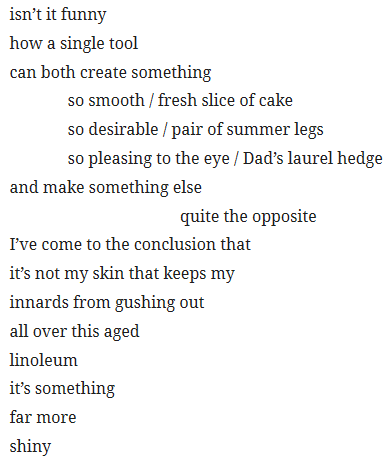
just a little cut

Laura Owens


Laura Owens writes from a small apartment in Oxford, UK, and animates characters in videogames for a living. Recent pubs include perhappened magVersificationDetritus, and ang(st) zine’s Distanced project. Say hi on Twitter/Instagram @laurabethowens.

‘Under the Influence of Nothingness’ by Dan Provost


Dan Provost aptly describes this collection as a series of ‘confessional’ poems. Every word is scraped from the depths of his heart — the effect is sometimes messy, often uncomfortable and always heartfelt.

As we enter the poet’s mind, things quickly get dark. Provost chronicles ‘The Beginnings of My Despair’ in which he addresses the oppressive nature of time. From a young age he would stare at the clock ‘with direct horror’, interpreting each ticking second as a step ‘closer to eternal darkness’. We all have moments like these, forced to confront our own mortality by the imposing presence of an external influence. The language here is raw and honest, a striking statement of despair and misery.

The stains of a self-
inflicted failed life lie
directly in front
of you

Extract from ‘Overrated’

Self-reflection is a theme which resurfaces time and time again in this collection. Pascal famously wrote, ‘All of humanity’s problems stem from man’s inability to sit quietly in a room alone’. Provost doesn’t seem to struggle with this; it’s just that he doesn’t like what he finds when he does.

The poet also observes others. In ‘The Little Notebook’, he describes ‘jotting simple observations… just to prove I can witness’. Tired of introspection, this notebook allows the poet to turn his gaze outwards and ‘see all the budding traps an occasional man or woman may fall into’. The notebook collects little anecdotes of failure.

But in the end it is not such a symbol of despair: rather like a poet, the author of this notebook puts the misery of his surroundings into words, turning failure into art. And to whom does he want to prove his capacity to witness? To himself presumably. In which case, perhaps he hasn’t given up all hope.

Not begging for a banquet
of sincerity… but a moment of truth

Extract from ‘The Ghost of Coins’

Amidst the nothingness are many nobodies, including those in the subtle and understated ‘A Quintet of Champions’. The five men who sit at the bar ‘day after day, year after year’ are a sorry sight, a symbol of the hopeless misery of human existence. But the lives of this quintet don’t fall into complete despondency: they remain together and are united by a common pursuit, each ‘searching for discounted utopia’.

The utopic moment of truth eludes the poet and reader throughout Under the Influence of Nothingness. Ultimately, we are left with a dull sense of despair because Provost sees few redeeming glimmers of hope. But this is authentic life, sticky and heart-wrenching, repetitive yet unpredictable, a brief journey from an unknown beginning to an uncertain destination.

‘The Burning Chambers’ by Kate Mosse


Gripping plot. Fast-paced action. Lifelike characters. So what’s missing?

The Burning Chambers is an epic adventure that takes the reader to the heart of sixteenth-century France, a country in turmoil amidst the bloody Wars of Religion. Set primarily across three southern cities — Carcassonne, Toulouse and Puivert — the historical backdrop is painted vividly, showcasing the author’s extensive historical research and interest in her subject.

Mosse manages to convey the fear and uncertainty of a country ravaged by years of infighting by creating believable characters that bring the history to life. Particularly strong are her portraits of Vidal, a power-hungry Catholic priest, and his deranged mistress, Lady Bruyère.

At times, however, these characters can tip over into types. The formulaic, rather predictable plot is constructed along starkly divided oppositional lines and each character is included to fill a particular role. Moreover, in the closing scenes, Mosse relies a little too readily on unlikely coincidences to advance the plot to its dramatic denouement. This diminishes some of the vraisemblance she had earlier developed.

If I may allow myself to offer a piece of writing advice to an international bestselling author whose novels have been translated into thirty-seven languages, it is that she often overuses rhetorical questions. This becomes more noticeable as the story progresses. Presumably, Mosse’s intention in doing so is to increase the suspense, but this is not the effect: the constant questions frustrate the reader and slow our progress.

It is this sort of contrived technique that raises our awareness of the book’s formulaic structure and ultimately stops the reader from fully engaging with the text. Of course, all books are artificially constructed, but the best ones are those that are able to hide this and make you forget you are reading. The Burning Chambers doesn’t achieve this because the plot follows a predictable pattern and is engineered to progress through a series of unbelievable coincidences.

Despite these minor grievances, The Burning Chambers is a lively and addictive historical novel. It won’t be your book of the year, but is well worth a read.

Untitled

DL Shirey


Rock, paper or scissors. Can’t decide.


DL Shirey writes fiction, by and large, unless it’s small. He lives in Portland, Oregon and has been caught flashing at Café Aphra, 365 Tomorrows, ZeroFlash, Fewer Than 500 and others listed here and @dlshirey on Twitter.

Kickstart Your Reading with this Four-Week Challenge

With so many “must-reads” out there, which should you pick first?

Most of us have more time on our hands at the moment. And reading is one of the best ways to make the most of it.

If you’ve fallen out of love with books, it’s time to get the reading bug back!

Get the stats working for you

Like many bookworms, my reading has often been sporadic. I will read any book in any form: fiction or non-fiction, horror or romance, paperback or e-book, classic or contemporary. It’s rare I don’t have at least four on the go at any one time.

I would guess that I finished more than 50 books in 2019. But since I didn’t record them, I have no idea what percentage were written by women, or how many different cultures I explored.

Similarly, I would struggle to say whether I read more first- or third-person narrators, and whether I spent more time in the past or future.

Of course, you may wonder why you should be interested in this data. After all, you read in order to enjoy a good book not so that you can create pie charts.

This is the argument I repeated to myself for years to justify not tracking my stats.

To be clear, I firmly believe reading is about feelings not maths. It boils my blood when I see an article like “Ten tricks to hack any book”, invariably written by some “self-made entrepreneur” who would sell his grandmother’s kidneys if the price was right.

Reading is a pleasure not a commodity. But having a greater awareness of your preferences allows you to enjoy reading more.

Keeping track of your books isn’t just statistical. Here are four major benefits of recording your reading:

  • It helps you read more widely and therefore experience more cultures, genres and styles
  • It opens your eyes to subconscious prejudices that may be creeping into your choices
  • It makes it easier to remember everything you’ve read
  • It motivates you to keep reading!

Picking the right books

Reading opens the door to new cultures, new experiences and new ways of thinking. And the best way to do this is by making an effort to include writers, themes and viewpoints you might (unintentionally) be neglecting.

There are an overwhelming number of challenges available online though, bizarrely, many seem to restrict rather than extend your reading.

This should not be the case. Categories like ‘A book with the letter X in the title’ or ‘A book about the medical profession’ are far too arbitrary and won’t help you become a better reader.

These sorts of challenges dictate to you, rather than help you make more informed choices.

The following four-week challenge was born out of this frustration. Its six categories are open ended enough not to constrain you, whilst still offering a framework to guide your selections.

The Challenge

How many categories can you tick off in four weeks?

  • A “classic” you’ve not read before
  • A book with a child narrator
  • A book recommended by a friend or relative
  • A book that’s been sitting on your shelf unread for a long time
  • A book set in a location significant to you
  • A prize-winning book

Here’s what I’ll be reading:

  • Brave New World by Aldous Huxley
  • Paddy Clarke Ha Ha Ha by Roddy Doyle
  • I Know Why the Caged Bird Sings by Maya Angelou (recommended by my sister)
  • Frankenstein by Mary Shelley (has been sitting on my shelf for at least ten years)
  • Yuki chan in Brontë Country by Mick Jackson (set in Haworth, West Yorkshire)
  • Lincoln in the Bardo by George Saunders (winner of the Man Booker Prize 2017)

What books have you picked? Leave a comment below!

Submit to Briefly Zine

Briefly Zine is a literary journal seeking bold, succinct writing and photography. We publish writers and photographers from the UK and around the world. Free to submit… and we pay!

Submissions are closed. Issue 14 coming soon.


We’re looking for:

  • PHOTOGRAPHY
  • POEMS – up to 16 lines
  • STORIES – 6 to 300 words

Writing that blurs genres (prose poems, poetic prose, etc.) is welcome.


BRIEFLY RIGHT:

  1. Submit up to three pieces of your best brief writing via the correct online form:
  2. Include a short third-person bio (under 40 words). Please don’t feel any pressure with this – we choose our favourite photos, poems and stories, not the publication history of the author
  3. Please only submit previously unpublished work, i.e. nothing that has appeared in print or online (including on a personal website or social media)
  4. Simultaneous submissions are OK, but please please please let us know if your work is accepted elsewhere
  5. Please wait for our reply before sending more work. If we publish your writing, please wait at least two issues before submitting again

BRIEFLY WRONG:

  1. We will not publish writing or photos that are sexist, racist, classist, homophobic, transphobic, ableist or speciesist
  2. We are unlikely to be interested in gratuitous sex or violence

Our response time is up to three months, though will usually be quicker.

There is no submission fee. There will never be a submission fee. Financial barriers should not stop people sharing their work.

We pay our writers as much as we can. Currently, this is not a lot. If you would like to help us pay more, please consider making a small donation.

By submitting to Briefly Zine, you are granting us first electronic rights. Copyright reverts to the author upon publication.


Expedited Response

Get a faster response and support our little literary space

For Issue 14, donate £6 on our Ko-fi page to get a one-week guaranteed reply.

For the first time, we are also offering:

  • Short feedback on 1 poem or story for £10
  • Short feedback on 3 poems or stories for £20

**In the comments box when you make your donation on Ko-Fi, please tell us you are paying for an expedited response or feedback. Then submit your photography, poetry or prose in the normal way.

See full information here: https://ko-fi.com/brieflywrite

NOTE: We publish our favourite writing and photography. Whether or not you donate will have no impact on the outcome of your submission. We do, however, greatly appreciate any support. Every penny we receive is spent directly on the costs of running Briefly Write (i.e. website + paying writers).