Ships, salt and a social conscience

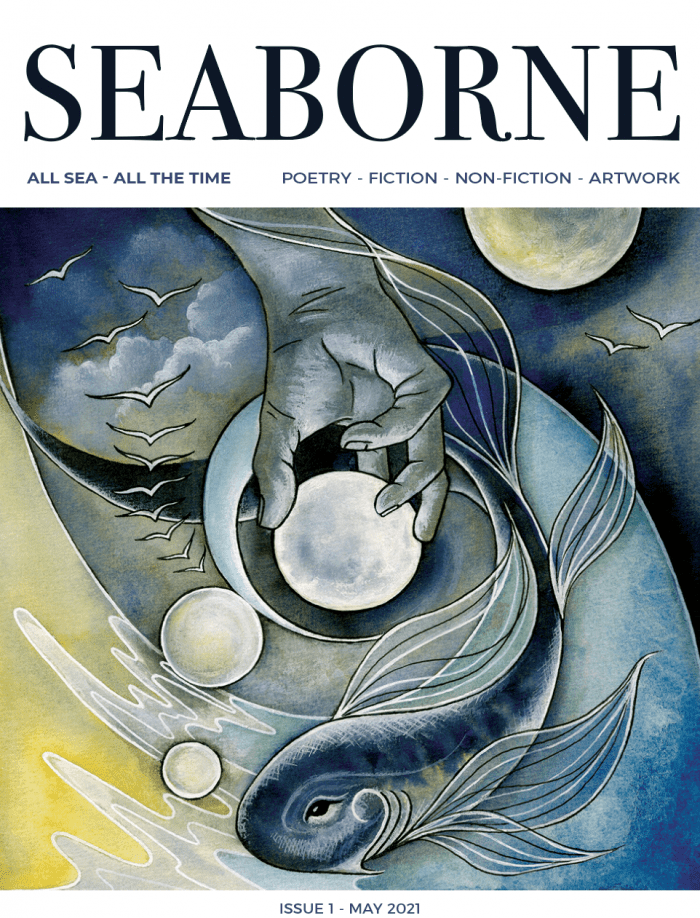
Seaborne Magazine, Issue 1 (May 2021), eds. Adriana Ciontea & Kevin Woodley


The inaugural issue of Seaborne Magazine is a treasure trove of writing and artwork inspired by the sea. Beautifully crafted, the magazine celebrates the maritime in all its glory: the editors’ and contributors’ love of the sea makes every page sparkle. This passion is punctuated only by pressing messages surrounding the threats facing Earth’s oceans and seas. The co-existence of awe and warning is apparent in the magazine’s spotlighting of the Cornish Seal Sanctuary, to which 15% of Issue 1 profits are being donated.

The sea is a timeless theme for literature. In Carolyn Stockdale’s powerful story, ‘High Tide’, the reader notes its power to unite disparate time periods. The spatial contradiction of the sea, which both connects and separates land masses, is reflected in the temporal bridges it builds and disrupts. The pregnant narrator provides the connection between three generations and represents the cyclicality of sea and stories. Likewise, Nicole Kelly’s poignant micro, ‘The Last Keeper’, emphasises this bond between humans and the sea, and portrays the devastating impact of its rupture.

Today only one word is written in the ledger: Decommissioned. He puts his pen down. His swim in the waves today will be his last.

‘The Last Keeper’

This changeability is approached through a cerebral lens by Roberta James. Her poem, ‘After the Memo’, embodies the shifting patterns of the waves: words are washed in and out again in a different order. Paired with Amy Corcoran’s stunning artwork, the poem reminds us of the sea’s unpredictability. Such a message can be frightening: ‘It seems all has turned fish, but she is gill-less’.

Faith Paulsen offers a wry yet worrying glimpse at the extent of plastic pollution in the sea. Her poem takes the reader to the depths of one of Earth’s most remote locations, which has nevertheless been unable to resist the scourge of human contamination.

They call it a record-setting dive,
a great exploration. Still, it turns out,
like Leif Erikson, a stray Dorito bag
got there first.

‘Letter to Mariana Trench’

This warning connects the wonderful poetry and prose to the issue’s social engagement. In an important interview, Jana Sirova (General Manager of the Cornish Seal Sanctuary) educates the reader on these incredible animals and the dangers they face. The threats are commonly wrapped up with their charm: ‘Netting entanglement is also sadly a very common injury with seals… Seals are naturally very curious animals and will investigate and play with anything they find floating around’. Opening the issue from a conservationist perspective guides the reader to link their love for the sea with the harm they might inadvertently be causing it.

The difficulties of representing the sea are brought to life in Natalie Hart’s ‘Writing the Ocean’. ‘I do not know how to write about the ocean’ she writes, before beautifully capturing the complexity and beauty of these vast expanses. Similarly, Linda Hibbin’s delightful descriptions in ‘The Living Canvas’ depict the beauty of the sea, whilst also expressing frustration at our failure to do it justice: ‘How long before these pebbles are grains of sand? How many grains of sand are in the world? More, or less, than the stars in the sky?’

These two pieces embody the battle of the intellectual and emotional. Born in the sea is a deep connection, something that bypasses words and sentences and paragraphs. Ultimately, for Hart, everything can be reduced to the touch of the water.

Close your eyes, push your hand
into the waves,
touch this water with me,
and tell me it is not worth protecting.

‘Writing the Ocean’

Seaborne Magazine intersects and blurs lines. Folklore sits side by side with tangible present-day threats; scientific perspectives infuse the literary, and literary flair explains the scientific; messages in bottles float for centuries unread, and we read impossible messages from the depths of the Earth. As Gill McEvoy writes, many pieces seek ‘that spot/ where the haze of sea and sky are one’ (‘Sea Captain’). Such unity seems achievable by the sea. Indeed, the editors’ greatest achievement might be combining disparate strands of maritime literature into one memorable and distinct reading experience.


Seaborne Magazine, Issue 1 (May 2021). Available here.
Briefly Write Prompt Game (2.8)

The Briefly Write Prompt Game aims to inspire bold, succinct micro fiction and poetry. 

Every Wednesday, we will provide a brief prompt to inspire your boldest prose or verse. The prompts will be released on Twitter (via @BrieflyWrite) and right here on the website.

Your creation can take any form and any style. The prompts can (and should) be interpreted loosely.


This week’s prompt ~

Use one or more of the words SOURCE / SAUCE / SORES in your micro story or poem

Briefly Write Prompt Game (2.7)

The Briefly Write Prompt Game aims to inspire bold, succinct micro fiction and poetry. 

Every Wednesday, we will provide a brief prompt to inspire your boldest prose or verse. The prompts will be released on Twitter (via @BrieflyWrite) and right here on the website.

Your creation can take any form and any style. The prompts can (and should) be interpreted loosely.


This week’s prompt ~

Use the word UNDERWHELMED in your micro story or poem

Briefly Write Prompt Game (2.6)

The Briefly Write Prompt Game aims to inspire bold, succinct micro fiction and poetry. 

Every Wednesday, we will provide a brief prompt to inspire your boldest prose or verse. The prompts will be released on Twitter (via @BrieflyWrite) and right here on the website.

Your creation can take any form and any style. The prompts can (and should) be interpreted loosely.


This week’s prompt ~

Be inspired by the phrase OPEN WINDOW

Two Poems

J.V. Sumpter


So Close, So Close

I’m almost asleep –
my head, pillowed on your knees –
please do not get up.

I’ll Love That Teddy Even If Cerberus Bites Him

If I have to go
to the underworld tonight,
can I bring my bear?


J.V. Sumpter (BFA from University of Evansville) is an assistant editor for Kelsay Books, Thera Books, and freelance clients. She has work in (or forthcoming in) New Welsh Review, Leading Edge Magazine, The Amethyst Review, Not Deer Magazine, Wretched Creations, Flyover Country Magazine, Southchild Lit, Selcouth Station, and The Augment Review. Visit her Twitter (@JVSReads).

Stencils

Rachel Bruce


Ancient stencils in pink and silver
dust the walls, faded from the sun.
The old shed smells of sawdust.

An image floods the empty space –
stamping these walls with my mother.
Her face, now lost, springs from mine.
At once a fairy castle and a tired hut,
I am a grown child in the presence of the memory.
My feet had almost forgotten the way.

I survey it all one last time.
Tomorrow the shed will be taken and burned.
Ashes to ashes,
dust to pink and silver stencils.


Rachel Bruce is a poet from Hitchin (UK). Her work has appeared in The Telegraph, Second Chance Lit, Eye Flash Poetry, Eponym Magazine, The Daily Drunk Mag and The Hysteria Collective.

Summer Night City

JP Seabright


Night, a sky pinpricked with stars,
like embers, burning still in the electric
orange of the city lights.

The warm joy of jasmine
embraces the garden.
Petals are curled, ready for sleep.

All is still, but for the distant hum of the cars,
the clock on the stairs
and the coughing fox.


JP Seabright is a queer writer living in London. Their work can be found in Babel Tower Notice BoardFugitives & FuturistsFull HouseUntitled Voices and elsewhere. Occasionally they can be found hanging out on Twitter (@errormessage) and blogging about music.

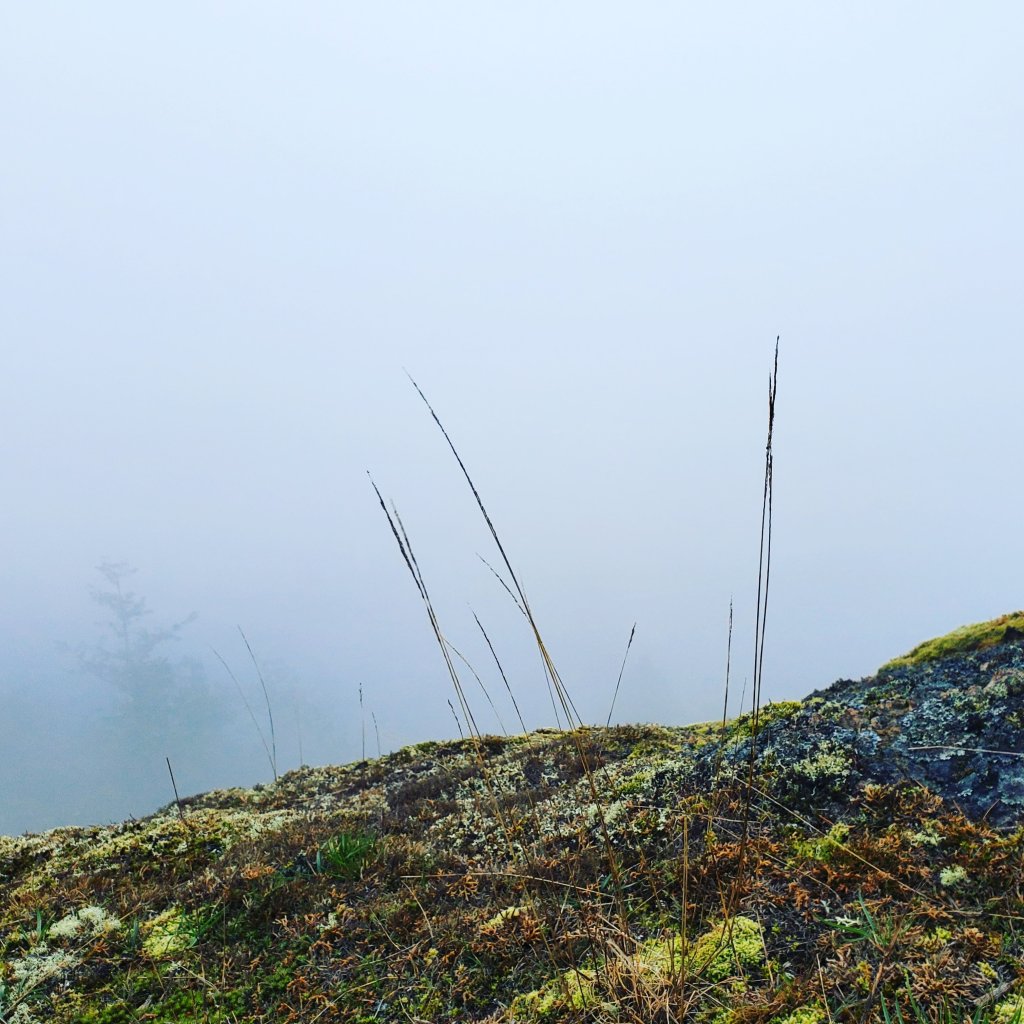
Island Fog

Rachel Newcombe


Rachel Newcombe is a psychoanalyst, teacher and supervisor on Orcas Island, WA. Her writing has appeared in Contemprary Psychoanalysis, The Psychoanalytic Reviewed, The Rumpus, Ellipse Zine, 7x7LA and elsewhere.

On an Old Photograph

Sreekanth Kopuri


A time frame hangs me
between the known and the unknown
beyond the glass
stilled by words
a grey souvenir bigger than the earth,
sometimes it is a train’s window pane,
images pass the eye
blinded by time.

We are like the lines of holes
on a flute’s dark wooden face.


Sreekanth Kopuri is an Indian English poet from Machilipatnam – a colony – India. He was an alumni Writer in Residence at Strange Days Books Greece. He recited his poetry and presented his research papers in many countries. His poems and research articles were widely published. His book Poems of the Void was the finalist for the EYELANDS BOOKS AWARD. Kopuri is presently an independent research scholar in Contemporary Poetry, silence, and Holocaust poetry. He lives in his hometown Machilipatnam with his mother teaching and writing.

On the Goats that Invaded a Welsh Town during the First Coronavirus Lockdown

Carl Farrell


The goats are coming down from the hills
In from the dense thickets,
From the cold sharp streams
And the rocky peaks and pastures
That for so long have been their shrinking domain
To overrun now the ring roads and the roundabouts
To occupy suburban back gardens
And vandalise the striplings newly planted
Round perimeters of pupil-free primary schools.
Yes, the goats are coming down from the hills
Down to reclaim their lost low territories
And looking on from a vantage place on the hillside
Are the twins Pablo and Pan laughing approval
The former furiously sketching the chewed transgressions
While the latter pipes a wild celebratory jazz.


Carl Farrell compulsively writes short poems and occasionally short fiction. He likes to read widely in several languages, but is increasingly drawn to the lyrical and life-affirming, albeit with elements of grit. He grew up in Nottingham, where he now lives, but spent most of his twenties in Greece.