In Search of Gender

Dervla O’Driscoll


I spent my life sitting amidst three walls, each one constructed in decaying stone. I would trace my fingers down the crumbling bricks, caressing their greening edges and allowing their cool surface to lay against my cheek.

As I rubbed each inch of myself against its rough surface, my skin began to dissolve. My eyes watered as they saw the pink grazes stretch around the softness of my belly and reach down between my thighs.

It was years before I felt the cool breeze gently nudge my back, the tenderness of its touch sent a rush of terror down my spine. It was months longer before I drew the courage to even turn. As I spun around, my nails dug deep into my cheeks.

Before me hung a great tapestry, the flag of my freedom. It swayed before me, the sun creeping through its exquisite colours. I knew escape was within reach.

I scrabbled at the floor beneath my feet, pushing the dirt from the ground. The deeper I dug, the softer the mud became. Frantically, I tossed the ground to the side. I would tunnel deeper and find the sun. I would tunnel further and find the sun.

It was the weight of the tapestry that finished me. It was the weight of ambition that finished me. It was the longing for difference that finished me.

I reached up to scratch my way further through the earth. I allowed my fingertips to explore the new land at the crown of my head. My fingernails caught the edge of something soft.

The coloured silk only flashed before my eyes for a second before the darkness engulfed me.

I writhed against the weight of my prison collapsing above me. As the earth stole the breath from my lungs, I craved nothing more than the dull ache those walls inflicted.


Dervla O’Driscoll is currently an undergraduate student at the University of Manchester. She has previously published non-fiction works in The Mancunion and Mouthy Magazine.
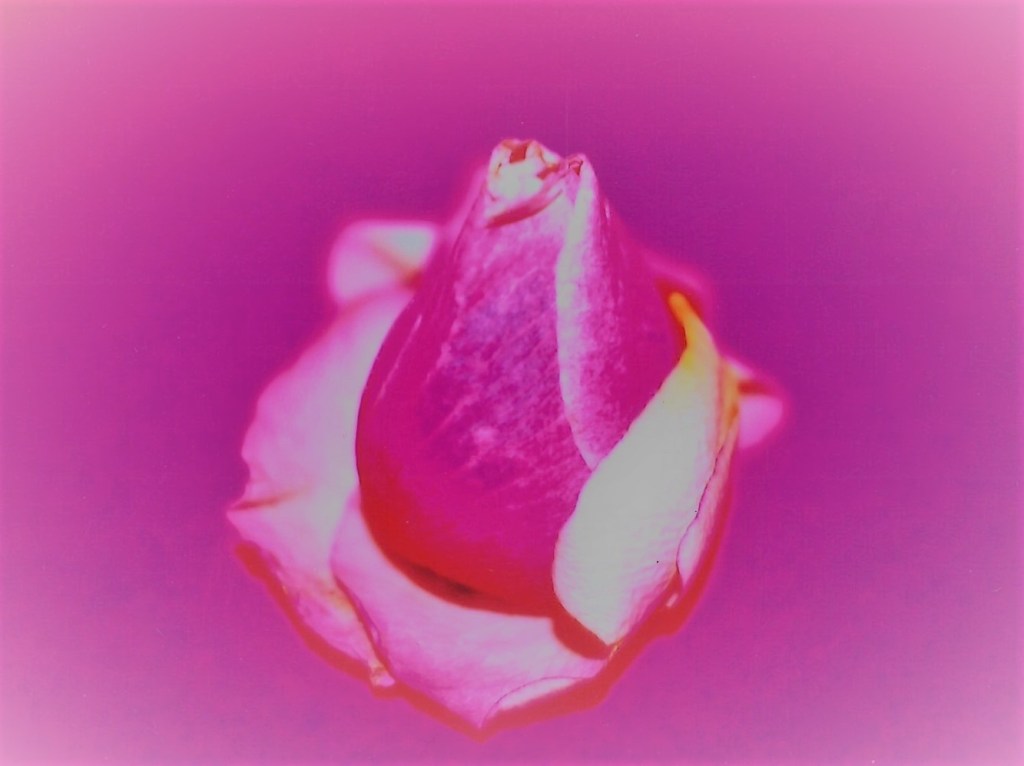
Still Life – In Pink

Kimberly Madura


Kimberly Madura lives and writes from a cabin in the woods of Vermont. Originally from Chicago, she has been a social worker for 21 years. She has been published in multiple anthologies and literary magazines including Mad Swirl, Northwest Indiana Literary Journal, and Brief Wilderness.

Each Morning

Will Musgrove


            Each morning, I let my dog out.

She whines by the door. When I get off the couch, she spins in a circle. We go outside. I hook her collar to a leash that’s connected to a wire that’s connected between two trees. My lawn’s spacious with lots of things to sniff. She bolts off the stoop. She glances back at me. I’m static. She’s kinetic. When she realizes I’m not coming, she transforms into a rocket, back and forth, choking herself to catch a squirrel or a stick or a breeze.

            Each morning, I let my dog out.

I hear barking. Thinking of the neighbors, I peek through the blinds. She’s wrapped around a tree. I go back outside. She untangles herself and brings me her frisbee. I tug the disc from her maw and give it a hurl. When she skips back, instinctively shaking life from plastic, I’m again an eye between two blinds.

            Each morning, I let my dog out.

She’s quiet. I put my ear to the wall. Nothing but chewing termites. This time I raise the blinds. Her leash stretches around the house, so I can’t tell if she’s still attached. I rush outside and find an empty collar. Woof. My dog is standing on the stoop. I step toward her, and she retreats inside. I holler. I pace. I scratch at the door. But she won’t come save me.

            Each morning, my dog lets me out.

I pluck grass. I draw figures in the clouds. Curled in a ball, I nap under the sun. I shout obscenities at the neighbors whenever they hop into their cars to leave. I run back and forth, choking myself, knowing—no, hoping—one day I’ll go somewhere free of leashes, wires, and collars.


Will Musgrove is a writer and journalist from Northwest Iowa. He received an MFA from Minnesota State University, Mankato. His work has appeared or is forthcoming in Versification, Unstamatic, (mac)ro(mic), Ghost Parachute, Serotonin, Rabid Oak, Flash Frontier, and elsewhere. Follow him on Twitter (@Will_Musgrove).

Two Poems

Jayant Kashyap


The Three of Us

Let’s go for a walk today, it’s been a while;

that shrine, it is still there –
evenings we spent there everyday, the three of us,
walking.

Do you remember? – oh, you must!
One’s been long dead now,

his grave dried, why then this new headstone?

Let’s go dust some altars again, just once! –
we haven’t touched those cold feet for long.


Loss’s Ghazal

Six years after home, in my distant longing, there is no sense of loss.
When for days you’d said nothing, there had to be no inference of loss.

I left everywhere you were meant to be, even in the memories we shared;
I left the country you loved when it echoed merely an assonance of loss.

In the bleak whiteness of an airport, they asked of me my identity, I held,
respectfully, my heart, said there isn’t and is only an essence of loss.

They let me go, those harbingers of peace; I knock at the doors of an un-
named asylum, they measure my words, my pain of its resonance of loss.

Now the door will open, they’ll let me in, and I’ll think of that long night,
the damp discomfort of the dark room; its stiff, quiet inhabitance of loss.

That long night, when in silence you could but you said nothing, I knew
then that your words, and Elise, my name, were my inheritance of loss.


Jayant Kashyap is a Pushcart Prize-nominee and was shortlisted for the 2021 New Poets Prize. He is the author of two pamphlets, Survival (Clare Songbirds, 2019) and Unaccomplished Cities (Ghost City Press, 2020), and co-founded Bold + Italic back in 2018.

Like the wind

Ruth Callaghan do Valle


“Race you home!” Makani shouts.

I start after her, fighting to catch up. She always does this, always takes me by surprise, and I end up running in her tail wind with just a view of her back, straight as a rod, arms and legs pumping like pistons, skirts flapping around her knees.

Makani’s not just fast, she’s quick. Quick with a reply, quick to get back up after a fall, quick to make a joke. My big sister will go places, I always said.

*

They say she would never have seen it coming, never have felt more than a moment of pain. I don’t know about the driver, but I remember Makani every time I feel the wind on my face. 


Ruth Callaghan do Valle lives in rural Brazil with her husband and three year old. Her poetry has been published in TunaFish Journal, streetcake magazine, The Minison Project, Lost Pen Magazine, Off Menu Press and Re-side Zine. You can find Ruth on Twitter (@rufusmctoofus) or on her blog

With orange blossom scented soap

Lorelei Bacht


and boiling water, I have scrubbed
your face off. I have scoured your
photograph from devices: his, mine
and everyone else’s – the clouds
are clean. I am prepared to storm
my sketchbooks, to pull out, tear,
to flame up a barrel, watch you
depart, a moonstone, a monsoon,
a monster gone for good. I do not
owe you an explanation. I do not
owe you a handshake. The five
syllables of your name recalled:
as a plainsong, a plague, a bunion,
a bad bout of food poisoning. And
that is it.


Lorelei Bacht (she/they) is a person, a poet, queer, multi-, living in Asia. Her work has appeared / is forthcoming in Anti-Heroin Chic, Visitant, The Wondrous Real, Abridged, Odd Magazine, Postscript, PROEM, SWWIM, Strukturriss, The Inflectionist Review, Hecate, and others. She is also on Instagram (@lorelei.bacht.writer) and Twitter (@bachtlorelei).

Two Haiku

Tenarevyč


autumn night i survey constellations of windows

vaccinated i open the door with my elbow lingering fear


Tenarevyč is a Ukrainian author currently dabbling in literary language experiments. Find him on Twitter (@tenarevych).

Submission Call for Issue 7: Climate Action

With COP26 taking place in Glasgow from 31 October until 12 November, we would like to dedicate a special feature in Issue 7 to the climate emergency.

Submit up to three:

  • Stories (up to 600 words)
  • Poems (up to 16 lines)
  • Photos

We are looking for work that says something meaningful about the natural world (or human destruction of it) in a bold, brief way.

Please note: For this special submission call, the usual rules about waiting an issue after being accepted do not apply.

Regular submissions will also remain open for Issue 7. See the full guidelines here.

Words + Shapes = Poetry

Elisabeth Kelly, Mind Mathematics (HybridDreich, 2021)


Mind Mathematics is a poetic experiment and eye-opening experience. While we tend to associate poets with descriptions of shores and trees, Kelly’s poetic persona shifts the focus to shapes and degrees.

Intangible, internalised feelings are mapped onto a geometric landscape. In ‘Lines’, ‘hope [is] paralleled, across the field’; in ‘Rhombus’, yearning is grounded in concrete measurements: ‘One hundred and eighty degrees away,/ you walk,/ leaving patterns of solitude/ on a shifting beach’. Kelly constructs her poetic environment with deft skill, stripping nature to its core mathematical elements before ‘silently building us a new picture, a new whole’ (‘Patterns of You’).

Like wholeness, balance is a recurring theme. To a logical mind, the practice of mathematics possesses a reassuring quality, an unequivocal certainty amidst the chaos of the outside world. In ‘Subtrahend’, the poet strives for stability. She laments efforts ‘to subtract,/ to lose parts of me’ that she has spent a lifetime trading with ‘desperately attempting to add’. This ‘sum/ I hoped would balance’ represents the elusive ideal towards which we all struggle; perfect equilibrium is harder to find in real life than on paper.

You set the constant,
the old beech glinting,
the balance in my equation.

‘My Equation’

The pamphlet’s success comes from its portrayal in poetic form of an experience of the world through a purely mathematical perspective. The poet uses this contradiction to unite two seemingly irreconcilable worldviews and in so doing enriches our overall outlook. Kelly reconciles mathematics and poetry, science and art, logic and creativity, and demonstrates that what falls under these labels should not so hastily be kept apart. In the end, ‘Mind Mathematics’ is a beautiful expression of unity.


Elisabeth Kelly, Mind Mathematics (HybridDreich, 2021). Available here.

Briefly Write Prompt Game (2.9)

The Briefly Write Prompt Game aims to inspire bold, succinct micro fiction and poetry. 

Every Wednesday, we will provide a brief prompt to inspire your boldest prose or verse. The prompts will be released on Twitter (via @BrieflyWrite) and right here on the website.

Your creation can take any form and any style. The prompts can (and should) be interpreted loosely.


This week’s prompt ~

Use one or more of the words GOAL / GOAD / GOAT in your micro story or poem