at twelve they tell Peter fly fly forever take what you want boy
at twelve they tell Wendy be prepared to fall from the sky you’re too old take off your blue nightgown
Halle George is a writer who spends most of the day working in advertising. She’s previously been published in Midsummer’s Eve. She lives in Los Angeles with a ficus named Jim.
I, having been bitten by an angel – I am going through a lostness.
I am hoping to be done with it before the mould on the window returns.
I am refusing everything. I am waiting for the room
to flood with trumpets. I am waiting for my hair to grow and be grabbed by a man come to save me.
Fistfuls of nobody, parched and sweaty in the dark.
Beattie is a writer and lapsed drag queen from Merseyside. They were the winner of the Chester Cathedral Young Poets’ Competition and were longlisted for the Spelt Poetry Competition. Their work has appeared in Datableed and Travesties?!.
Throw enough mud, they said, and some of it will stick to the wall.
The wall? Why didn’t I think of that? I’ve been throwing mud at nothing
in particular. And now they tell me, now, when I have filthy hands
and a clean wall. My apologies. Mind your fingers turning the page.
Al McClimens is a Sheffield-based writer who is old enough to know better. An unemployed waster, Scrabble fan and lapsed socialist, he reads a novel a week and writes a poem a day. His literary ambition is to replace Don ‘Dundee’ Paterson as UK sonnet king.
It’s 35 degrees, a burning July day and the metallic, coppery stench is overpowering as I stand in the shower, pressing the ball of my foot onto black fabric and watching my blood seep out, washing away. Another month, cycle, shedding. It is a kind of cleanse, a small sense of renewal as I keep pushing my toes to watch more blood drain away, drain away, drain away.
Ellen Clayton is a poet from Suffolk, England. Her poetry has been published in various online and print publications, including Capsule Stories, Nightingale & Sparrow and Brave Voices magazine. Her debut chapbook, Home Baked, was published in April 2022 by Bent Key Publishing. More of her work can be found on Instagram (@ellen_writes_poems).
He would like me better if I wrote about trees or lamented on leaves or mused on moss.
When you grow up in a city you don’t have the language to show fervour for forests.
I like a crunchy leaf as much as the next person. But that’s not enough.
Galia Admoni is Head of English at a school in London. She has poems in Bad Lilies, Anthropocene, Atrium, Streetcake and others. She is forthcoming in both Under your Pillow and Sex Tape Digest anthologies. She has lectured at Shakespeare Institute, BFI, British Library and is committee member for the London Association-Teaching of English. Her debut pamphlet will be published in 2024. Follow her on Twitter (@galiamelon).
I can’t stop looking at the naked shape of his head. Ghosts of curls collect in his collar. For a moment I think I can see the outline of the man he will become, in the twist of his mouth as he concentrates on the scissors snick of his reflection. I hold my breath, all the time trying not to grab handfuls of cuttings, to fill my pockets with blond.
Jennie E. Owen’s writing has been widely published online, in literary journals and anthologies. She teaches Creative Writing for The Open University and lives in Lancashire with her husband and three children. She is a PhD student at Manchester Metropolitan University, focusing on poetry and place.
I want to lie on bare concrete, spread arms and fingers, and once more inhale the mingled smells of your menthol cigarettes and motor oil, hold still until my limbs turn cold, until I hear the clatter of billiard balls across a felted table. And when I get up, I will be eight years old, running for coffee. Mugs balanced carefully, I’ll tiptoe down the narrow stairs.
Aimee R. Cervenka is a writer, climate activist, and professional baker. Her poetry has appeared in Poet Lore, Ascent, Slab, and others, and was selected as a runner up in Headway Quarterly’s Winter 2020 Writing Contest. She currently lives in Spokane, Washington, with her husband, dog, and two rabbits.
Judging the Briefly Write Poetry Prize 2022 was a joy, a delight, an inspiration… and a headache.
In every poem is a little piece of the self; in every stanza, a light that illuminates a life. Every word is an opening to new worlds. We read, re-read and re-read every poem submitted to the Poetry Prize because every entry was worthy of careful re-reading.
Popular themes this year included love, hope, loneliness and revenge. Flowers, friends and poetry all played starring roles; trees, coffee and the sky at night were close behind. Every voice added something unique.
Poetry is a conversation and we hope our choices spark discussion. We hope you’ll agree with some of our picks… and would love to hear what you think in the comments below. Feel free to reflect on the poems and congratulate the winning poets!
We are so grateful for the support and love shown to our little literary space. Thank you… and you and you and you.
Gaynor Beesley * Creana Bosac * Jonathan Chan * Ion Corcos * Jennifer R. Edwards * Carl Farrell * Donna Faulkner (née Miller) * Lindsey Harrington * Kerry J Heckman * Jennifer Ruth Jackson * Helen Kay * Keith Li-Bouchard * Mina Malik * Miruna Marin * Tony Maude * Ed Meek * Emily Munro * Muiz Opeyemi Ajayi * Aly Rhodes * Shana Ross * Abdulrazaq Salihu * Nnadi Samuel * Kay Sfictos * Hibah Shabkhez * Ana C. H. Silva * Jenniska Small * Sally Jane Tate * Chidiebere Udeokechukwu * Candace J. Williams * Angela Zimmerling
Above the plastic-cluttered high tide line there’s an empty pair of wings. Probably a kittiwake, with feathers of pearl grey, ink-dipped and grafted to a stub of spine.
The rest of what made it a kittiwake is gone: the head and lungs and crying call, but nothing wants these two wings. What would? All the world knows that only the birds can make
anything of them. A sudden gust flips them over, the wind knowing well how to lift this structure it evolved. They leave two scoops in the dry sand, symmetrical dips
like those corny angels I made with you in the snow. At least it’s something to show for what was left; but even that will blow away. The wind knows how to shift sand, too.
Karen Macfarlane lives in Perthshire and spends as much time as possible letting Scotland’s coast and islands inspire her. She is studying for a BA (Art & Humanities) with the Open University. Her poetry and non-fiction have appeared in various magazines, including Poetry Scotland and Spelt.
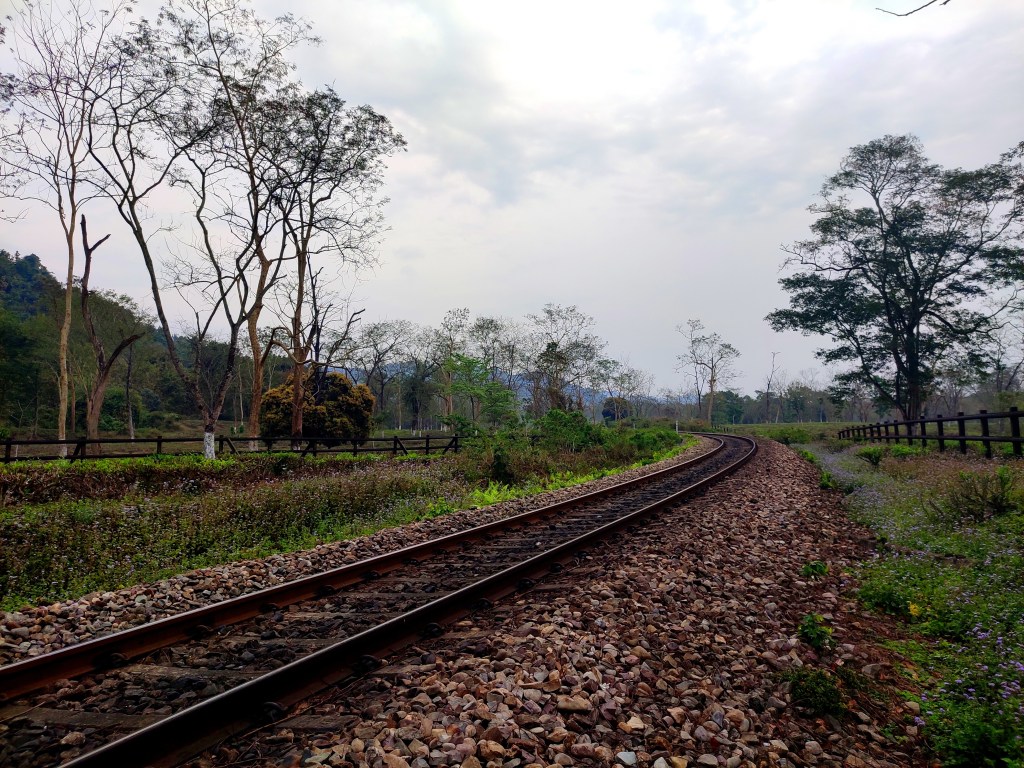
Paths, whether footbridges or dirt roads or railroads, indisputably exist with a purpose. They were never intended to be deserted when they were created. But paths are deserted, as though such a fate is inevitable.
I often wonder: Do they face existential crises when they are deserted? Do they continue to stand alone with hope and faith or do they continue to stand out of helplessness?
But the question that haunts me is this: Are they wary of the indifference of their surroundings? To me, the word ‘empty’ signifies emotional emptiness, and the word ‘spaces’ means physical places; but when I put the two words together, ‘empty spaces’ remind me of the indifference of the universe towards deserted places.
Through this photograph series, allow me to take you to three deserted paths I found during my 2020 pre-pandemic trip to the northern districts of West Bengal in India – or as we collectively call them, North Bengal. There were tourists around me, albeit a handful, yet these paths stood deserted either completely or for a moment in time.
Suntaleykhola, a village and tourist attraction in Eastnar Forest (Gorubathan, Kalimpong District in West Bengal, India). A footbridge stands over a stream, alone and drenched in rain while the hills and her trees remain indifferent.
Jaldapara National Park, home to the largest population of the nearly extinct Indian one-horned rhinos, at the foothills of the Eastern Himalayas on the banks of the Torsa River (Alipurduar District in West Bengal, India). A dirt road stands in the middle of a clearing, alone, while the forest and her creatures remain indifferent.
Ellenbarrie Tea Garden, a privately owned tea estate between National Highway 17 and the Teesta River (Malbazar, Jalpaiguri District of West Bengal, India). A railroad stands in the middle of a tea garden, alone while the tea plantations and their underpaid workers remain indifferent.
Tejaswinee Roychowdhury is an Indian lawyer, writer, poet, artist and photographer. Her works have been published worldwide and can be found on her website. Twitter (@TejaswineeRC).


 Briefly Write